Best Electronic Shelf Labels for Hotels: How to Choose (and What Disqualifies a System)
Key Takeaways
- IP65 is the minimum hardware rating for hotel buffet environments — verify independently, not from marketing materials.
- Run a 30-day pilot before full deployment: choose a single outlet, test allergen update propagation, measure staff time saved.
- POS integration is the feature that pays back fastest — automatic menu sync eliminates a full-time labelling role at many properties.
- DACH vendors with EU data centres (DSGVO-compliant storage) are a procurement requirement, not a preference, for German and Swiss hotel groups.
Why Most ESL Reviews Miss the Point for Hotels
The majority of electronic shelf label reviews are written for retail — supermarkets, pharmacies, warehouses. Hotel buffet environments are fundamentally different. Heat, steam, humidity, daily cleaning with commercial sanitizers, and the need to display allergen information accurately (with legal consequences if wrong) mean that a system that works in a clothing store is not necessarily suitable for a hotel kitchen. Choosing the wrong system means replacing it within 18 months. Here is what to evaluate.
Aus der Praxis / From the field
Procurement teams at DACH hotel groups consistently flag two non-negotiables during ESL vendor evaluation: offline resilience (the labels must still display if Wi-Fi drops during service) and update latency under 30 seconds. Anything slower creates a window where a displayed allergen is incorrect — which is the exact scenario the LMIV is designed to prevent.
The Five Criteria That Actually Matter
IP rating — minimum IP54
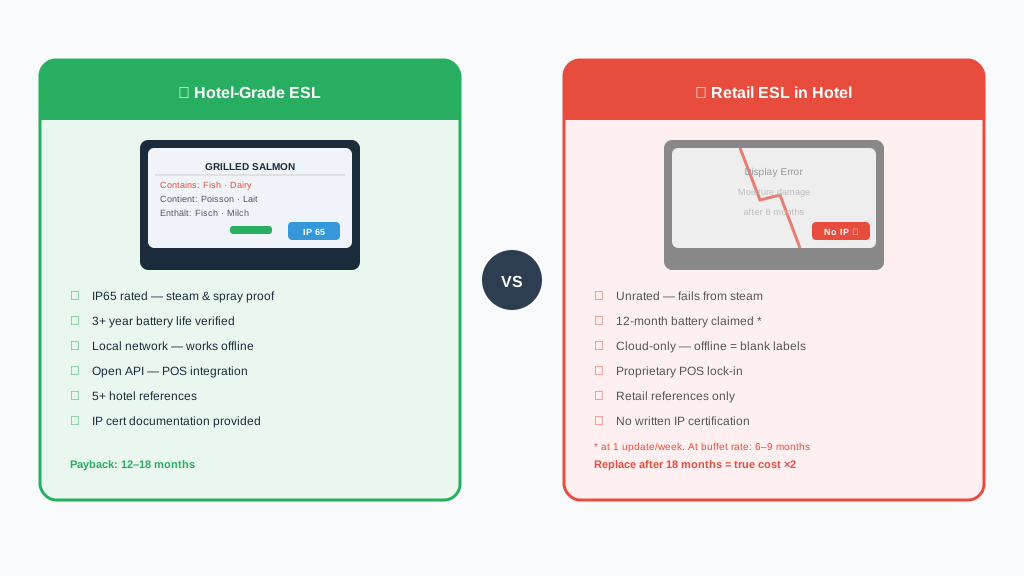
IP54 means protected against dust and water spray from any direction. For food service areas, IP65 (dust-tight, water-jet resistant) is the appropriate minimum. Retail ESLs are typically unrated or IP30 — they will fail from steam and cleaning spray within months
Battery life — 3 years minimum
Replacing batteries on 60 labels every 12 months is a hidden labor cost. Look for verified 3-year battery life at typical update frequencies (5-10 updates per day). Some vendors claim longer life based on one update per week — not relevant for an active buffet
Platform independence
Does the system require your kitchen to use their proprietary POS or recipe software? Proprietary lock-in means every future software change goes through one vendor. Open API integration with your existing systems is strongly preferable
Hospitality references
A vendor with 200 retail deployments and 2 hotel trials is not yet proven in your environment. Ask specifically for references at properties with similar scale and F&B complexity to yours
Local network operation
Cloud-dependent systems fail when internet connectivity drops. Your buffet labels must continue displaying correct information during outages. Local network operation with cloud sync when available is the correct architecture
Get the complete ROI calculator for your property
Enter your email and hotel name — we'll send the full cost-vs-paper breakdown with real numbers from comparable properties, plus a demo invite with no obligation.
No spam. Unsubscribe anytime. Your info is never shared.
The IP Rating Is Not Optional
Commercial kitchen environments expose labels to steam from serving dishes, spray from cleaning operations, and condensation from temperature differentials. A label mounted next to a hot soup tureen will experience far more moisture exposure than the same label mounted on a retail shelf next to a box of cereal. IP54 is the minimum for hotel use; IP65 is what you should specify for any label near cooking equipment, serving vessels, or outdoor areas. Ask vendors to provide the actual test certification, not just a claimed rating.
The Retail Hardware Red Flag
Several vendors sell retail electronic shelf label hardware into hotels on the basis that it is cheaper. It is — until you factor in the replacement rate. Retail ESL enclosures are not sealed against kitchen moisture, their displays are not rated for temperature variance, and their magnets and attachment systems are designed for wire shelving, not hotel chafing dishes and buffet risers. If a vendor is offering you hardware they also sell to Walmart, ask them specifically about their hotel failure rate and warranty terms for food service environments.
What Good Looks Like: A Checklist
For more information, see our compatible ESL hardware guide.
"We chose a system based on price. After eight months, 23 of our 60 labels had failed — mostly from moisture near the hot station. The replacement cost plus the downtime more than offset the initial savings. We replaced the entire system with IP65-rated units and have had zero hardware failures in two years."
— Director of F&B Technology, international hotel group
6 Questions to Ask Any ESL Vendor Before Buying
1. Is the software designed for food service or retail? ESL technology originated in retail for price labels. Most systems lack allergen icon sets, meal period scheduling, and HACCP audit trails. Confirm that food safety features are native, not afterthoughts.
2. How do updates propagate when I change a recipe? Acceptable answer: updates push wirelessly to all labels in under 60 seconds. Unacceptable: labels require manual triggering per station or synchronise only at set intervals.
3. What is the battery life and how are batteries replaced? Look for 3-5 year battery life with easy end-user replacement. Avoid systems where battery replacement requires vendor service visits.
4. Does the system work if the internet goes down? Labels should communicate via local gateway, not cloud-only architecture. If the internet drops, your labels should continue displaying current content and accept updates via local network.
5. What integration does the system offer with my POS or recipe management software? Native integrations with hospitality-specific systems (Gastrofix, Fourth, Lightspeed, Opera POS) reduce double-data-entry and allergen transcription risk.
6. Can you show me the audit trail feature? Any system positioned for allergen compliance should be able to show a timestamped log of every label change, exportable for inspection purposes.
Common ESL Buying Mistakes in Hospitality
Buying retail ESL systems for hospitality use. Retail ESL focuses on price and product code display. Food safety features — allergen icons, dietary tags, freshness timestamps, meal period scheduling — are not available. Several hotels have deployed retail ESL and then discovered mid-rollout that the software cannot display the data they need.
Underestimating the label count. Hotels count the number of dishes and order that many labels. In practice, displays for live cooking stations, condiments, accompaniments, and rotating daily specials mean the actual label count is typically 30-50% higher than the initial estimate. Ask your vendor for a site assessment before finalising the order.
Choosing by hardware price alone. The hardware is a one-time cost. The software subscription cost and capabilities determine long-term value. A system that costs EUR 2,000 less in hardware but lacks allergen audit trail capability will cost far more in liability exposure over 5 years.
Not testing the update latency. Always request a demo where a menu item is changed in the system and you observe how long the label takes to update. Anything over 2 minutes is unacceptable for a high-change buffet environment.
Related Resources
Frequently Asked Questions
Quellen / Sources
- 1.HFTP Technology Benchmarks(HFTP)
- 2.hotelleriesuisse Technologiestandards(hotelleriesuisse)
See How Our System Meets These Criteria
Book a demo to review our IP ratings, battery specifications, API documentation, and hospitality reference list.
Frequently Asked Questions
What should hotels look for when choosing electronic buffet labels?
Key criteria include allergen compliance features (structured data per dish, audit logs), multilingual display support, wireless update speed, battery life (3+ years preferred), display size options for different buffet stations, and integration with your PMS or kitchen management system. Hospitality-specific software matters more than the hardware brand.
What is the difference between retail ESL and hospitality buffet ESL?
Retail ESLs are designed to show prices and product codes. Hospitality buffet ESLs need to display allergen icons, ingredient lists, dietary tags, multilingual descriptions, and freshness timestamps. Software designed for retail lacks these features, making purpose-built hospitality platforms like BuffetDisplay the better choice for hotels.
Which electronic shelf label brands work for hotel buffets?
Zkong, SES-imagotag, and Solum are the leading hardware manufacturers. The hardware is less critical than the software layer: a hospitality-specific platform that supports any of these brands provides more flexibility than locking into a single vendor ecosystem. BuffetDisplay is hardware-agnostic and supports multiple ESL brands.
How long do e-ink buffet labels last on one battery charge?
Modern e-ink labels last 3-7 years on a single battery or built-in cell, depending on how frequently they update. E-ink displays only consume power when the image changes, not when displaying static content. A buffet label updating 6 times per day typically lasts 4-5 years before battery replacement is needed.