Casino Buffet Labeling: How High-Volume Operations Manage 5,000 Covers a Day
Why Casino Buffets Are a Different Problem
Casino buffets in Las Vegas, Macau, Singapore, and Monte Carlo face a set of requirements that no other food service environment combines: continuous menu rotation across breakfast, lunch, dinner and late-night service periods; international guests speaking 15+ languages; freshness expectations from high-value guests who equate label clarity with food quality; gaming regulator food safety requirements layered on top of standard health codes; and the need to update 150+ labels instantly when an item runs out or a component changes.
Paper labels do not survive this environment. They get wet, torn, misplaced between service shifts, and hand-written by a rotation of staff with different handwriting and different attention to allergen detail. The result is either a compliance exposure or a guest experience problem — sometimes both at the same shift.
5 Requirements Unique to Casino Buffet Labeling
Sub-60-second label updates across all stations
When crab legs run out at 11pm and the replacement item goes on, every station sign needs to update before the next guest reaches that counter. A system requiring staff to physically swap labels across 20 stations creates a 10-15 minute window of wrong information at the busiest point of service.
Freshness timestamps visible at the counter
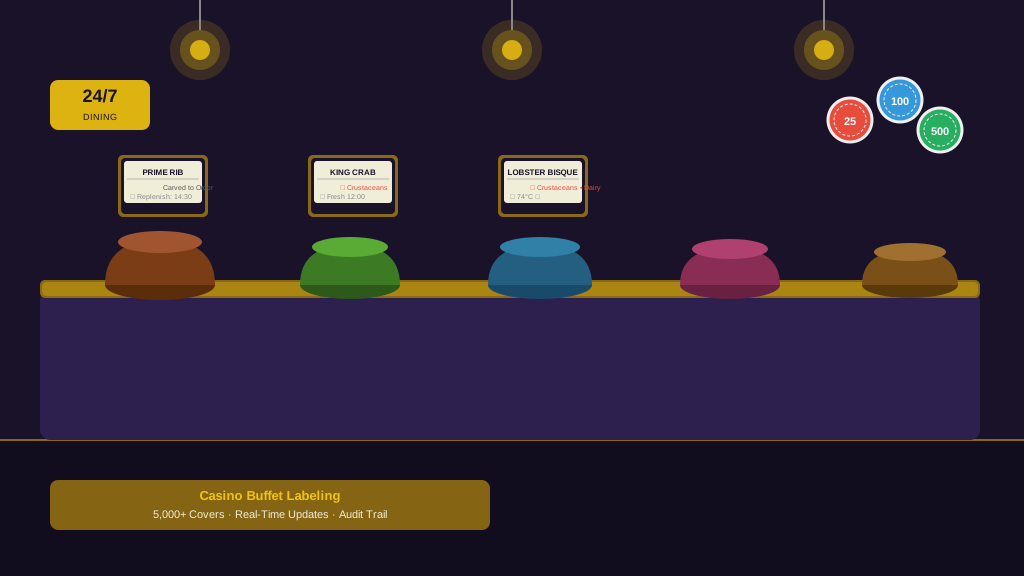
High-value casino guests — especially in VIP and high-roller dining areas — read labels differently from hotel breakfast guests. They want to see "Replenished 14 minutes ago" on hot dishes. This detail alone drives guest satisfaction scores more than any other label element in casino environments.
Service period switching without staff intervention
Casino buffets cycle through 4-6 named service periods (breakfast, brunch, lunch, dinner, late dinner, midnight). Each period has a different menu, different pricing, and different allergen profiles. The label system should switch entire menu sets on a schedule — not require staff to manually update 150 labels at the transition.
Multilingual display for international guest mix
A Macau casino buffet serves guests from mainland China, Southeast Asia, Japan, Korea, Australia and Europe in the same service period. A Las Vegas property sees similar international distribution. Labels displaying dish names and allergens in one language exclude a significant portion of guests from the information they need to make safe choices.
Audit trail across every service shift
Gaming regulators in Nevada, Macau and Singapore include food safety in their compliance frameworks. A documented record of every label change — timestamp, item, allergen declaration, staff user — protects the property during inspections and in the event of a guest incident.
The 24-Hour Rotation Challenge
Paper label systems break down within the first week of casino operation. Staff responsible for writing 150 labels per shift — four or more times per day — make errors under time pressure. Allergen information is the most common omission, because it requires checking a separate reference rather than copying the dish name. In a high-volume environment, that check is often skipped.
Electronic labeling solves this by making the allergen declaration part of the dish record, not a separate step. When a chef adds a new dish to the system, allergens are mandatory fields. When the label publishes, allergens publish with it — every time, for every service period, without staff discretion.
Allergen Risk at Casino Scale
The risk factors that amplify in casino environments are: menu complexity (more dishes = more allergen combinations), high staff turnover (new staff less familiar with allergen protocols), time pressure (buffet lines do not pause for label verification), and guest distraction (casino guests are often focused on gaming, not careful menu reading).
Electronic labels with prominent allergen display — icons, bold formatting, consistent position on every label — reduce incident risk by making the information impossible to miss. The system also prevents the most dangerous failure mode: a label from the previous service period remaining at a station after the dish has changed.
"We had three allergen near-misses in our first year of operation with paper labels. After switching to digital, we have had zero in eighteen months. The audit trail alone has paid for the system in risk mitigation."
— F&B Director, integrated resort casino, Southeast Asia
What Implementation Looks Like at Casino Scale
Week 1: Gateway installation (typically 2-3 gateways for a large casino buffet floor to ensure full coverage). Hardware mounting at each station — labels clip into existing label holders or replace them.
Week 2: Menu data migration. This is the largest effort in a casino context because the rotating menu may have 300-400 dishes across all service periods. Most casino operations already maintain this data in their kitchen management system — the migration is an import, not manual entry.
Week 3: Service period scheduling setup. Each transition time (breakfast ends 11am, lunch begins 11am) is set in the platform. From go-live, the system switches menu sets automatically at the configured times.
Week 4: Staff training on the real-time update workflow — how to push a single dish change during service, how to mark an item as depleted, how to add a substitute item. Most casino F&B staff are proficient within one shift.
After go-live, the label update task — previously a 45-60 minute manual process per service period — becomes a 2-minute dashboard operation.
For full specifications and ROI analysis, see our casino buffet display solution page.
Dynamic Pricing and Comp Integration
Integration with casino management systems (CMS) and player tracking platforms allows the label platform to reflect real-time comp status in designated areas, adding a guest experience dimension beyond basic menu information.
Related Resources
Quellen / Sources
- 1.EU-Verordnung Nr. 1169/2011 (LMIV)(EUR-Lex)
- 2.EFSA Lebensmittelsicherheit(EFSA)
Spec a Casino Buffet Label System
Casino buffets have requirements that standard hospitality ESL configurations do not cover out of the box. Book a technical session with BuffetDisplay to spec the right configuration for your property — gateway placement, service period scheduling, and CMS integration.
Frequently Asked Questions
What labeling system do casino buffets use for 24-hour operations?
High-volume casino buffets use wireless e-ink label systems that update automatically on a schedule. Labels for breakfast, lunch, dinner, and late-night menus activate at configured times without any staff intervention. This is essential for 24-hour operations where staff shifts change and manual label handling would cause inconsistency across thousands of daily covers.
How do casinos manage food safety compliance on high-volume buffets?
Casino buffets use digital label systems to maintain allergen compliance across hundreds of daily menu changes. E-ink labels display freshness timestamps so staff know when to replenish or remove items. The system logs every label update with timestamp and user ID, providing the audit documentation required by gaming authority food safety inspections and HACCP regulations.
What ROI do casinos see from digital buffet label systems?
Casino buffets typically achieve ROI within 6-10 months due to the high volume of label changes. A casino printing and placing labels across 150+ buffet stations for 4 service periods daily saves 4-6 staff hours per day versus manual systems. Reduced food waste from freshness tracking adds a further 30-35% reduction in overproduction, typically worth 20,000-50,000 EUR per year for large casino operations.
Can casino buffet labels handle dynamic pricing and promotions?
Yes. BuffetDisplay supports price display on e-ink labels. Casino buffets that run time-based promotions — reduced pricing during off-peak hours, premium pricing during high-traffic periods — can update displayed prices from the central dashboard without touching any labels. All price changes log with timestamps for audit compliance.