Digital Buffet Labels for Airport Lounges and Stadium Catering
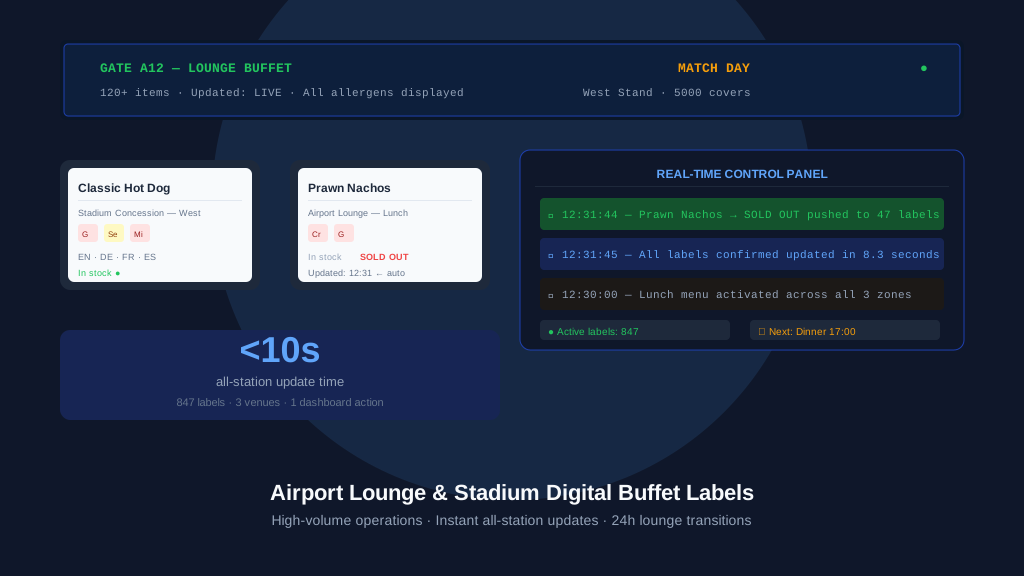
The High-Volume Food Service Environment
A hotel breakfast serving 200 covers over 2 hours has a label failure tolerance of minutes — a mislabeled dish during a quiet period may be caught and corrected before causing an incident. A stadium concession stand processing 5,000 transactions in a 15-minute pre-kickoff window has essentially no tolerance for allergen label errors — the volume prevents individual guest verification of label accuracy.
This is the core case for digital labels at high-volume venues: the system that works reliably when you have time to check also works reliably when you do not. An e-ink label that was correctly programmed at setup displays the correct information during the pre-kickoff rush without requiring any staff action. The accuracy is structural, not dependent on the state of the team during the event.
High-volume food service also benefits disproportionately from the label update speed that digital systems provide. When a venue needs to pull a dish from service during an event (ingredient issue, contamination concern, unexpected stock depletion), every label for that dish across every station updates within 60 seconds. In a paper system, this requires staff to physically reach every station and manually change labels — impossible to execute completely during peak service.
Airport Lounges: 24-Hour Operations and Menu Transitions
The 24-hour operational dimension creates a specific labeling challenge. Airport lounges typically run 4-6 menu periods through a 24-hour cycle: breakfast from 5:00-10:00, light lunch 10:00-14:00, main dining 14:00-20:00, evening service 20:00-23:00, and overnight provision 23:00-05:00. Each period transition requires a complete label changeover across all food stations. For a lounge with 30 food positions and 6 transitions daily, this is 180 label change events per day, 365 days per year — approximately 65,700 label changes annually.
Digital label systems handle this through scheduled publishing: each menu period is configured in advance with the correct dishes and allergens, and transitions are scheduled to activate automatically at the configured time. A lounge manager sets up the full day schedule at the start of the week; each daily transition then happens without requiring staff presence at every station. Staff can focus on food replenishment and quality rather than label management during transitions.
The multilingual dimension is particularly acute at international airports. A lounge at Heathrow, Charles de Gaulle, or Dubai International may serve guests speaking 30+ languages in a single day. Digital labels that display primary content in English with secondary display in 2-3 additional languages cover the majority of the guest population without requiring per-language label sets.
Stadium Catering: Event Day Pressure and Rapid Changeover
The event-day allergen context at stadiums is higher-risk than it appears. Stadium food tends toward convenience formats (hot dogs, burgers, nachos, fried food) where allergens — wheat, dairy, eggs, sesame from bun sesame seeds — are standard. The guest population includes fans who have been drinking alcohol, which affects attention and inhibition around allergen checking. And the volume-per-station is high enough that staff have no time to answer allergen queries individually during peak service.
Digital label systems at stadium venues are deployed differently from hotel buffets. Labels are typically on fixed stands or integrated into concession counters rather than placed next to dishes on a buffet line. The gateway covers the concourse level or suite level as an architectural zone. Multi-site events (championships, concerts across multiple dates) can run the same label configuration from a remote management console without requiring on-site staff to manage label updates between events.
The changeover capability is particularly valuable for venues hosting multiple event types in sequence. A stadium that hosts a football match on Saturday and a family concert on Sunday serves different food menus (adult-oriented F&B versus family-friendly options). The label configuration for both events is set up in advance and switched between events in minutes from the management dashboard, rather than requiring a full manual label replacement across 200+ concession positions.
Ready for High-Volume Digital Label Deployment?
BuffetDisplay handles high-volume stadium, arena, and airport lounge deployments with scheduled publishing, instant all-station updates, and the multilingual display international venues require.
Frequently Asked Questions
How do digital buffet labels handle high-volume airport lounge and stadium catering?
Digital e-ink labels handle high-volume catering through system-level reliability rather than speed of human response. A label that was correctly programmed before the event displays accurate allergen and menu information during the 15-minute pre-kickoff rush without requiring staff action. When a dish needs to be pulled from service during an event, all labels for that dish across every station update within 60 seconds from one dashboard action. Volume amplifies the value of system-level accuracy because there is no time for individual staff verification during peak service.
Can airport lounge buffet labels handle automatic menu period transitions?
Yes. Airport lounge labels with scheduled publishing support automatic transitions between breakfast, lunch, dinner, and overnight menus. Each menu period is configured in advance with the correct dishes and allergens, and transitions activate automatically at the configured time. A lounge manager sets up the full day schedule at the start of the week; each daily transition then happens without requiring staff to physically update any label. For a 24-hour lounge with 6 menu transitions daily and 30 label positions, this eliminates approximately 180 manual label changes per day.
What is the best label system for stadium concession stands?
Stadium concession stands require labels on fixed stands or integrated into counters rather than buffet-line positioning. The key requirements are: (1) scheduled publishing for event vs. non-event menus, (2) remote management so label configurations for multiple events can be set up in advance and activated between events, (3) instant all-station updates when dishes sell out or need to be removed, and (4) allergen display for common stadium allergens — wheat (buns), dairy, eggs, sesame (sesame seed buns). E-ink labels with a cloud management dashboard meet all four requirements better than printed menu boards.
How do allergen labels work at high-volume venues where guests have no time to ask staff?
At high-volume venues like stadiums and airports, guests typically have seconds to make food choices and cannot easily ask staff allergen questions during peak service. This makes accurate, self-service allergen labeling more critical than at sit-down restaurants. E-ink labels display all 14 EU allergens as visual icons at the point of selection, allowing guests to make allergen-safe decisions independently. The structural accuracy of a digital system — where the allergen information matches the recipe database and updates when recipes change — provides the reliability guests need when self-service is their only option.