Electronic Shelf Label ROI for Hotels: Real Numbers, Not Marketing Claims
Key Takeaways
- Swiss hotels should calculate ROI in CHF using local wage benchmarks (CHF 35–45/hr for F&B staff) — German/Austrian figures significantly underestimate Swiss payback times.
- Staff time, not consumables, is the dominant cost driver in paper labelling — often 80%+ of total annual cost.
- Break-even for a 50-station Swiss property is typically 10–16 months; for German/Austrian properties at lower wage rates, 14–22 months.
- The allergen compliance benefit (avoided incident costs, audit protection) is real but asymmetric — most hotels will never have an incident, but those that do face costs that dwarf the system investment.
Why the ROI Case Is Stronger Than Most Hotels Realize
Aus der Praxis / From the field
Payback calculations for digital buffet labels in Austrian properties typically run 12–18 months when factoring in staff time, printing, and compliance risk reduction. Austrian LMG enforcement is substantive; a formal complaint from a guest allergen incident carries documentation requirements that are significantly easier to satisfy with a digital audit trail than with paper records.
The Core Labor Calculation
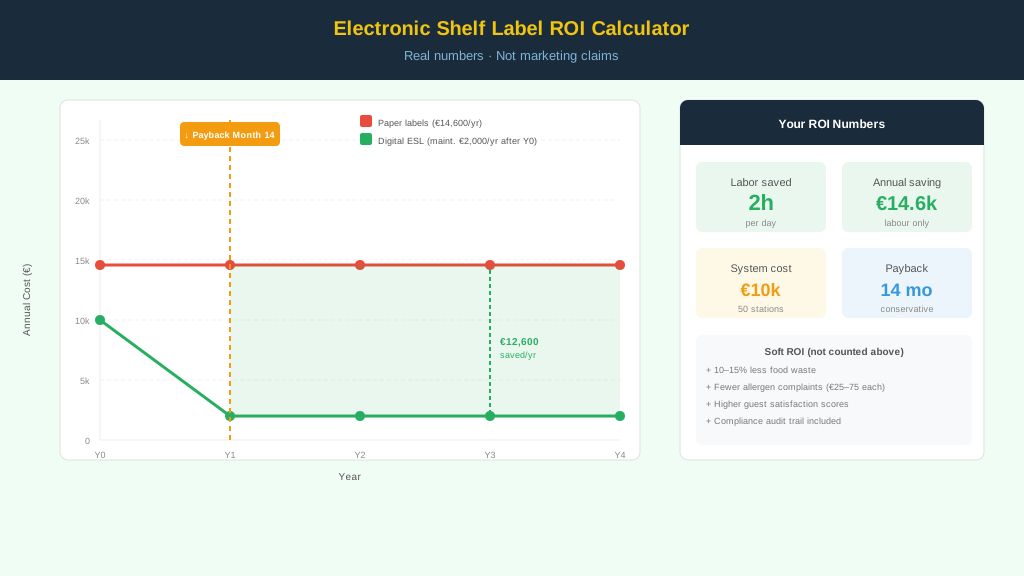
The math starts with a single measurement: how long does your team spend on buffet labels per meal service? For a typical 50-dish breakfast buffet, the answer is 90 to 120 minutes — writing labels, verifying allergen information, placing labels at each station, and replacing ones that are damaged or incorrect. At the average European hospitality hourly rate of €13-15 per hour (including employer contributions), one meal service represents €20-30 in labor. With two meal services per day, that is €40-60 daily — or €14,600 to €21,900 per year, from label writing alone.
Get the complete ROI calculator for your property
Enter your email and hotel name — we'll send the full cost-vs-paper breakdown with real numbers from comparable properties, plus a demo invite with no obligation.
No spam. Unsubscribe anytime. Your info is never shared.
ROI by Property Size
Small property (20 buffet stations)
~60 min/day label work × €14/hr = €3,000/yr labor. System cost: ~€4,000-6,000. Payback: 18-24 months
Mid-size property (50 buffet stations)
~120 min/day × €14/hr = €8,500/yr labor. System cost: ~€8,000-12,000. Payback: 12-18 months
Large property (80+ stations, multiple F&B outlets)
~240 min/day × €14/hr = €17,000/yr labor. System cost: ~€15,000-25,000. Payback: 12-18 months
Event-heavy property (add banquet labeling)
Event labor often billed at overtime rates. Add 30-50% to base labor figures for properties with active banquet calendars
The Soft ROI That Accelerates Payback
Labor savings are the easiest number to calculate, but several other factors contribute to the real ROI: reduced food waste (better freshness labeling improves rotation, reducing waste by an estimated 10-15%), fewer guest complaints (correct allergen information and multilingual labels reduce enquiries and complaints at a cost of €25-75 staff time per incident), lower compliance risk (one allergen incident can cost €25,000+ in legal fees alone), and improved guest satisfaction scores (research shows international guests rate clarity of food information as a top-five satisfaction driver at buffet venues).
What the Calculation Does Not Include
The numbers above are conservative and exclude several factors that your property may need to add: the cost of reprinting labels during a service when a dish changes, overtime during events when label changes are time-critical, the cost of maintaining physical label stock (card holders, label sleeves, marker pens), and the management overhead of coordinating kitchen changes with F&B floor staff. When hotels build these into their analysis, the payback period typically shortens by 20-30%.
How to Build the Business Case Internally
For more information, see our ESL vs paper labels cost comparison.
"When I showed our GM the actual time our team spent on labels — 2.5 hours a day, every day — the conversation changed immediately. The system paid for itself in 14 months. That was four years ago. We have not written a buffet label by hand since."
— F&B Manager, 4-star hotel group, Switzerland
Where the ROI Actually Comes From: Breaking Down the Numbers
Allergen incident cost avoidance. A single allergen incident resulting in a guest medical event carries average costs (direct medical response, legal defense, settlement, insurance premium impact, reputational damage) ranging from EUR 50,000 to EUR 500,000 depending on severity and jurisdiction. One incident avoided more than pays for a multi-outlet ESL deployment. This value is difficult to quantify prospectively but becomes very clear retrospectively. Hotels that have experienced allergen incidents report that the ROI argument for digital labeling becomes trivially easy to make in the aftermath.
Compliance inspection cost avoidance. A failed food safety inspection results in remediation costs, potential temporary closure, and significant reputational damage from public scoring systems (VSP for cruise ships, Food Hygiene Ratings in the UK, cantonal inspection scores in Switzerland). Properties with digital allergen labeling systems consistently perform better on the labeling and allergen information components of these inspections. The cost of a single rating-impacting failure exceeds the cost of the labeling system by a large multiple.
F&B upsell from informed guests. Guests who can see clear allergen and dietary information at every buffet dish select more dishes and express higher satisfaction. Higher breakfast F&B satisfaction scores correlate with repeat bookings in brand loyalty data across major hotel chains. This revenue effect is diffuse but real — it shows up in NPS and repeat stay metrics over 12-month periods at properties that have tracked it.
Breakeven Timeline by Property Type
Single-outlet hotel restaurant (40-60 labels): Investment EUR 12,000-22,000. Annual labor saving EUR 8,000-12,000. Annual consumable saving EUR 3,000-6,000. Breakeven: 12-18 months.
Full-service resort with 2-3 outlets (80-150 labels): Investment EUR 20,000-40,000. Annual labor saving EUR 18,000-28,000. Annual consumable saving EUR 6,000-12,000. Breakeven: 10-15 months.
All-inclusive resort with 4+ outlets and daily menu rotation (150-300 labels): Investment EUR 35,000-70,000. Annual labor saving EUR 35,000-55,000. Annual consumable saving EUR 12,000-20,000. Breakeven: 8-12 months. The breakeven is fastest here because menu change frequency is highest — the comparative cost of paper labels scales with menu changes, while ESL cost does not.
Cruise ship (200-400 labels across multiple venues): Investment EUR 60,000-120,000. Annual labor saving EUR 45,000-80,000. Annual consumable saving EUR 15,000-25,000. Breakeven: 10-16 months. Maritime deployment adds hardware ruggedization costs but also eliminates the consumable supply chain complexity of maintaining label printing supplies at sea.
In all property types, the breakeven shortens substantially if an allergen incident or regulatory inspection failure occurs and is counted as a cost the ESL system would have prevented. Properties that include this risk-adjusted calculation typically find breakeven in under 6 months.
Related Resources
Frequently Asked Questions
Quellen / Sources
- 1.hotelleriesuisse Kennzahlen Hotellerie Schweiz(hotelleriesuisse)
- 2.HFTP ROI Frameworks for Hospitality Technology(HFTP)
Calculate Your Property's Specific ROI
Book a 30-minute call and we will walk through the ROI calculation with numbers from your actual operation.
Frequently Asked Questions
What is the average ROI timeline for electronic buffet labels in hotels?
Most hotels achieve full ROI within 8-18 months. Properties with high label-change frequency (daily specials, multiple meal periods) see faster payback due to larger staff time savings. Hotels with multiple outlets see the fastest ROI due to centralized management eliminating duplicated labor.
How much staff time do electronic buffet labels save per day?
Properties report saving 30-90 minutes per service period on label printing, placement, and collection. For a hotel running three service periods daily, this is 1.5-4.5 hours per day per outlet. At average F&B staff wages, this represents 8,000-22,000 EUR in annual labor savings per restaurant.
What are the cost savings from switching to digital buffet labels?
The three main savings categories are: (1) consumables - paper, ink, laminating pouches, printer maintenance, typically 3,000-8,000 EUR per year per outlet; (2) staff time - 1.5-4.5 hours per day, worth 8,000-22,000 EUR annually; (3) allergen incident avoidance - a single incident can cost 10,000-50,000 EUR in liability.
What is the upfront cost of electronic buffet labels for a hotel?
Hardware costs for a 50-station buffet typically range from 8,000-20,000 EUR depending on display size and brand. Annual software subscription adds 1,500-4,000 EUR per year. Total 5-year cost is typically 15,500-36,000 EUR, compared to 34,000-50,000 EUR for paper labels over the same period.
Related Articles
US Hotel Buffet Digital Labels: Real ROI Numbers, Staff Time Savings, and FDA Big 9 Compliance in One System
Paper buffet labels cost a 150-room full-service US hotel over $45,000 per year when you add printing materials, staff time at US labor rates, food waste from missing freshness cues, and allergen liability exposure. Digital e-ink buffet labels eliminate the majority of these costs and pay back in under eight months — while simultaneously satisfying FDA Big 9 FALCPA compliance and state health department documentation requirements.
Read article →Casino F&B Cost Control: Real-Time Margin Tracking with Digital Buffet Labels
Casino buffets operate at a scale and frequency that makes manual food cost tracking impractical. Digital buffet labels integrated with recipe management give F&B directors real-time per-dish margin visibility, waste alerts by freshness timestamp, and meal-period cost breakdowns — all without additional administrative work.
Read article →Best Electronic Shelf Labels for Hotels: How to Choose (and What Disqualifies a System)
Not all electronic shelf labels are built for hotel buffets. Retail ESL hardware fails in kitchen environments within months. Here are the evaluation criteria that actually matter — and the red flags that should end a conversation.
Read article →