US Hotel Buffet Digital Labels: Real ROI Numbers, Staff Time Savings, and FDA Big 9 Compliance in One System
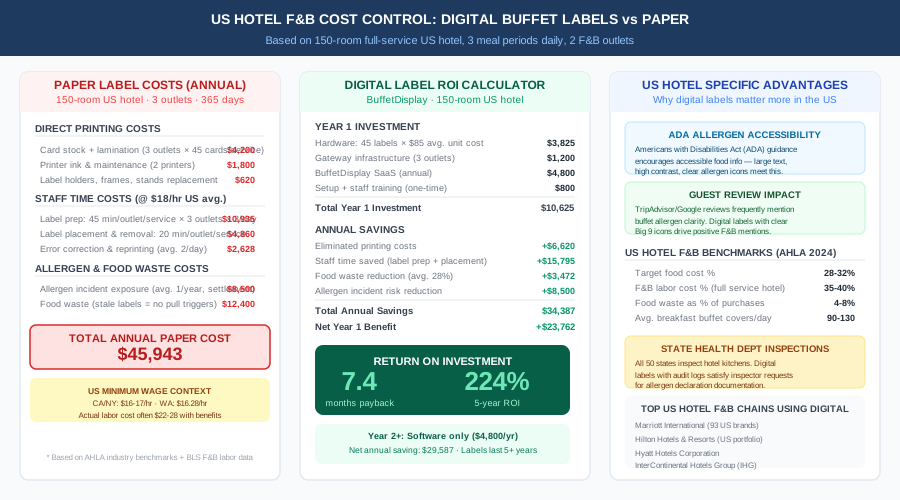
What Paper Buffet Labels Actually Cost a US Hotel
A standard label prep cycle at a hotel breakfast buffet takes 35-45 minutes per outlet per service: printing, cutting, laminating, and placing 40-50 cards. With three outlets and three service periods daily, that is approximately 6 hours of productive staff time per day spent on label administration. At $22/hour with benefits, this alone runs $48,000 annually before a single sheet of card stock is purchased.
On top of labor, direct material costs for card stock, laminating film, printer ink, and label frames run $6,000-7,000 annually for a property this size. Food waste attributable to missing freshness indicators — paper labels do not show prep times or pull triggers — adds another $10,000-15,000 in avoidable waste per year based on AHLA industry benchmarks. The cumulative annual cost of paper labeling at a 150-room US hotel is typically $40,000-50,000. This figure surprises most hotel GMs when they see it calculated, because the costs are distributed across multiple budget lines and never appear as a single line item.
FDA Big 9 Compliance as Part of the ROI Calculation
The allergen liability exposure of a paper-based system is real. When a recipe change introduces a new allergen — a supplier switches to a sesame-based tahini in a salad dressing without notification, or a kitchen substitutes an ingredient — the paper label is unlikely to be updated in time. If a guest with a sesame allergy has a reaction to a dish the label did not flag as containing sesame, the hotel faces civil liability. Industry data suggests allergen incidents at US hospitality properties cost an average of $8,000-12,000 when settled out of court, with jury awards significantly higher in states with active food safety litigation.
A digital label system synced to the recipe database eliminates this class of error. When the recipe changes, the label changes — automatically, simultaneously across every station displaying that dish. The audit log records the change with timestamp and approver, providing the documentation a legal defense requires. For US hotels, this allergen risk reduction is part of the ROI calculation, not a separate compliance budget. For more on the FDA Big 9 regulatory framework, see our FDA Big 9 hotel buffet allergen guide.
State Health Department Inspections and Documentation
When a health inspector asks to see the allergen declaration history for a specific dish — or to verify that the information currently displayed matches the recipe on file — a digital label system with a complete audit log answers the question in under a minute. The system exports a timestamped record of every label state, every allergen change, and every approver identity. A paper system cannot produce equivalent documentation, and the absence of documentation is itself a finding that can result in a follow-up inspection or citation.
For hotel groups with multiple US properties, centralized digital label management provides a further advantage: allergen updates made centrally push to all properties simultaneously. When a vendor changes a product formulation that affects allergen declarations across 20 hotel properties, the update propagates to all 20 automatically. The alternative — calling each F&B manager and trusting that they update their paper labels before the next service — is not a defensible process.
Calculating Your US Hotel ROI: The Key Variables
For a 150-room full-service hotel running 3 outlets and 3 daily service periods at $22/hour fully loaded labor cost, the investment payback period is typically 7-8 months. Year 2 and beyond, with no hardware amortization, the annual net benefit exceeds $28,000. Over five years, the cumulative ROI on the initial investment exceeds 200%.
Properties in high-labor-cost states (California, New York, Washington, Massachusetts) see faster payback because labor cost savings are larger. Properties with high food waste rates see faster payback through the waste reduction component. Properties with recent health inspection findings related to allergen labeling see immediate risk-reduction value. For a side-by-side comparison of digital versus paper costs including a five-year TCO model, see our ESL vs paper total cost comparison.
Quellen / Sources
- 1.EU-Verordnung Nr. 1169/2011 (LMIV)(EUR-Lex)
- 2.EFSA Lebensmittelallergene(EFSA)
Calculate Your US Hotel Digital Label ROI
BuffetDisplay handles FDA Big 9 allergen compliance, state health department documentation, and US POS integration (Toast, Square, Oracle Micros Simphony) — with a custom ROI calculation for your property type and labor market.
Frequently Asked Questions
What is the ROI of digital buffet labels for a US hotel?
For a typical 150-room full-service US hotel running 3 outlets and 3 daily service periods, digital buffet labels pay back in approximately 7-8 months. The savings come from four areas: eliminated printing costs ($6,000-7,000/year), staff time savings at US labor rates (35-45 minutes of label prep per outlet per service, saving roughly $15,000-16,000/year at $22/hour fully loaded), food waste reduction averaging 28% when freshness timestamps guide pull decisions ($3,000-5,000/year), and allergen incident risk reduction valued at $8,000-12,000/year based on industry average settlement costs. Total annual savings of $32,000-38,000 against a Year 1 investment of $9,000-12,000 yields a 5-year ROI exceeding 200%. Year 2+ costs drop to the SaaS subscription only ($3,000-6,000/year depending on property size), making ongoing returns very high.
How do digital buffet labels help US hotels comply with FDA Big 9 allergen requirements?
US hotels must disclose the FDA Big 9 allergens — milk, eggs, fish, shellfish, tree nuts, peanuts, wheat, soybeans, and sesame — at the point of service under FALCPA (Food Allergen Labeling and Consumer Protection Act). Sesame became the ninth mandatory allergen under the FASTER Act effective January 1, 2023. Digital buffet labels satisfy this requirement by displaying all Big 9 allergens as visual icons or text on each dish label automatically, drawing from the recipe database. When a supplier changes a product formulation — introducing sesame into a product that previously did not contain it — the recipe update propagates to every buffet label displaying that dish immediately. The system logs every allergen declaration with timestamp and approver identity, providing documentation if a guest reports an incident.
How do US state health departments inspect hotel buffet allergen labeling?
All 50 US states conduct routine health department inspections of hotel food service operations, typically annually or semi-annually. Inspectors evaluate allergen labeling as part of the food safety inspection — checking whether allergen information is displayed at the point of service, whether it matches the recipes prepared, and whether documentation exists to verify accuracy. States with more active food safety enforcement include California (CDPH), New York (DOHMH), Florida (DBPR Division of Hotels and Restaurants), and Texas (DSHS). A digital label system with a full audit log satisfies inspector documentation requests that a paper system cannot: it can show what allergen information was displayed at any specific dish station at any specific time during the previous 90-day inspection window.
What US hotel POS systems does BuffetDisplay integrate with?
BuffetDisplay integrates with the major US hotel POS systems used in full-service and upscale hotel F&B operations. These include Oracle MICROS Simphony (the most widely deployed US hotel POS), Toast POS (growing rapidly in hotel F&B), Square for Restaurants, Clover POS, SpotOn Restaurant, TouchBistro, and Lightspeed Restaurant. For hotel groups using property management systems, BuffetDisplay connects to Opera PMS for guest dietary preference data. The integration means allergen data from the recipe management system flows automatically to buffet labels without manual re-entry — a recipe change in the POS or recipe management system updates the corresponding label allergen declarations in real time.
Related Articles
Senior Living Dining Labels: Managing Complex Resident Dietary Needs with Digital Displays
Senior living dining is the most complex dietary management environment outside a hospital. Residents commonly carry three to seven simultaneous restrictions: a tree nut allergy, a diabetic diet, low sodium, and an IDDSI Level 5 texture requirement — all at once. Digital food labels that pull from resident dietary profiles and display all restrictions at the buffet station are the only reliable safeguard when dining staff turnover exceeds 60% annually.
Read article →Cruise Ship Digital Food Labels: USPH VSP Compliance, FDA Big 9, and Multilingual Display for 6,500 Passengers
A cruise ship buffet is unlike any other food service environment. Royal Caribbean Allure of the Seas serves 6,500 passengers representing 42 nationalities, 280 buffet dishes across four daily meal periods, with no reliable internet connection while at sea — and unannounced CDC inspectors who can board at any US port. Paper labels last about two hours in the humidity of a lido deck. Digital e-ink labels with offline-first architecture are the only workable solution.
Read article →School Cafeteria Digital Food Labels: USDA NSLP and Smart Snacks Compliance
US school cafeterias serving the USDA National School Lunch Program must display accurate allergen information, meet Smart Snacks nutritional standards for a la carte items, and maintain HACCP documentation for state SNO reviews. Digital e-ink labels update automatically when recipes change — eliminating reprinting costs and the allergen errors that occur when nutrition staff turnover runs at 40-60% per year.
Read article →