Cruise Ship Digital Food Labels: USPH VSP Compliance, FDA Big 9, and Multilingual Display for 6,500 Passengers
The USPH Vessel Sanitation Program and What Inspectors Look For
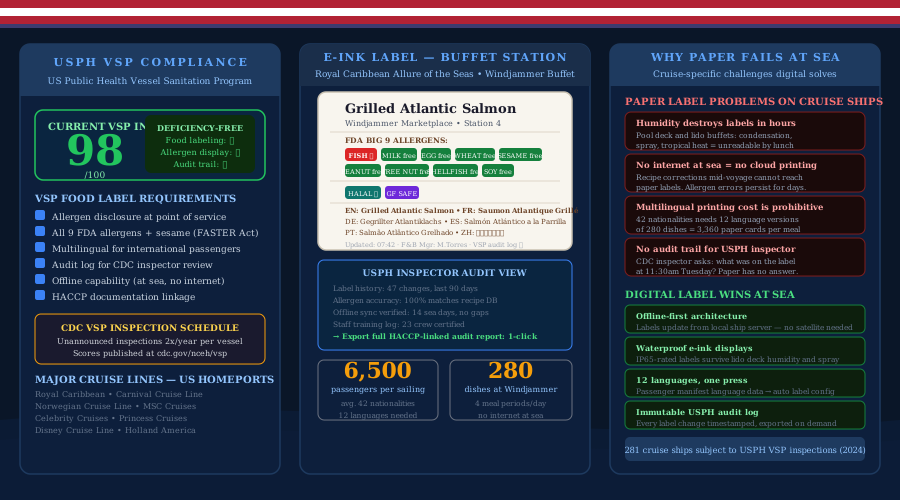
VSP inspectors look for: allergen disclosure at the point of service for all nine FDA major allergens including sesame (added by the FASTER Act, effective January 1, 2023); accurate multilingual labeling for the passenger composition of each sailing; documentation that label content matches the ship culinary team recipe records; and an audit trail showing who changed what and when. A paper label system satisfies none of these documentation requirements. For the US allergen regulatory background that applies to cruise ship buffets, see our FDA Big 9 allergen guide for US food service.
Cruise ships sailing from US homeports — Miami, Port Canaveral, Galveston, Seattle, Los Angeles, New York — are subject to VSP inspections regardless of flag state. A Bahamian-flagged Royal Caribbean vessel departing from Miami is inspected under the same VSP standards as a US-flagged vessel.
Aus der Praxis / From the field
Alpine resort properties serving guests from 15+ countries during peak season find multilingual label support a genuine operational necessity, not a luxury. The ability to switch label language on-demand eliminates a category of guest-staff misunderstandings — typically around allergen queries where language uncertainty was previously escalated to a manager or resolved by removing the dish from the guest's plate.
Why Paper Labels Fail on Cruise Ships
First, humidity destroys paper labels. Lido deck buffets operate in tropical and subtropical conditions, with pool spray, condensation from chilled platters, and outdoor humidity that can exceed 85%. A paper card placed at 07:00 for breakfast service is frequently unreadable by the lunch changeover at 11:30. Lamination helps but does not fully solve the problem, and laminated cards cannot be reprinted quickly when a recipe changes mid-voyage.
Second, there is no internet at sea. A large cruise ship spends 60-80% of its time outside reliable satellite internet coverage. When a supplier notifies the culinary team of an allergen change to a product loaded in Miami, that change cannot reach paper labels in any systematic way while the ship is three days out of port. The allergy risk persists for the remainder of the voyage.
Third, multilingual labeling at paper scale is economically impossible. A ship carrying passengers from 42 countries needs labels in 10-12 languages. For 280 buffet dishes across four daily meal periods, that is 3,360+ individual label versions per meal — printing hundreds of thousands of cards per week at sea is not viable.
Fourth, paper creates no audit trail. When a VSP inspector asks what allergen information was displayed at a specific station at 09:15 on a specific date, a paper system has no answer.
Offline-First Architecture: How Digital Labels Work at Sea
When the ship is in port and internet is available, the local server syncs with the cloud platform: downloading any recipe changes made ashore, uploading the local audit log, and receiving any new passenger language preferences from the boarding manifest. At sea, the system runs fully independently.
For the culinary team, the operational result is identical to a land-based hotel: update a dish allergen from the tablet or dashboard, all labels at the relevant stations update within 60 seconds. The difference is that it works 100% of the time regardless of satellite availability. For a wider view of how cruise ship digital label requirements compare to hotels, see our cruise ship food label compliance guide.
Passenger Language Configuration from the Boarding Manifest
Where the property management system exposes sailing manifest language data, it can be imported to apply automatically to the label templates for the voyage. When the ship departs with a different nationality mix for the next Caribbean round-trip, the label language configuration updates from the new manifest.
The same system handles dietary preference data collected at booking. Major cruise lines collect pre-voyage dietary preferences including food allergies. This data, where available through the property management system, can inform the culinary team's real-time count of how many guests on this sailing have each FDA Big 9 allergen restriction — supporting both menu planning and station-level allergen communication at the buffet.
Quellen / Sources
- 1.EU-Verordnung Nr. 1169/2011 (LMIV)(EUR-Lex)
- 2.EFSA Lebensmittelallergene(EFSA)
Digital Labels Built for Cruise Ship VSP Compliance
BuffetDisplay runs offline-first on ship local servers, displays all nine FDA Big 9 allergens with FASTER Act sesame, supports 12+ passenger languages, and generates the full USPH VSP audit trail inspectors request on demand.
Frequently Asked Questions
What is the USPH Vessel Sanitation Program and how does it affect cruise ship buffet labeling?
The CDC Vessel Sanitation Program (VSP) inspects cruise ships sailing from US ports at least twice per year, unannounced. Inspection scores are published publicly at cdc.gov/nceh/vsp — a score below 86 triggers public reporting and can affect bookings. Allergen labeling at buffet stations is an explicit inspection criterion. Inspectors look for point-of-service allergen disclosure covering all nine FDA Big 9 allergens including sesame (which became mandatory under the FASTER Act on January 1, 2023), an audit trail showing label change history, and documentation that label content matches the shipboard recipe records. Any cruise ship departing from a US homeport — Miami, Port Canaveral, Galveston, Seattle, Los Angeles, or New York — is subject to VSP inspections regardless of flag state.
How do digital buffet labels work on cruise ships without reliable internet at sea?
Digital e-ink labels on cruise ships use an offline-first architecture. The label management system runs on a local server installed aboard the ship rather than connecting to a cloud server. All label content, allergen databases, and scheduled meal period transitions are stored and processed on the ship local network. Label updates propagate from the local server to the e-ink displays over the ship wireless network — no satellite internet required. This means allergen corrections and recipe changes reach every buffet label in under 60 seconds even when the ship is in the middle of the Atlantic with no connectivity. When the ship calls at port and internet is available, the local server syncs with the cloud platform to download any recipe changes made shoreside and upload the local audit log.
How many languages do cruise ship buffet labels need to support?
The number of languages depends on the sailing and route. A typical Caribbean cruise from Miami may carry passengers from 40+ nationalities. The most common mix on mainstream cruise lines such as Royal Caribbean and Carnival includes significant proportions of US, UK, German, Brazilian, Italian, Spanish, and Australian guests, plus varying numbers from Latin America, Asia, and the Middle East. The practical approach is to import the booking manifest language data and configure the top 6-8 languages for each specific sailing. BuffetDisplay supports up to 12 languages simultaneously on each label, with the layout configured for the label size. A 4.2-inch label can display three languages side by side; a 7.5-inch label can show six.
Can cruise ship digital buffet labels generate documentation for CDC VSP inspectors?
Yes. A digital label system with a full audit log generates on demand: a timestamped record of every label update across the voyage (what allergen data was displayed, when it was set, and which crew member approved the change); a point-in-time snapshot of every station label at any moment during the sailing; a comparison report showing label allergen declarations against the recipe database (to demonstrate accuracy); and an export of all changes made after any specific date or time. When a CDC VSP inspector boards in Miami and asks for documentation of allergen labeling during the last three voyages, the system produces a complete export in minutes. This is the documentation gap that paper label systems cannot fill — paper has no historical record of what was displayed at a specific time.
Related Articles
Senior Living Dining Labels: Managing Complex Resident Dietary Needs with Digital Displays
Senior living dining is the most complex dietary management environment outside a hospital. Residents commonly carry three to seven simultaneous restrictions: a tree nut allergy, a diabetic diet, low sodium, and an IDDSI Level 5 texture requirement — all at once. Digital food labels that pull from resident dietary profiles and display all restrictions at the buffet station are the only reliable safeguard when dining staff turnover exceeds 60% annually.
Read article →FDA Big 9 Allergens: What Changed for US Hotel Buffets in 2023
The FASTER Act added sesame as the 9th major food allergen under US federal law, effective January 1, 2023. For hotel buffets still running allergen systems built for the old Big 8, this is a compliance gap. Digital buffet labels connected to recipe management systems can add sesame tracking without a system overhaul.
Read article →US Hotel Buffet Digital Labels: Real ROI Numbers, Staff Time Savings, and FDA Big 9 Compliance in One System
Paper buffet labels cost a 150-room full-service US hotel over $45,000 per year when you add printing materials, staff time at US labor rates, food waste from missing freshness cues, and allergen liability exposure. Digital e-ink buffet labels eliminate the majority of these costs and pay back in under eight months — while simultaneously satisfying FDA Big 9 FALCPA compliance and state health department documentation requirements.
Read article →