Senior Living Dining Labels: Managing Complex Resident Dietary Needs with Digital Displays
The Dietary Complexity Problem in Senior Living
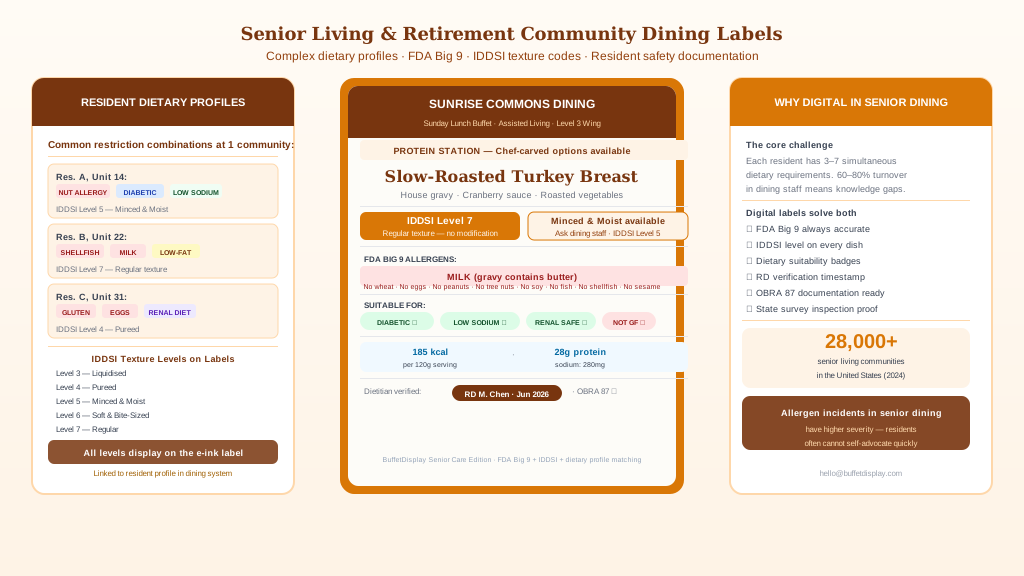
More importantly, the restriction profiles are stacked. It is not just "one allergy per person." Residents frequently carry three to seven simultaneous requirements: a diagnosed tree nut allergy alongside a diabetic diet, a low-sodium prescription from their cardiologist, a renal diet from nephrology, and a swallowing modification ordered by their speech therapist. Every dish at the buffet has to be evaluated against all of those simultaneously.
The problem is not knowledge — most registered dietitians managing senior dining programs know their residents well. The problem is knowledge transfer. Annual dining staff turnover in senior living facilities in the US exceeds 60%, according to industry surveys. A new server on their second shift has no reliable way to know which dishes are safe for which residents unless that information is at the point of service — on the label itself.
IDDSI Texture Levels on Digital Labels
Digital labels display the IDDSI level of each dish directly on the label: Level 7 for a regular dish, Level 6 for soft and bite-sized, Level 5 for minced and moist, Level 4 for pureed. When the kitchen prepares a texture-modified version of a dish (a pureed turkey breast alongside the regular carved turkey), both versions appear on the same or adjacent labels with their respective IDDSI codes.
Combining IDDSI display with FDA Big 9 allergen badges and dietary suitability indicators (diabetic-safe, low-sodium, renal-safe) on a single label gives dining staff a complete picture at a glance. No verbal handoff required, no binder to check during service. For a guide to setting up this kind of comprehensive allergen and dietary management system, see our allergen compliance system setup guide.
FDA Big 9 and OBRA 87 Documentation Requirements
First, FDA Big 9 allergen compliance under FALCPA and the FASTER Act applies to all food service operations including senior dining. Sesame became the 9th mandatory allergen as of January 1, 2023. Many senior living dietary management systems were built before that date and do not track sesame as a discrete field. The risk: a dish containing tahini, sesame oil, or a sesame-coated item is served to a resident with a sesame allergy without any label warning.
Second, OBRA 87 (the federal Nursing Home Reform Act) requires that nursing homes provide residents with diets that meet their nutritional needs and that honor physician-ordered dietary restrictions. State survey inspectors evaluate compliance during routine inspections — and they look at documentation. A digital label system that logs every allergen declaration with timestamp, dietitian verification, and approver identity provides exactly the paper trail that surveyors expect to see.
State health departments in California, Florida, Texas, and New York have all issued guidance reinforcing documentation requirements for resident dietary management. Digital label systems provide this documentation automatically, without any additional administrative work from the dietary team. For the US-specific allergen regulatory background, see our FDA Big 9 allergen guide for US food service.
Matching Labels to Resident Dietary Profiles
At the serving station, the label shows the overall dish allergen and texture profile. At the resident level — via a companion app on the dining room tablet — a server can pull up any resident profile and see exactly which dishes are safe for them today. This is particularly valuable when a resident returns from a hospital stay with new dietary orders that the full kitchen team has not yet internalized.
Communities implementing this integrated approach report that allergy-related service errors drop significantly in the first month. Dietitian time spent on staff education also decreases — because the system carries the knowledge that previously required face-to-face training for every new hire.
Quellen / Sources
- 1.EU-Verordnung Nr. 1169/2011 (LMIV)(EUR-Lex)
- 2.EFSA Lebensmittelallergene(EFSA)
Digital Labels Built for Senior Living Dining
BuffetDisplay displays FDA Big 9 allergens, IDDSI texture levels, and dietary suitability badges at every buffet station — with RD verification timestamps and a full audit trail for state health surveys.
Frequently Asked Questions
What dietary restrictions do senior living food labels need to display?
Senior living dining labels need to display significantly more than standard restaurant allergen information. A fully featured label for a continuing care retirement community (CCRC) or assisted living facility shows: (1) FDA Big 9 allergens including sesame per the FASTER Act effective January 1, 2023; (2) IDDSI texture level codes (Levels 3-7) for residents with physician-ordered swallowing modifications; (3) dietary suitability indicators such as diabetic-safe, low-sodium, renal-safe, low-fat, and low-potassium; (4) RD verification timestamp confirming a registered dietitian has reviewed the label content; and (5) calorie and macro information for residents tracking nutritional intake. The combination of all five elements on a single label gives dining staff the complete picture without requiring reference to a binder or separate resident chart.
What is IDDSI and why does it matter for senior living dining labels?
IDDSI stands for International Dysphagia Diet Standardisation Initiative. It is a globally standardized framework for describing food textures and drink consistencies for people with difficulty swallowing (dysphagia). The framework uses numbered levels: Level 7 is regular food, Level 6 is soft and bite-sized, Level 5 is minced and moist, Level 4 is pureed, and lower levels cover liquid and semi-liquid foods. In US senior living communities, a meaningful portion of residents — often 20-30% in memory care and skilled nursing units — have physician-ordered texture modifications. A dining label that displays the IDDSI level of each dish allows any staff member, including new hires, to serve residents safely without memorizing individual texture requirements. IDDSI coding also documents compliance when state health department surveyors audit the facility.
How does OBRA 87 relate to senior living food labeling?
OBRA 87 (the Omnibus Budget Reconciliation Act of 1987) established federal standards for nursing home care including the requirement that residents receive diets meeting their nutritional needs and honoring physician-ordered dietary restrictions. State survey inspectors evaluate compliance with OBRA standards during routine inspections that occur at least annually for Medicare and Medicaid certified facilities. A digital label system that maintains an audit log — recording every allergen and dietary declaration with the timestamp, the user ID who made the change, and any RD verification — provides exactly the documentation that surveyors expect. When an inspector asks for evidence that a resident received appropriate dietary accommodation, the digital audit trail can be exported and presented within minutes. Paper-based systems often cannot provide equivalent documentation.
How do digital food labels help when senior living dining staff turnover is high?
Annual dining staff turnover in US senior living communities averages 60-70%, with some facilities seeing complete kitchen crew turnover two to three times per year. New staff cannot be expected to have memorized the dietary profiles of 80-150 individual residents by the second week of employment. A digital label system addresses this by embedding the knowledge in the label itself: the IDDSI texture level, FDA Big 9 allergen status, and dietary suitability indicators are visible at the point of service without requiring any memorization. When a new server is assigned to a station, they can serve safely based on what the label displays. When a resident returns from a hospital stay with updated dietary orders, the RD updates the affected dishes in the system and every label reflecting those dishes updates immediately across all dining stations. The information is always current regardless of which staff member is on shift.
Related Articles
Cruise Ship Digital Food Labels: USPH VSP Compliance, FDA Big 9, and Multilingual Display for 6,500 Passengers
A cruise ship buffet is unlike any other food service environment. Royal Caribbean Allure of the Seas serves 6,500 passengers representing 42 nationalities, 280 buffet dishes across four daily meal periods, with no reliable internet connection while at sea — and unannounced CDC inspectors who can board at any US port. Paper labels last about two hours in the humidity of a lido deck. Digital e-ink labels with offline-first architecture are the only workable solution.
Read article →FDA Big 9 Allergens: What Changed for US Hotel Buffets in 2023
The FASTER Act added sesame as the 9th major food allergen under US federal law, effective January 1, 2023. For hotel buffets still running allergen systems built for the old Big 8, this is a compliance gap. Digital buffet labels connected to recipe management systems can add sesame tracking without a system overhaul.
Read article →US Hotel Buffet Digital Labels: Real ROI Numbers, Staff Time Savings, and FDA Big 9 Compliance in One System
Paper buffet labels cost a 150-room full-service US hotel over $45,000 per year when you add printing materials, staff time at US labor rates, food waste from missing freshness cues, and allergen liability exposure. Digital e-ink buffet labels eliminate the majority of these costs and pay back in under eight months — while simultaneously satisfying FDA Big 9 FALCPA compliance and state health department documentation requirements.
Read article →