How to Set Up an Allergen Compliance System for Your Hotel Buffet
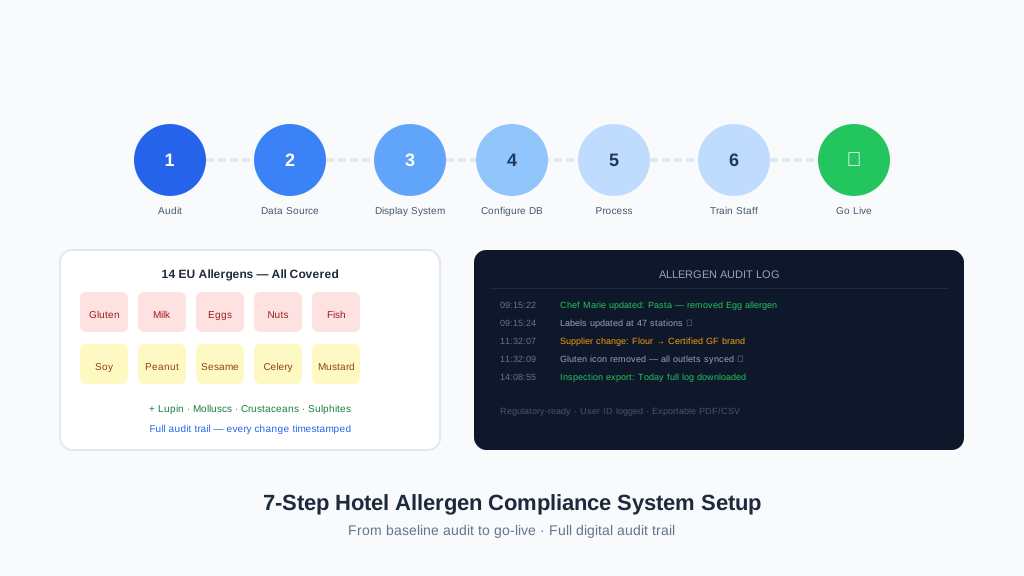
Step 1: Audit Your Current Allergen Process
Questions to answer in your audit:
Where does allergen data currently live? (Recipe cards, chef memory, a shared spreadsheet, a POS system, or nowhere consistent?)
How does that data reach the buffet? (Who writes or prints the label? Who checks that the label is correct? Is there a sign-off process?)
What happens when a recipe changes mid-week? (Does the label change the same day? Who is responsible? Is there a record?)
How long does label setup take per service period? (Measure actual time for one week.)
What documentation exists of what was displayed on a given day? (Could you produce it for an inspection tomorrow?)
The audit output is your baseline. It tells you exactly what your compliance gaps are and what a replacement system needs to fix. Hotels that skip this step often buy systems that do not address their actual problems.
Step 2: Choose Your Allergen Data Source
Recipe management system (most reliable). If your hotel uses a recipe management platform (CalcMenu, Fourth, Harbortouch, or similar), allergen data may already exist there. The best allergen display systems connect directly to your recipe management platform via API, so allergen data flows automatically when recipes are updated. Ask your recipe management vendor what API access is available.
Supplier specification sheets (reliable). For hotels without recipe management software, allergen data comes from supplier technical data sheets. The setup process requires systematically collecting spec sheets for every ingredient in every dish and entering the allergen data per ingredient into your allergen management system. This is more work upfront but produces a reliable, documented data set. Many allergen software platforms support bulk import of this data from standardized CSV formats.
Manual entry (least reliable, but sometimes the only option). If recipe management integration and supplier spec import are not available, allergen data is entered manually per dish. This is the highest-risk approach because manual entry is where transcription errors occur. It should be treated as a temporary solution while integration or spec-sheet processes are established. Implement a mandatory two-person review process for any manual allergen entry.
Step 3: Select a Display System
Digital e-ink labels (highest compliance). E-ink labels connected to your allergen database update automatically when the database changes, display allergen icons and text at each dish position without guest interaction, and generate a timestamped audit log of every change. This is the only option that satisfies all three compliance requirements: accurate information, accessible at point of service, with documented audit trail. The audit trail is the feature that distinguishes this option legally from all others — it is the only system that can answer "what was displayed for this dish at 8:15 AM on November 14th?"
Digital displays or tablets. Tablets at buffet stations can display allergen information but require daily charging, create shared touch surfaces at food stations (a hygiene risk flagged by inspectors), and are more expensive to maintain over time. They can maintain a limited audit trail if connected to a logged system, but do not produce the same quality of evidence as a purpose-built label system. See our comparison of e-ink labels vs tablets for a detailed analysis.
Printed paper labels. Paper labels can be accurate and professional but produce no audit trail beyond a file of printed sheets (which are often not retained systematically). They are the only option for operations where the investment in digital systems is not currently feasible, but require a documented print-and-check process to maintain compliance. Any paper label process should include a mandatory allergen review step with a named responsible person and a date/signature on the review.
Steps 4-7: From Integration to Go-Live
Step 5: Establish your change management process. Define and document the process for what happens when a recipe changes. Who updates the allergen database? Who reviews the update for accuracy before it publishes? For digital systems, the update-then-publish workflow enforces this automatically. For paper systems, it requires a documented two-step process: (1) update the recipe card, (2) update or replace the buffet label on the same day, with sign-off.
Step 6: Train your team. All F&B staff who interact with the buffet need basic allergen awareness training (at minimum, knowing which dishes contain which allergens and what to do if a guest asks a question they cannot answer). The team responsible for managing labels (typically the F&B manager or head chef) needs system-level training on the allergen management software. Document training completion with dates and signatures — this is evidence of your compliance process.
Step 7: Go live and verify. Launch the new system during a low-traffic service period. Walk the buffet immediately after the first update to verify that displayed allergens match the recipe database. Run this spot-check daily for the first two weeks. After 30 days of stable operation, conduct a formal allergen audit: pull a sample of 10 dishes and cross-check displayed allergens against current supplier specification sheets. Correct any discrepancies immediately and document the correction with timestamp.
Ready to Set Up Your Hotel Allergen Compliance System?
BuffetDisplay guides you through every step of this process — from connecting to your recipe management system to printing labels to running compliance checks. Our implementation team has helped 500+ hotel properties complete this setup.
Frequently Asked Questions
What are the steps to set up allergen compliance in a hotel buffet?
A hotel allergen compliance system setup has seven steps: (1) audit your current process to identify gaps, (2) choose your allergen data source (recipe management integration, supplier spec import, or manual entry), (3) select a display system (e-ink labels recommended for audit trail), (4) configure your allergen database, (5) establish a documented change management process, (6) train your team with documented completion records, (7) go live and run spot-checks for 30 days. The audit step is most often skipped but most critical.
How long does it take to implement a hotel allergen compliance system?
A complete hotel allergen compliance system implementation typically takes 2-4 weeks from start to go-live. The longest phase is allergen data setup (1-2 weeks for a full menu), which can be shortened significantly if your recipe management system already holds allergen data with API access. Hardware installation takes one day. Staff training takes 2-4 hours. The post-go-live verification period (30 days of spot-checks) should be included in your implementation timeline.
What is the legal requirement for allergen display at hotel buffets?
EU Regulation 1169/2011 requires that food businesses provide information on all 14 major allergens for every dish at point of service. For buffet-style service, this means allergen information must be available at each dish position — not only on request at a service counter. UK allergen regulations (including Natasha's Law) have equivalent requirements. Hotels must also be able to demonstrate the accuracy of their allergen information if challenged by an inspector or in a legal proceeding.
What documentation does a hotel need for allergen compliance?
Hotels need: (1) allergen records for each dish showing the 14 allergens and whether each is present, (2) a change log showing when allergen information was updated and why, (3) evidence that the information displayed matches the actual recipes (cross-check records), and (4) staff training records. A digital allergen management system with an audit trail generates items 1 and 2 automatically. Items 3 and 4 require a defined process.
Related Articles
Electronic Buffet Labels for Hotels: The Complete Buyer's Guide
Everything F&B managers need to know before buying electronic buffet labels — from IP ratings and <a href="/blog/eu-allergen-labeling-requirements-hotels-2026" class="text-blue-600 hover:underline">allergen compliance</a> to TCO, supplier red flags, and integration with kitchen systems.
Read article →EU Allergen Labeling Requirements for Hotels in 2026
A practical guide to current EU food allergen regulations for hotels, what inspectors actually check, and how digital labels make compliance effortless.
Read article →Hotel Buffet Allergen Software: What to Look For (and What to Avoid)
Most hotels buy an allergen system that covers one of the three things they actually need — and discover the gaps during an inspection. Here is what a complete hotel buffet allergen software solution must do.
Read article →