How to Manage Multilingual Buffet Labels Without Creating an Allergen Risk
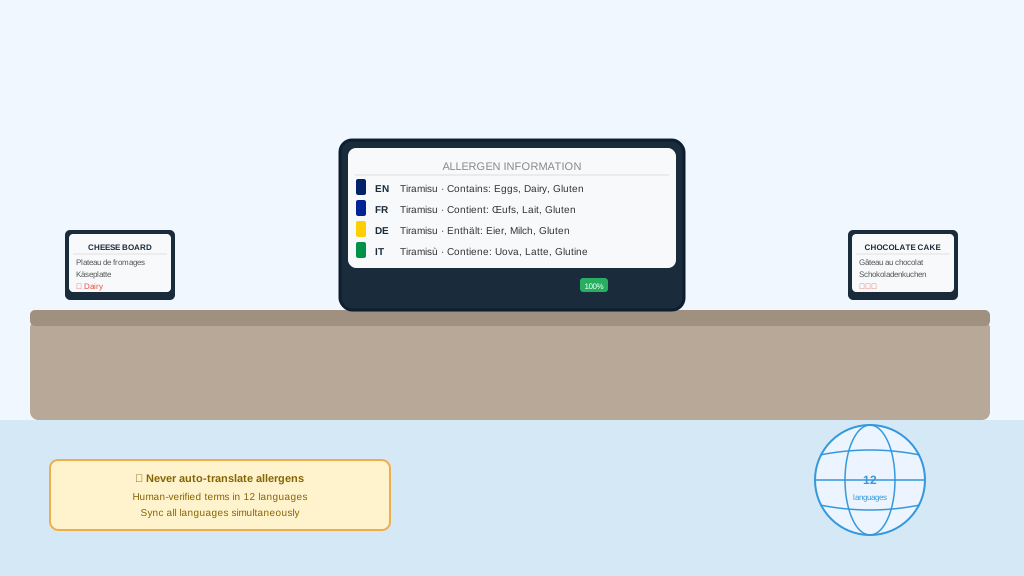
Why Multilingual Labeling Is Harder Than It Looks
Adding more languages to your buffet labels seems straightforward — just translate the text. In practice, it creates a set of problems that catch most hotels off guard: Which languages do you prioritize? How do you handle characters that do not fit on a small display? Who verifies that the translation is correct for allergen names specifically? What happens when a dish is updated in one language and the others fall out of sync? A multilingual labeling strategy needs answers to all of these questions before you configure a single label.
Language Prioritization: Start With Your Guest Mix
Most hotels try to support too many languages simultaneously and end up with labels that show truncated text in every one of them. A better approach: identify the top three languages of your actual guest mix (your front office system has this data), add English as the baseline for international guests, and add your local language for regulatory compliance. For most European hotels, this means four or five languages — enough to cover 80-90% of guests without overwhelming the display.
The Four Multilingual Failure Modes
Auto-translate allergens
Machine translation of allergen terms is unreliable. "Sesame" has multiple translations in Arabic alone. Always use human-verified allergen term lists
Character set overflow
Chinese, Japanese, Korean, and Arabic characters are significantly wider than Latin characters. A 20-character display in English may only show 8 Arabic characters
Sync lag
When a recipe changes, all language versions must update simultaneously. A system that updates English first and queues other languages creates a compliance window
No language fallback
If a label has no translation for a given language, it must fall back gracefully to English rather than showing a blank field or an error code
The Allergen Translation Problem
This is where multilingual labeling becomes a safety issue, not just a guest experience issue. The EU's 14 allergen names sound simple in English: milk, eggs, peanuts, tree nuts. In practice, "tree nuts" is a category that covers almonds, cashews, walnuts, pistachios, and more — and different languages may have different conventions for how these are named and grouped. If your system relies on automated translation and a guest with a cashew allergy misses it because it was translated as the generic "tree nuts" category, you have a liability problem. Human-verified allergen term libraries in each supported language are not a luxury — they are a baseline requirement.
Adding New Languages
When you add a new language to your system, the process should include: (1) a verified translation of your full allergen term library for that language, (2) a character set test on your actual display hardware to confirm text is legible and does not overflow, (3) a full menu review with a native speaker to catch idiomatic errors, and (4) a pilot period on a subset of labels before full deployment. Skipping any of these steps introduces errors that are very difficult to catch once they are live on 80 labels across your restaurant.
"We tried adding Arabic and Japanese using auto-translate. Within two weeks, a guest with a sesame allergy flagged that the Arabic label did not show sesame correctly. We pulled all labels, had them manually reviewed, and lost three weeks of multilingual capability. The lesson: never auto-translate allergens."
— F&B Operations Manager, luxury resort
What Good Multilingual Labeling Looks Like
For more information, see our cruise ship buffet display solution.
Building a Translation Workflow That Stays Accurate
The standard failure scenario: a dish changes its recipe (a new supplier changes an ingredient). The head chef updates the label in English. The French and German versions are not updated because the person who manages translations is not part of the kitchen change notification chain. For the next two weeks, the French and German labels display outdated information. In an allergen context, this is not a minor inconsistency — it is a compliance failure.
The solution is to treat the source-language recipe as the single source of truth and make translation update mandatory before any label can publish. In practice, this means: when a recipe is changed in the management system, the system flags all translations as requiring review. No multilingual label can update on the display until either: the translation has been reviewed and confirmed accurate, or a user with override authority explicitly approves the previous translation as still valid. This creates an enforced review gate rather than relying on the translator to notice a change.
Properties with fewer than five languages typically handle this with a bilingual member of the F&B team who reviews flagged translations as part of their daily pre-service check. Properties with six or more languages typically maintain a translation log and assign specific language pairs to staff or outsource periodic review to a hospitality translation service on a retainer basis.
Which Languages to Prioritize and When
Step 1: Pull the nationality breakdown from your PMS for the past 12 months. Identify the languages covering 80% of your guests.
Step 2: Launch with English plus the top 2-3 languages from step 1. These are the languages where translation accuracy most directly affects guest satisfaction and compliance risk.
Step 3: Add languages in order of volume as operations stabilize. Each added language increases the translation maintenance burden — add languages when you have the workflow to maintain them, not as a launch aspiration.
For most Western European hotel properties, the practical sequence is: English first (universal in hospitality), then German or French (highest-volume non-English European source markets), then Italian or Spanish. For Southeast Asian and Middle Eastern properties, Arabic and Mandarin or Japanese typically follow English. Cruise ships serving multiple itinerary regions maintain a base set of 4-6 languages with itinerary-specific additions activated for relevant sailings.
One practical note: allergen terms have regulated vocabulary in several EU languages. Always verify that your translations use the legally recognized term for each allergen in the target language, not a colloquial synonym. A German label that says "Nuss" (general nut) instead of the specific regulated terms for "Haselnuss" and "Cashewnuss" creates compliance ambiguity even if the intent is correct.
Related Resources
Quellen / Sources
- 1.EU-Verordnung Nr. 1169/2011 (LMIV)(EUR-Lex)
- 2.EFSA Lebensmittelallergene(EFSA)
Multilingual Labels Without the Risk
See how our system manages multilingual buffet labels with human-verified allergen terms in 12 languages.
Frequently Asked Questions
How can a hotel display buffet dish information in multiple languages?
The most effective approach is e-ink labels that store and display dish information in multiple languages simultaneously. BuffetDisplay supports up to 12 languages per label. The label cycles through languages on a timed interval, or guests can select their preferred language via a nearby touchpoint. All translations are maintained centrally — when a dish name or description changes in one language, all versions update together.
What languages should hotel buffet labels support for international guests?
The optimal language set depends on the guest mix. European resort hotels commonly need English, German, French, Russian, and Arabic. Cruise ships typically need English, Spanish, German, Italian, French, and Mandarin. For all-inclusive resorts in Asia-Pacific, English, Mandarin, Japanese, Korean, and Thai cover most guests. BuffetDisplay supports any language set based on the property guest profile.
How do multilingual e-ink buffet labels work technically?
E-ink labels receive content wirelessly from a gateway device. The gateway stores each dish entry with translations for all supported languages. When labels update, they receive the multilingual content package for all assigned dishes. The label then displays the appropriate language based on its configuration — cycling through languages, or locked to a single language per station to serve different guest segments.
What is the biggest risk of manual multilingual buffet labeling?
The primary risk is translation inconsistency: allergen information in one language contradicts allergen information in another because different staff members created each version independently. A guest who reads only Arabic or Russian may see different allergen data than the English label shows. Digital systems that share a single allergen source of truth across all languages eliminate this risk entirely.