Digital Food Labels on Cruise Ships: What Compliance Actually Requires
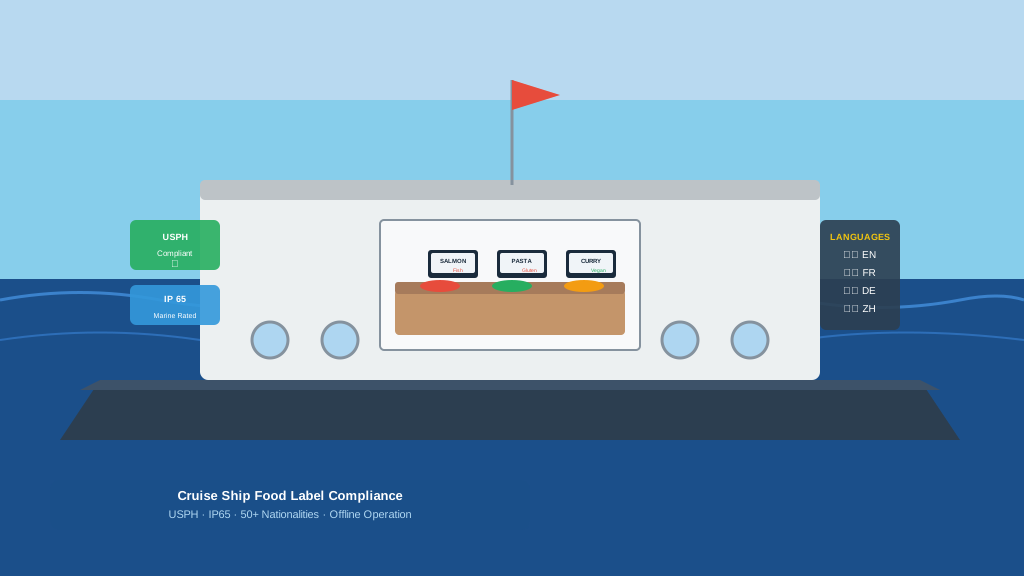
The Most Demanding Buffet Environment on Earth
A cruise ship buffet is not a hotel buffet with a view. It operates 24 hours, serves guests from 50 or more countries, changes menus at every port, and faces unannounced USPH (United States Public Health) inspections with zero tolerance. The physical environment adds salt air, humidity, and the constant vibration of a vessel at sea. Most labeling systems designed for hotel kitchens fail within weeks on a ship. Digital food labels built for maritime use are a different category entirely.
USPH and SOLAS: What the Regulations Demand
The USPH Vessel Sanitation Program (VSP) requires allergen information to be available at the point of food selection for every dish. Inspectors board unannounced and check labels for accuracy against the actual dishes served — not against yesterday's menu or a master recipe file. SOLAS (Safety of Life at Sea) requirements add food safety traceability obligations. A label that was correct this morning must be updated before the afternoon service, and the system must prove it was.
What Maritime Digital Labels Need to Do Differently
IP65+ rating minimum
Salt air and humidity destroy consumer-grade displays within months. Marine-rated enclosures are not optional
Offline operation
Satellite internet at sea is slow and drops constantly. Labels must work and update locally without a cloud connection
Multi-deck gateway coverage
A single gateway cannot cover multiple decks through steel bulkheads. Mesh or multi-gateway deployments are required
USPH audit trail
Every label change must be timestamped and stored with the dish, service period, and operator who made the change
The 50-Nationality Problem
A major cruise line carries guests from every continent. A guest with a nut allergy who only reads Chinese cannot rely on an English-only label. USPH does not specify which languages must be displayed, but international cruise lines face civil liability if a guest suffers an allergic reaction because the information was only available in a language they could not read. Best practice — and the practice major cruise lines are adopting — is a minimum of English plus the top three or four languages of the current voyage.
Menu Changes at Every Port
Cruise menus change constantly. Local ingredients are loaded at each port, theme nights are scheduled weeks in advance, and the chef may substitute an ingredient due to supply issues with less than an hour's notice. Paper labels on a 3,000-passenger ship mean a team of people writing labels by hand for 200+ buffet dishes across multiple restaurants. Digital labels update from the kitchen management system instantly — the chef makes one change, every label on every deck reflects it within seconds.
"During our last USPH inspection, the inspector specifically asked how our labels stay current when menus change mid-cruise. The audit log from the digital system answered the question in 30 seconds. That was the first inspection in three years where labeling was not a finding."
— Fleet Food Safety Manager, major cruise line
Choosing the Right System for Maritime Use
For maritime-specific specifications and deployment examples, see our cruise ship buffet display solution page.
Maritime Food Safety Regulations and the Allergen Gap
VSP inspections cover buffet service comprehensively: labeling accuracy, temperature controls, cross-contamination prevention, and staff knowledge of allergen controls. The allergen labeling component has become increasingly weighted in recent inspection cycles as the VSP updated its guidelines to reflect EU allergen regulation standards, which most major cruise operators must comply with for their European itineraries.
The EU Food Information Regulation (EU 1169/2011), which requires declaration of all 14 major allergens at point of service, applies to food service operations within EU territorial waters and ports. Cruise ships on Mediterranean, Baltic, and Northern European itineraries are in EU territorial waters for significant portions of their routes, requiring compliance during those periods. Ships calling at UK ports are additionally subject to UK allergen regulations, which remained aligned with EU standards post-Brexit.
The practical compliance challenge for cruise buffets is that these regulatory regimes apply in the same operation, often within hours of each other, and the buffet team must maintain compliant allergen display at all times regardless of which waters the vessel is in.
Connectivity, Offline Capability, and the At-Sea Requirement
E-ink label systems for cruise ship buffets must operate reliably without depending on internet connectivity — the critical path for label updates runs from the recipe management system through a local gateway to the labels, all on the vessel network. Internet connectivity is not in this chain. An e-ink label system that requires cloud connectivity for updates is not suitable for maritime deployment; a system with a local gateway and local network communication is.
The practical architecture for a cruise ship buffet label system: a recipe management module running on the vessel server, a label management gateway connected to the vessel LAN, and e-ink labels communicating wirelessly to the gateway within range. Updates made by the F&B team on any device connected to the vessel network push to labels immediately. When the vessel has internet connectivity, the system can sync with a cloud management console for fleet-level reporting and recipe library sharing between vessels. When connectivity is limited, operations continue without interruption.
Battery life is a specific cruise ship consideration. Port calls typically last 8-14 hours, and label charging or battery replacement during turnaround is impractical at scale. E-ink labels with 3-5 year battery life eliminate this concern entirely — no charging infrastructure, no turnaround battery swap, no labeling delays during port operations.
Related Resources
Quellen / Sources
- 1.EU-Verordnung Nr. 1169/2011 (LMIV)(EUR-Lex)
- 2.BVL Lebensmittelkennzeichnung(BVL)
Built for the Demands of Maritime Catering
Talk to us about cruise ship labeling requirements — including multi-gateway deployments, offline operation, and USPH audit trail capabilities.
Frequently Asked Questions
What allergen regulations apply to cruise ship buffets?
Cruise ships must comply with the regulations of their flag state and the ports they visit. Ships flagged in EU countries follow EU Regulation 1169/2011. Many cruise lines also voluntarily comply with EU standards globally due to the international passenger mix. SOLAS requirements apply to food safety systems.
How do cruise ships manage multilingual buffet labels?
Modern cruise ships use digital e-ink label systems that display dish information in multiple languages simultaneously. BuffetDisplay supports up to 12 languages per label, enabling one label to serve guests from different countries without staff translation.
Can digital buffet labels work on cruise ships with unreliable internet?
Yes. Digital buffet label systems using e-ink technology store content on-device. The gateway server can operate offline once the menu has been loaded. Labels update via local wireless protocol, not internet, making them resilient to satellite connectivity gaps at sea.