Casino F&B Cost Control: Real-Time Margin Tracking with Digital Buffet Labels
Key Takeaways
- Casino buffet operations run 18–24 hours daily — allergen compliance must be maintained continuously, not just at start-of-service.
- Multi-outlet casino properties managing 200+ label positions require centralised update capability — distributed manual systems create compliance gaps.
- Gaming authority inspections in European jurisdictions increasingly include food safety compliance reviews as part of operating licence renewal.
- Real-time menu change propagation (under 60 seconds) eliminates the compliance window that exists between a dish change and a paper label update.
Why Casino F&B Cost Control Is Uniquely Difficult
The result: most casino F&B directors rely on weekly or bi-weekly cost reports that aggregate everything — but by the time a cost spike is visible in the report, two weeks of margin loss have already occurred. Digital buffet labels, integrated with the kitchen management and POS system, shift food cost visibility from lagging to real-time. For a full overview of how casino buffets operate at scale, see our casino buffet display solution page and the casino buffet labeling system guide.
Aus der Praxis / From the field
A large European casino resort running 18-hour buffet operations found that their digital label system effectively eliminated the 'end-of-service sweep' — the 45-minute task where staff verified all paper cards matched current offerings. With digital, that verification is continuous and automatic.
Per-Dish Margin Visibility
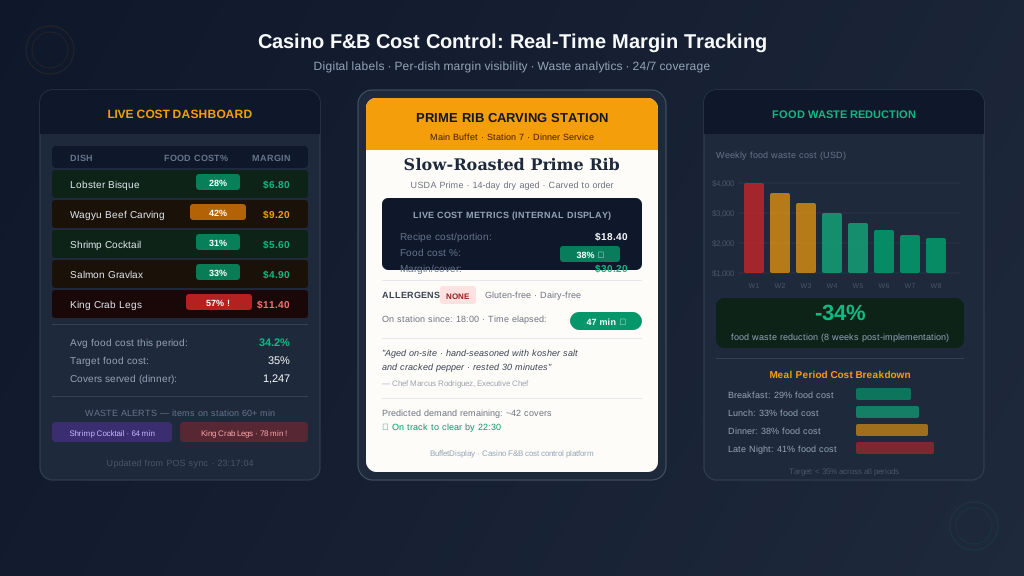
The system pulls recipe cost per portion from the kitchen management database. It tracks covers served via POS integration. The result: at any point during service, a floor manager can see which stations are running at target food cost, which are above threshold, and which dishes are driving margin loss — without going to the back office.
For a casino running a 150-item dinner buffet, identifying that the king crab station is running at 57% food cost versus the 38% target — in real time, not next week — is the difference between an operational decision (pull the crab legs at 20:00 instead of 22:00) and a reporting post-mortem.
Get the complete ROI calculator for your property
Enter your email and hotel name — we'll send the full cost-vs-paper breakdown with real numbers from comparable properties, plus a demo invite with no obligation.
No spam. Unsubscribe anytime. Your info is never shared.
Waste Tracking via Freshness Timestamps
At the 60-minute mark, the dashboard flags the item for replenishment decision: does the dish need replacing before service quality degrades, or can it run to natural depletion? Without this visibility, casino kitchens default to over-preparation to avoid gaps — the most common driver of excess food cost. With timestamp-based waste management, kitchens prepare to demand rather than to safety stock.
Hotels and resorts that have implemented this system report 25-35% reductions in buffet food waste within the first eight weeks of operation. For a large casino buffet spending $800,000 annually on buffet F&B, a 30% waste reduction is $240,000 in recovered cost. For a detailed analysis, see our post on reducing food waste with smart buffet label analytics.
Meal Period Cost Breakdown and Forecasting
Digital label platforms aggregate cost data by service period, making it possible to identify which periods are consistently above target and adjust prep quantities, menu composition, or service duration accordingly. A casino that identifies late-night as running consistently at 44% food cost might shift to a reduced-price menu after midnight to improve cover volume and bring the cost ratio into line — a decision previously invisible until the monthly P&L review.
Integrated with your POS, the system can also project remaining demand against prep quantities, alerting the kitchen when it is likely to over-prepare or under-prepare based on current cover velocity. This demand-driven preparation model is the operational standard at the best-performing casino F&B operations globally.
Frequently Asked Questions
Quellen / Sources
- 1.HFTP Casino F&B Technology Benchmarks(HFTP)
- 2.EU-Verordnung Nr. 1169/2011 (LMIV)(EUR-Lex)
See Casino F&B Cost Control in Action
BuffetDisplay integrates with casino kitchen management systems and POS to deliver per-dish margin tracking, waste alerts, and meal period analytics across your entire buffet floor.
Frequently Asked Questions
How do digital buffet labels help casino F&B cost control?
Digital buffet labels integrated with a casino kitchen management system give F&B directors real-time per-dish cost visibility at the station level. The label management platform pulls recipe cost per portion from the kitchen database, tracks covers served via POS integration, and calculates the current food cost percentage for each dish on the floor. A floor manager can identify dishes running above target food cost during service — not in a weekly report — and take immediate corrective action: adjusting portion size, swapping a dish, or pulling a high-cost item earlier in the service period. This shifts food cost management from reactive to proactive.
How do freshness timestamps reduce food waste at casino buffets?
Freshness timestamps in a digital label system log the exact time each dish is placed on the buffet. The platform tracks elapsed time and triggers management alerts at configurable thresholds — typically 45, 60, and 90 minutes depending on food type and service standards. These alerts allow kitchen managers to make informed replenishment decisions: replace a dish approaching service quality limits, reduce the portion on the next batch, or allow natural depletion rather than over-replenishing near the end of service. Casino buffets that implement freshness tracking consistently report 25-35% reductions in food waste within eight weeks, because decisions are driven by actual data rather than habitual over-preparation.
Can digital labels connect to a casino POS system for real-time cover tracking?
Yes. Digital buffet label platforms with POS integration receive cover count data from the casino floor management system in real time. This enables demand-driven preparation decisions: if cover velocity in the current hour is tracking 20% below the historical average for a Monday dinner service, the kitchen can reduce prep quantities for the second replenishment cycle. Over time, the system builds a demand forecast database by service period, day of week, and event calendar, improving preparation accuracy and reducing both waste and service gaps.
What is the ROI of digital buffet labels for casino F&B operations?
Casino F&B operations typically achieve ROI on digital label systems within 12-18 months, driven primarily by food waste reduction and staff time savings. A large casino buffet spending $800,000 annually on buffet F&B that achieves a 30% waste reduction recovers $240,000 per year. Staff time savings (label management that previously required 45-60 minutes per service period is reduced to under 5 minutes) add a further $15,000-30,000 annually for a typical casino F&B team. Allergen compliance improvements and reduced incident liability are additional value that is harder to quantify but meaningful for a gaming operation subject to regulatory inspection.
Related Articles
US Hotel Buffet Digital Labels: Real ROI Numbers, Staff Time Savings, and FDA Big 9 Compliance in One System
Paper buffet labels cost a 150-room full-service US hotel over $45,000 per year when you add printing materials, staff time at US labor rates, food waste from missing freshness cues, and allergen liability exposure. Digital e-ink buffet labels eliminate the majority of these costs and pay back in under eight months — while simultaneously satisfying FDA Big 9 FALCPA compliance and state health department documentation requirements.
Read article →Las Vegas Casino Buffets: Managing 5,000+ Covers a Day with Digital Labels
Las Vegas casino buffets are the highest-volume, most operationally complex buffet operations in the world. No closing time, four overlapping service periods, 200+ menu items, and guests from 60+ countries. Digital buffet labels built for hospitality — not retail — are the only practical solution at this scale.
Read article →Electronic Shelf Label ROI for Hotels: Real Numbers, Not Marketing Claims
The ROI case for electronic buffet labels is strong — but only if you use real numbers. Here is the actual calculation, with different scenarios for small and large properties, and what payback period to expect.
Read article →