Las Vegas Casino Buffets: Managing 5,000+ Covers a Day with Digital Labels
Why Las Vegas Buffets Are Different
A standard hotel breakfast buffet has maybe 40 menu items and runs for three hours. A Las Vegas casino dinner buffet has 150 to 250 items across stations — prime rib carving, live seafood, Asian, Italian, American classics, dessert — and it runs for six hours with continuous replenishment. Staff who are managing the buffet floor do not have time to handle paper labels between service periods.
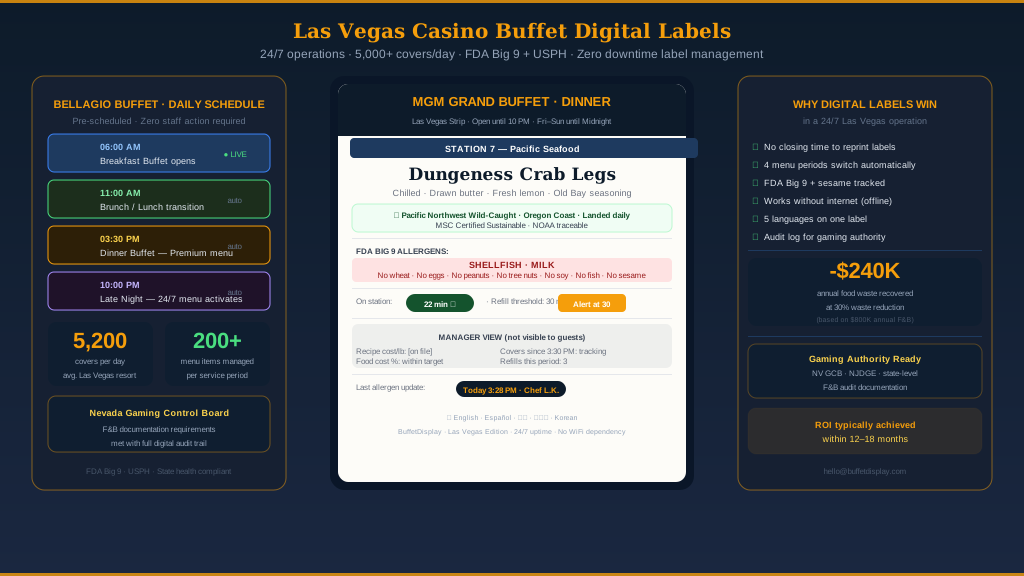
The properties that have moved to digital labels — e-ink displays managed from a central dashboard — report that the transition from one service period to the next now takes under 10 seconds. No staff action required. The system switches at the scheduled time. See how this works at the operational level in our casino buffet use case overview.
FDA Compliance in a 24/7 Operation
The compliance challenge in a 24/7 operation is not the initial setup — it is change management. A supplier changes the sesame oil in the Asian stir-fry sauce. A new bread delivery from a different vendor introduces a tree nut risk that was not in the previous recipe. In a property doing three label reprints per day across 200+ items, this change management is nearly impossible to execute reliably with paper.
Digital labels connected to the recipe management system update automatically when a recipe record changes. The update propagates to every affected label on the floor within 60 seconds. The audit log records the change, the timestamp, and the user who approved it. For a casino where a single allergen incident could generate significant liability and media attention, this documentation is operational insurance. Read more on FDA Big 9 allergen requirements for US hotels.
Nevada Gaming Authority Documentation Requirements
Digital label systems with a full audit trail provide exactly the documentation a compliance team needs: timestamped records of every allergen declaration, session-by-session menu records, and staff approval logs. Atlantic City properties under New Jersey Division of Gaming Enforcement oversight have the same documentation needs under state health code requirements.
Beyond regulatory protection, there is a brand consideration. A severe allergen incident at a named Las Vegas resort generates national news coverage. The reputational cost dwarfs the operational savings that paper labels provide. Digital allergen documentation is part of risk management, not just compliance.
Multilingual Labels for an International Guest Profile
Printing multilingual labels for 200+ items across every language combination is not feasible with paper. An e-ink label system displays two, three, or four languages on a single label simultaneously. The language priority is configured per property — English plus two secondary languages based on the property guest mix.
For casino resorts that operate internationally (MGM China, Marina Bay Sands in Singapore, Sands in Macau), a single digital label platform that handles both US Big 9 requirements and EU 14-allergen requirements from the same recipe database reduces the compliance overhead substantially.
Quellen / Sources
- 1.EU-Verordnung Nr. 1169/2011 (LMIV)(EUR-Lex)
- 2.EFSA Lebensmittelsicherheit(EFSA)
Built for Las Vegas Casino Buffet Operations
BuffetDisplay manages 24/7 casino buffet operations: four service periods on auto-schedule, FDA Big 9 allergen tracking including sesame, multilingual display, and a full audit trail for gaming authority documentation.
Frequently Asked Questions
How do digital buffet labels handle four service periods in a 24/7 Las Vegas casino operation?
Digital buffet labels for casino operations use pre-scheduled publishing to manage service period transitions without staff intervention. The F&B team pre-loads the full day schedule — breakfast, brunch/lunch, dinner, late night — into the management dashboard at the start of the week or even further in advance. At the configured transition time (for example, 3:30 PM for dinner), all labels across every station update simultaneously in under 10 seconds. No staff member needs to touch a label, visit a station, or verify a display. If a transition needs to be delayed or adjusted (a banquet running long, a VIP event extending lunch), the scheduled time can be changed from the dashboard in real time.
What FDA allergen requirements apply to Las Vegas casino buffets?
Las Vegas casino buffets must comply with the FDA Big 9 allergens under FALCPA and the FASTER Act: milk, eggs, fish, shellfish, tree nuts, peanuts, wheat, soybeans, and sesame (sesame effective January 1, 2023). Clark County health code enforcement through the Southern Nevada Health District adds local food safety requirements on top of federal standards. For casino resorts with international guests, displaying allergen information in multiple languages is a best practice even when not legally required. A digital label system that auto-updates allergen declarations when recipes change is the only reliable approach at the scale of a Las Vegas casino buffet with 150 to 250 active menu items.
Can digital buffet labels work offline in a Las Vegas casino property?
Yes. BuffetDisplay uses an offline-first architecture. Menu data and the current label schedule are cached on the local gateway device on the property network. Labels update from the local gateway, not directly from the cloud. This means a brief internet outage — not uncommon on large casino properties with complex network infrastructure — does not affect label operation. Labels continue displaying correctly, transitions continue at scheduled times, and changes made during the offline period sync to the cloud when connectivity is restored. This architecture was originally designed for cruise ships at sea but is equally relevant for large hotel and casino properties.
How do Las Vegas casino buffet labels handle multilingual requirements for international guests?
Las Vegas casino buffets routinely serve guests speaking Mandarin, Cantonese, Japanese, Korean, Spanish, Portuguese, and Arabic, among others. Digital e-ink labels can display two, three, or four languages simultaneously on a single label, depending on label size. The language priority is configured per property based on guest profile data. For a typical Las Vegas Strip casino, English plus Mandarin plus Spanish covers the majority of international guests who need language support. A digital system applies the language configuration globally, so a language update affects every label on the property instantly — unlike printed labels where a language addition requires a full reprint of every menu item.
Related Articles
Senior Living Dining Labels: Managing Complex Resident Dietary Needs with Digital Displays
Senior living dining is the most complex dietary management environment outside a hospital. Residents commonly carry three to seven simultaneous restrictions: a tree nut allergy, a diabetic diet, low sodium, and an IDDSI Level 5 texture requirement — all at once. Digital food labels that pull from resident dietary profiles and display all restrictions at the buffet station are the only reliable safeguard when dining staff turnover exceeds 60% annually.
Read article →Cruise Ship Digital Food Labels: USPH VSP Compliance, FDA Big 9, and Multilingual Display for 6,500 Passengers
A cruise ship buffet is unlike any other food service environment. Royal Caribbean Allure of the Seas serves 6,500 passengers representing 42 nationalities, 280 buffet dishes across four daily meal periods, with no reliable internet connection while at sea — and unannounced CDC inspectors who can board at any US port. Paper labels last about two hours in the humidity of a lido deck. Digital e-ink labels with offline-first architecture are the only workable solution.
Read article →US Hotel Buffet Digital Labels: Real ROI Numbers, Staff Time Savings, and FDA Big 9 Compliance in One System
Paper buffet labels cost a 150-room full-service US hotel over $45,000 per year when you add printing materials, staff time at US labor rates, food waste from missing freshness cues, and allergen liability exposure. Digital e-ink buffet labels eliminate the majority of these costs and pay back in under eight months — while simultaneously satisfying FDA Big 9 FALCPA compliance and state health department documentation requirements.
Read article →