FDA Big 9 Allergens: What Changed for US Hotel Buffets in 2023
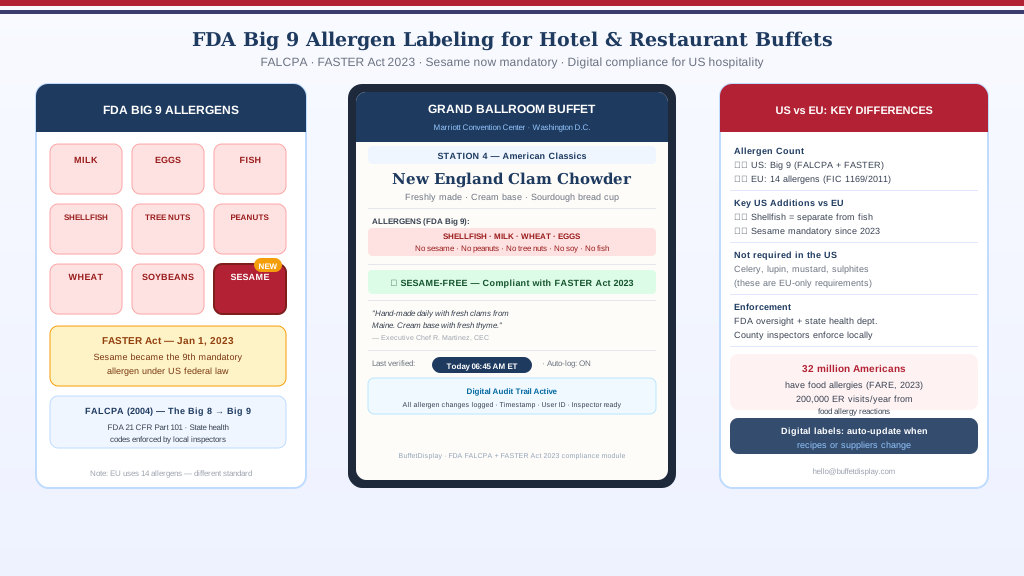
Sesame Is Now the 9th Mandatory Allergen
The practical implication for hotel F&B: any buffet label system built before 2023 was designed for 8 allergens. Sesame was not a tracked field. Switching to compliance means either updating every recipe record to include sesame status, or building sesame tracking into a new system from scratch.
This is not a theoretical issue. The FDA estimates that 1.6 million Americans have sesame allergies. Sesame appears in more buffet dishes than most F&B teams realize: hummus, tahini, falafel, Asian-inspired sauces, sesame seed buns, bagels, some bread coatings, and many spice blends. The risk of an undeclared sesame allergen incident at a hotel buffet is real — and the liability exposure under US law is significant.
Aus der Praxis / From the field
US properties within international hotel groups (Marriott, Hilton, IHG) operating under both FDA Big 9 rules and EU LMIV requirements for their European-origin guests find that the 14-allergen EU framework is typically a superset — meeting EU standards usually covers FDA compliance as well, simplifying multi-jurisdiction deployments.
The Big 8 vs Big 9: Full Comparison
Milk · Eggs · Fish · Shellfish · Tree Nuts · Peanuts · Wheat · Soybeans · Sesame (new 2023)
US requirements differ significantly from the EU standard. The EU Food Information to Consumers Regulation (FIC 1169/2011) mandates 14 allergens. The EU includes celery, lupin, molluscs, mustard, and sulphur dioxide — none of which are required disclosures under US law. Conversely, US law treats shellfish and fish as separate categories with separate declaration requirements, while some EU implementations group them.
For international hotel chains operating in both markets — Marriott, Hilton, Hyatt, IHG — this creates a compliance matrix problem. A digital label system that handles both the US Big 9 and the EU 14 from the same recipe database is simpler to manage than maintaining two separate allergen workflows. For a deeper look at EU requirements, see our EU allergen labeling guide for hotels.
What Enforcement Actually Looks Like
That said, civil liability is the bigger risk. A guest who has a sesame allergic reaction after consuming a dish that your label did not identify as containing sesame has a strong product liability claim. The defense hinges on what your allergen documentation shows at the time of service.
A digital label system with a timestamped audit log answers that question definitively. The log shows what was declared on the label at the exact time the guest visited the buffet, who approved the allergen information, and when the last recipe verification was completed. Paper labels or handwritten cards cannot provide this documentation.
Adding Sesame to Your Existing System Without Starting Over
BuffetDisplay was built after the FASTER Act took effect. Sesame is a native field in every recipe record, displayed on every label, and included in the allergen audit log by default. No workarounds, no custom configuration required.
For hotels currently running paper labels or a legacy digital system, migrating to BuffetDisplay is the shortest path to FASTER Act compliance. The recipe import process brings allergen data from your existing POS or kitchen management system and maps it to the Big 9 format, including sesame. Rollout for a typical hotel breakfast buffet takes less than a week. See our guide on setting up a hotel allergen compliance system for the full implementation steps.
Quellen / Sources
Get Your US Hotel Buffet FASTER Act Compliant
BuffetDisplay tracks all FDA Big 9 allergens — including sesame — with real-time label updates and a full audit trail for every change. Built for US hotel and restaurant operations.
Frequently Asked Questions
What are the FDA Big 9 allergens?
The FDA Big 9 are the nine major food allergens mandated for disclosure under US federal law: milk, eggs, fish, shellfish, tree nuts, peanuts, wheat, soybeans, and sesame. Sesame was added as the 9th allergen by the FASTER Act (Food Allergy Safety, Treatment, Education, and Research Act), effective January 1, 2023. Before 2023, only the Big 8 were required. The FDA estimates that together these nine allergens account for the vast majority of serious food allergy reactions in the United States, including the approximately 200,000 emergency room visits that occur annually due to food allergy reactions.
How does the US Big 9 differ from the EU 14-allergen standard?
The US mandates nine allergens under FALCPA and the FASTER Act. The EU mandates 14 allergens under Food Information to Consumers Regulation 1169/2011. The EU includes five allergens not required in the US: celery, lupin, molluscs, mustard, and sulphur dioxide/sulphites. The US treats shellfish and fish as two separate mandatory disclosures (the EU does the same, but some national implementations differ). For international hotel chains operating in both the US and Europe, a digital label system that handles both standards from a single recipe database eliminates the need for two separate compliance workflows.
What does the FASTER Act mean for hotel buffet allergen labels?
The FASTER Act, signed into law in 2021 and effective January 1, 2023, requires sesame to be declared on food labels in the United States just like the other Big 8 allergens. For hotel buffets, this means any dish containing sesame — hummus, tahini, falafel, sesame seed buns, Asian sauces, some salad dressings, and many spice blends — must clearly declare sesame as an allergen. Any hotel buffet allergen system built before 2023 may not have sesame as a tracked field. Staff manually noting sesame in a comments field introduces error risk. A digital label system with sesame as a native allergen field is the reliable solution.
How do digital buffet labels help hotels comply with the FASTER Act sesame requirement?
Digital buffet label systems built after January 1, 2023 treat sesame as a first-class allergen field in the recipe database — not a workaround or a notes field. When a recipe contains sesame (directly or through an ingredient), the sesame allergen badge appears automatically on the label. When a supplier changes an ingredient and sesame is introduced or removed, the recipe update triggers automatic label changes across every station displaying that dish. A full audit log records every allergen declaration with timestamp and approver identity. This documentation is available immediately if a guest reports a sesame allergic reaction.
Related Articles
Senior Living Dining Labels: Managing Complex Resident Dietary Needs with Digital Displays
Senior living dining is the most complex dietary management environment outside a hospital. Residents commonly carry three to seven simultaneous restrictions: a tree nut allergy, a diabetic diet, low sodium, and an IDDSI Level 5 texture requirement — all at once. Digital food labels that pull from resident dietary profiles and display all restrictions at the buffet station are the only reliable safeguard when dining staff turnover exceeds 60% annually.
Read article →Cruise Ship Digital Food Labels: USPH VSP Compliance, FDA Big 9, and Multilingual Display for 6,500 Passengers
A cruise ship buffet is unlike any other food service environment. Royal Caribbean Allure of the Seas serves 6,500 passengers representing 42 nationalities, 280 buffet dishes across four daily meal periods, with no reliable internet connection while at sea — and unannounced CDC inspectors who can board at any US port. Paper labels last about two hours in the humidity of a lido deck. Digital e-ink labels with offline-first architecture are the only workable solution.
Read article →US Hotel Buffet Digital Labels: Real ROI Numbers, Staff Time Savings, and FDA Big 9 Compliance in One System
Paper buffet labels cost a 150-room full-service US hotel over $45,000 per year when you add printing materials, staff time at US labor rates, food waste from missing freshness cues, and allergen liability exposure. Digital e-ink buffet labels eliminate the majority of these costs and pay back in under eight months — while simultaneously satisfying FDA Big 9 FALCPA compliance and state health department documentation requirements.
Read article →