Electronic Buffet Labels for Hotels: The Complete Buyer's Guide
Key Takeaways
- IP65 protection is the minimum hardware standard for hotel buffet environments — verify the certificate, not just the claim.
- EU Regulation 1169/2011 (LMIV) requires allergen information at the point of service for every dish — digital labels provide a timestamped audit trail paper cannot.
- A 50-station hotel typically goes live within two to three weeks of hardware delivery, with staff fully independent within the first week.
- The 3-year total cost of digital labels is equivalent to paper for most hotels, with zero consumable costs and dramatically less staff time after break-even.
- Always request hospitality-specific references — a vendor performing in a supermarket is not automatically qualified for steam, condensation, and chemical cleaning.
What Are Electronic Buffet Labels?
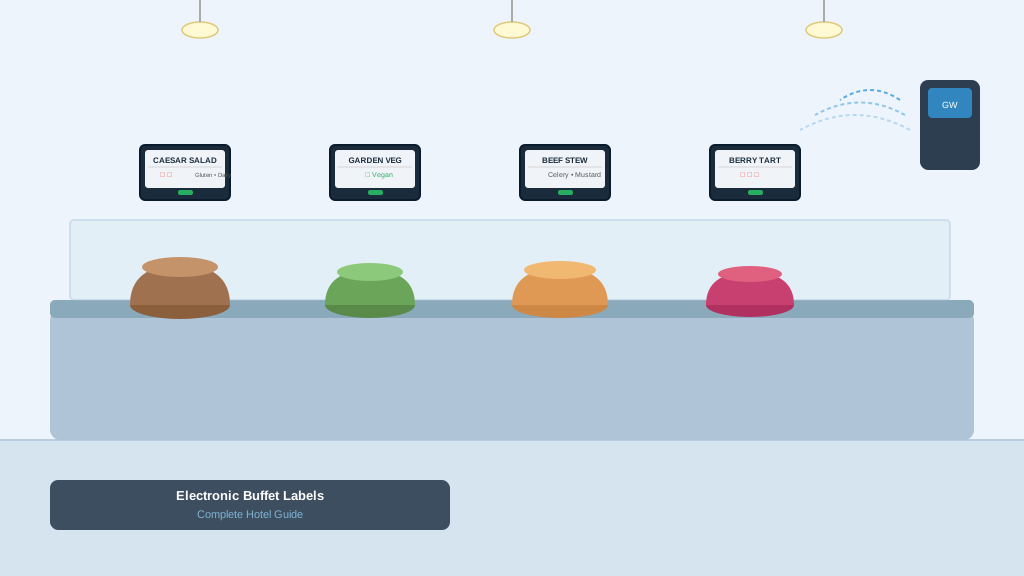
The technology has been standard in retail for over a decade. What changed recently is that hospitality-grade hardware now exists: labels built for steam, condensation, chemical cleaning, and premium visual environments — requirements that retail ESL cannot meet.
Aus der Praxis / From the field
The operational change that hotel F&B teams consistently report as most significant isn't cost — it's speed. Allergen updates that required reprinting 40+ cards and physical replacement across the buffet now take under two minutes from a browser or tablet. Morning briefings on allergen changes become a 30-second confirmation rather than a 20-minute reprint-and-distribute process.
Why Hotel Buffets Are Different From Retail Shelves
Beyond environment, the content requirements differ. A supermarket label shows one price and a barcode. A hotel buffet label must display a dish name in up to five languages, a full allergen matrix for 14 regulated substances, calorie and nutritional data, and optionally a QR code linking to the full ingredient list. That information changes multiple times per day as the buffet rotates.
This matters because a vendor whose product performs perfectly in a pharmacy chain is not automatically qualified for a 5-star hotel breakfast buffet. Always ask for hospitality-specific references.
Get the complete ROI calculator for your property
Enter your email and hotel name — we'll send the full cost-vs-paper breakdown with real numbers from comparable properties, plus a demo invite with no obligation.
No spam. Unsubscribe anytime. Your info is never shared.
5 Technical Requirements That Actually Matter
IP65 protection rating minimum
Hotel buffets expose labels to steam, condensation, and food-grade cleaning chemicals. An IP rating below IP65 (dust-tight, jet-water resistant) means hardware failure within months. Ask every vendor for the IP certificate, not just a verbal claim.
E-ink display for readability and battery life
E-ink displays are legible in direct sunlight and bright buffet lighting without glare. They only consume power when updating — a single charge lasts 2-5 years depending on update frequency. LCD alternatives show glare under buffet lighting and need replacing within 12-18 months.
Native multilingual display
Your buffet serves guests speaking 10+ languages. Labels that only display one language require separate hardware per language, multiplying hardware cost and creating placement complexity. A proper system stores all language versions centrally and switches display language per label or per zone.
Allergen-first template design
EU Regulation 1169/2011 requires clear display of 14 allergens at the point of service. Your label template must make allergens visually prominent — bold, high-contrast, ideally with icons. A system that treats allergens as a footnote in small text creates compliance risk and guest confusion.
Cloud management with timestamped audit trail
Every label change — dish name update, allergen correction, price adjustment — must be logged with a timestamp and user identity. Without an audit trail, you have no documentation if an allergen incident occurs. This is not optional; it is your legal protection.
EU Allergen Labeling: What Hotels Are Actually Required to Do
The 14 regulated allergens are: cereals containing gluten, crustaceans, eggs, fish, peanuts, soybeans, milk, tree nuts, celery, mustard, sesame, sulphur dioxide and sulphites, lupin, and molluscs.
The UK operates equivalent requirements under the Food Information Regulations 2014, extended under Natasha's Law for broader food service contexts. Switzerland applies similar requirements under the Lebensmittelinformationsverordnung (LIV). Hotels operating across multiple countries must comply with the strictest applicable standard — typically EU FIC.
Paper labels can technically satisfy the regulation, but they create compliance risk that digital systems eliminate: handwritten allergen information is prone to transcription error, labels can be displaced or swapped between dishes, and there is no audit trail when an incident occurs. Hotel breakfast buffets — the highest-volume, highest-turnover buffet context — carry the most exposure.
Paper Labels vs Electronic Buffet Labels: Side-by-Side
Update speed
Paper: 10–20 minutes staff time per update cycle, requires printing or handwriting. Electronic: instant — push from dashboard, all labels update simultaneously within seconds.
Allergen accuracy
Paper: human error on every manual update; no way to verify what is currently displayed. Electronic digital buffet tags: single source of truth synced from recipe database; changes propagate to all labels without retyping.
Multilingual support
Paper: separate physical labels per language, or a shared card with cramped multi-language text. Electronic: all languages stored per dish, displayed simultaneously or switched per zone with no additional hardware.
Compliance documentation
Paper: no audit trail; incident investigation relies on staff memory. Electronic: timestamped log of every change with user identity — complete documentation for health authority inspections.
3-year total cost (50 stations)
Paper: €35,000–€45,000 in staff labor, materials, and management time. Electronic: €9,000–€14,000 all-in including hardware, platform, and setup. Break-even typically in month 4–6.
"We had an allergen incident in 2023 traced to a mislabeled breakfast buffet item. After switching to digital labels, we have a complete audit trail for every change. That compliance record is worth more than any cost saving."
— Head of F&B, 4-star hotel group, Central Europe
Common Mistakes When Evaluating Suppliers
Underestimating the content management workflow. Hardware is the easy part. The critical question is: how many steps does it take to update one label? If the answer involves logging in, searching, opening an edit screen, saving, confirming, and triggering a sync — your staff will revert to paper within weeks. During any trial period, test the complete update workflow under realistic conditions: a dish name change, an allergen addition, and a last-minute menu swap.
Ignoring system integration. If your labels do not connect to your kitchen management system or recipe database, staff must enter data twice — once in the kitchen system and once in the label platform. This reintroduces the same error risk as paper labels, with more expensive hardware. Before selecting a vendor, map your existing systems (PMS, recipe software, F&B management tools) and ask specifically what integration is available, not what is "on the roadmap".
What Implementation Actually Looks Like
Week 1: Hardware mounting and gateway installation — typically a two-hour session with a certified engineer. Gateways connect via standard Ethernet or Wi-Fi; no structural changes required.
Week 2: Content migration — uploading dish names, allergen matrices, descriptions, and translations into the management platform. Most properties already have this data in a spreadsheet or recipe system; migration is usually a one-time import, not manual entry.
Week 3: Staff training (typically 45–90 minutes) and a soft launch with one buffet section. Most F&B teams are fully independent on the system within the first week of live use.
After go-live, the morning buffet setup — previously 45–60 minutes of label printing, writing, and placement — typically drops to under 10 minutes. The time saving compounds daily and is one of the most immediate operational benefits reported by properties switching from paper.
Questions to Ask Every Vendor Before Buying
1. What is the IP rating of the label hardware, and can you provide the test certificate?
2. Which hotel brands or groups are current customers — can I speak with an F&B reference?
3. How does the system integrate with [your specific PMS or kitchen software]?
4. What is the update latency from dashboard save to label display?
5. Where is data stored, and what is the uptime SLA for the cloud platform?
6. What happens to label content if the internet connection drops?
7. What is included in the annual platform fee versus what triggers additional charges?
8. How long is the hardware warranty, and what is the replacement process for a failed label?
Related Resources
Frequently Asked Questions
Quellen / Sources
- 1.EU-Verordnung Nr. 1169/2011 (LMIV)(EUR-Lex)
- 2.EFSA-Risikobewertung Lebensmittelallergene(EFSA)
- 3.hotelleriesuisse Lebensmittelkennzeichnung(hotelleriesuisse)
See Electronic Buffet Labels in a 20-Minute Demo
BuffetDisplay works with hotels from boutique properties to international chains. Book a demo to see the full platform workflow, ask technical questions, and get configuration pricing for your property.
Frequently Asked Questions
What are electronic buffet labels and how do they differ from traditional label holders?
Electronic buffet labels use e-ink display technology — the same used in e-readers like Kindle. They show crisp text and icons without any power consumption while displaying static content. Unlike traditional card holders where staff insert printed cards, e-ink labels update wirelessly from a central dashboard in seconds. No printing, no physical handling, no lamination. The label content changes; the hardware stays at the buffet station permanently.
How much do electronic buffet labels cost for a hotel?
Hardware for a 50-station buffet costs 8,000-20,000 EUR depending on display size and brand. Annual software subscription adds 1,500-4,000 EUR. Over 5 years, total cost is typically 15,500-36,000 EUR — significantly less than paper labels at 34,000-50,000 EUR over the same period when consumables and staff time are included. Most hotels achieve ROI within 8-14 months.
Can electronic buffet labels display allergen icons for all 14 EU allergens?
Yes. BuffetDisplay e-ink labels show allergen icons for all 14 EU allergens defined in Regulation 1169/2011. Icons are configurable for allergen present versus trace amounts. The labels can simultaneously display dish name, allergen icons, dietary category tags (vegan, halal, etc.), and freshness timestamps — all on a single display without needing multiple label slots per dish.
What hardware infrastructure is needed for electronic buffet labels in a hotel?
The only infrastructure required is a gateway device (similar in size to a WiFi router) placed in the F&B office, connected to the hotel network. No cables run to the buffet. Labels communicate wirelessly with the gateway using a proprietary radio protocol with range covering a full buffet restaurant. For hotels with multiple restaurants, additional gateways are placed per venue. Battery-powered labels last 3-7 years between replacements.
Related Articles
How to Set Up an Allergen Compliance System for Your Hotel Buffet
A 7-step guide for hotel F&B teams implementing an allergen compliance system from scratch: baseline audit, data source selection, display system choice, database configuration, change management, staff training, and go-live verification.
Read article →Digital Food Labels for Corporate Cafeterias
Corporate staff cafeterias face employer duty-of-care for allergen compliance under EU Regulation 1169/2011. Digital food label systems deliver the audit trail, daily rotation management, and dietary transparency that hotel buffets rely on — adapted for corporate catering scale.
Read article →University and School Cafeteria Digital Food Labels: Student Dining Allergen Compliance
University cafeterias face unique allergen compliance pressures: students with severe allergies living away from home for the first time, high-volume rush service, and rotating daily menus. Digital e-ink food labels solve all three — updating allergens instantly across multiple dining halls without extra staff.
Read article →