University and School Cafeteria Digital Food Labels
Why Campus Dining Allergen Risk Is Different
The Campus Dining Menu Challenge: Volume, Rotation, and Diversity
A mid-size university residential cafeteria typically serves 400 to 800 covers at lunch peak, offers 20 to 35 hot dishes per service, and rotates the menu completely every four to six weeks. Student populations skew toward higher rates of dietary restrictions than the general adult population: vegan rates of 8 to 15 percent are common, with significant halal and kosher requirements at urban universities, and a large number of students managing medically-diagnosed food allergies. Paper labels cannot keep up. Handwritten cards deteriorate during service, are left unlabelled when a dish is swapped at short notice, and are frequently moved by students — creating cross-contamination of information even when the actual food is handled correctly. The printing queue for a weekly menu change at a large campus dining operation can take half a working day. With digital e-ink labels, the same change takes under ten minutes and propagates to every station in every hall simultaneously. When a recipe is modified mid-service — a sauce changed because an ingredient ran out — the allergen update appears on the label before the dish reaches the serving counter. For campus dining teams managing a rotating calendar of recipe changes, this instant sync between the recipe database and the physical label is the single biggest operational improvement.
Multi-Hall Deployment: One Dashboard, Every Dining Hall
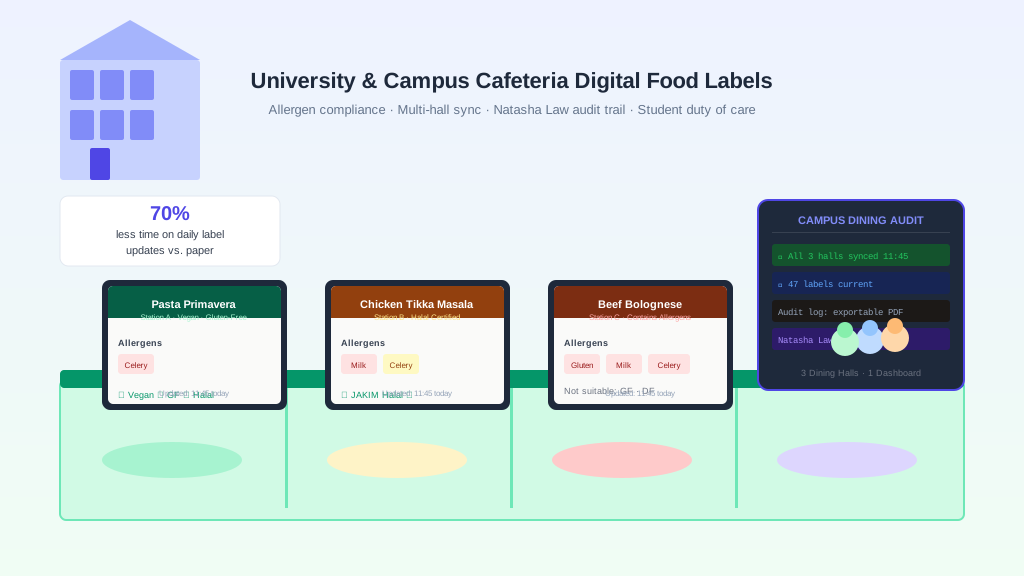
Large universities operate multiple residential dining halls, a main student union cafeteria, satellite cafes, and sometimes sports facility kitchens — all potentially serving food that carries allergen obligations. With a paper or static label system, each location manages its own labels independently, creating risk that a menu change communicated by email is not implemented at one of the sites. Electronic buffet label systems solve this at the architecture level: a single web dashboard controls every label across every location. A menu manager updating the pasta dish to note that the sauce now contains celery pushes that change to every dining hall label at once. There is no risk that one hall misses the update. The same system generates a time-stamped log of when each update was made and confirmed — documentation that can be produced immediately in the event of an incident or audit. Campus catering teams at institutions with two or three dining halls have found that central label management cuts the time spent on daily label updates by around 70 percent, allowing kitchen staff to focus on food preparation rather than label administration.
Regulatory Compliance and Audit Trails for University Health Teams
University health and safety teams and external environmental health officers increasingly request evidence of allergen management procedures, not just a description of those procedures. A digital food label system provides this automatically: every menu change, every allergen field update, and every label refresh is logged with a timestamp and the user account that made the change. This creates the kind of documented compliance trail that satisfies both internal university governance and external regulatory inspection. For institutions in the UK operating under Food Information to Consumers (FIC) regulations and Natasha's Law, the ability to demonstrate that Pre-Packed for Direct Sale items had accurate allergen information at point of sale is particularly important. For EU universities, the same FIC framework applies. Campus dining managers who have implemented digital label systems report that their confidence in regulatory compliance has improved substantially — not because the information is different, but because it is verifiable. The label that was on the counter at 12:15 on Tuesday is documented in the system log. That audit capability has material value when an incident occurs.
Quellen / Sources
- 1.EU-Verordnung Nr. 1169/2011 (LMIV)(EUR-Lex)
- 2.EFSA Lebensmittelallergene(EFSA)
Protect Your Students and Simplify Campus Dining Compliance
See how digital e-ink food labels work in a multi-hall university dining environment — and how the system generates the audit documentation your health and safety team needs.
Frequently Asked Questions
How do digital food labels help university cafeterias with allergen compliance?
University cafeterias face an unusually high duty of care: many students are managing severe food allergies independently for the first time, often with anaphylaxis risk. Digital e-ink food labels display all 14 EU allergens as icons at the point of selection, allowing students to make safe choices without needing to ask staff during a busy service period. When a recipe is changed — a sauce swap, an ingredient substitution — the allergen update propagates to every label across every dining hall simultaneously, eliminating the risk that one station carries outdated information during a peak rush.
Does a digital cafeteria label system generate an audit trail for Natasha's Law compliance?
Yes. Digital buffet label systems log every menu change, allergen field update, and label refresh with a timestamp and user account. This creates a documented audit trail that can be exported and presented to university health and safety teams or environmental health officers. For UK institutions operating under Natasha's Law (which requires accurate allergen labeling for Pre-Packed for Direct Sale food), the ability to demonstrate that the label displayed at a specific time matched the recipe's allergen profile is particularly valuable. Paper-based systems cannot produce this documentation.
Can one label system manage multiple campus dining halls from a single dashboard?
Yes. A single management dashboard controls every e-ink label across all dining locations — main cafeteria, residential halls, sports cafes, and satellite outlets. When the campus nutrition team updates a recipe allergen profile, the change propagates to every label at every location simultaneously. This eliminates the risk of one dining hall missing an allergen update communicated by email. The centralized architecture also means a single login can produce a consolidated audit report for all sites, which simplifies compliance documentation for the campus food safety team.
How much time do university cafeterias save with digital food labels vs paper?
Campus dining teams with 20 to 35 daily menu items typically spend 2 to 3 hours per day printing, laminating, and positioning paper labels, plus additional time correcting errors and responding to late recipe changes. A digital label system reduces this to under 30 minutes for the equivalent task — updating the management dashboard, with labels refreshing wirelessly across all stations. For multi-hall operations, the saving is proportionally higher. Teams consistently report that digital labels allow kitchen staff to focus on food preparation rather than label administration during the pre-service preparation window.
Related Articles
Digital Food Labels for Corporate Cafeterias
Corporate staff cafeterias face employer duty-of-care for allergen compliance under EU Regulation 1169/2011. Digital food label systems deliver the audit trail, daily rotation management, and dietary transparency that hotel buffets rely on — adapted for corporate catering scale.
Read article →How to Set Up an Allergen Compliance System for Your Hotel Buffet
A 7-step guide for hotel F&B teams implementing an allergen compliance system from scratch: baseline audit, data source selection, display system choice, database configuration, change management, staff training, and go-live verification.
Read article →Natasha's Law for Hotels and Catering: Buffet Allergen Labeling Compliance Guide 2026
Natasha's Law (October 2021) requires full ingredient listing and allergen emphasis labeling on all PPDS food in UK hospitality. Hotels with breakfast buffets, grab-and-go counters, and pre-portioned conference catering face significant compliance obligations. Digital e-ink labels provide the audit trail and instant-update accuracy that paper systems cannot.
Read article →