Digital Food Labels for Corporate Cafeterias
The Employer Duty of Care in Staff Dining
The allergen compliance framework applicable to corporate cafeterias follows food service regulations in most EU and UK jurisdictions. EU Regulation 1169/2011 and its national implementations do not distinguish between hospitality and workplace catering: if food is served to third parties in a catering context, allergen information must be available at point of service. For self-service buffet formats — the most common corporate cafeteria format — this means allergen declaration at each dish position.
The enforcement trend is toward requiring documented evidence of the system used, not just declarations that allergen information was provided. An employer responding to a staff allergen incident with a printed paper trail from handwritten labels, or no trail at all, is in a substantially weaker legal position than one with a digital audit log showing exactly what was displayed at the exact time the employee selected that dish.
Large employers with corporate governance obligations — listed companies, public sector organizations, regulated industries — are increasingly including food safety systems in their risk management frameworks. Facilities management teams responsible for on-site catering contracts now routinely specify allergen audit trail capability as a requirement in catering service contracts.
The Operational Reality of High-Volume Staff Cafeterias
Compressed service window. Hotel breakfasts run 2-3 hours with guests arriving continuously. A corporate lunch may serve 70% of its daily covers in 45 minutes — the window between 12:00 and 12:45 when most employees take their break. Setup errors discovered at 11:50 AM cannot be corrected before service starts.
Daily menu rotation as standard. Most corporate catering contracts specify daily menu rotation across a rolling 4-week cycle to prevent meal fatigue. This means the label set changes entirely every day — not just seasonal items, but every dish at every station. A staff cafeteria with 30 positions running daily rotation creates approximately 6,500 label-change events per year, each one an opportunity for human error in a paper system.
Dietary diversity at scale. The working population of a 1,000-person office includes a representative cross-section of dietary requirements: estimated 2-4% with clinical food allergies, 10-15% following specific diets (vegan, halal, kosher, low-FODMAP, diabetic management), and a larger proportion with dietary preferences. Digital systems that display dietary tags at each dish enable this population to self-select confidently, reducing the staff time spent answering allergen queries during the compressed lunch rush.
Digital Labels vs Paper and Chalkboard in Corporate Settings
Chalkboard/whiteboard: Fast to update but impossible to audit, difficult to standardize across multiple serving stations, and prone to legibility issues. Allergen information on a chalkboard cannot be photographed as compliance evidence in a useable form — the content is ephemeral by design.
Printed paper labels: More professional than handwriting but time-consuming to produce and vulnerable to the daily change requirement. In cafeterias with daily rotation, the print-cut-place-discard cycle consumes 45-90 minutes of staff time daily. Errors occur when labels from previous days are reused, when labels printed for similar dishes are swapped, or when the person placing labels is not the person who reviewed allergen accuracy.
Verbal staff communication: Entirely unscalable for allergen compliance purposes and creates direct liability exposure — there is no record of what was communicated, and staff knowledge of allergen status varies by individual and shift.
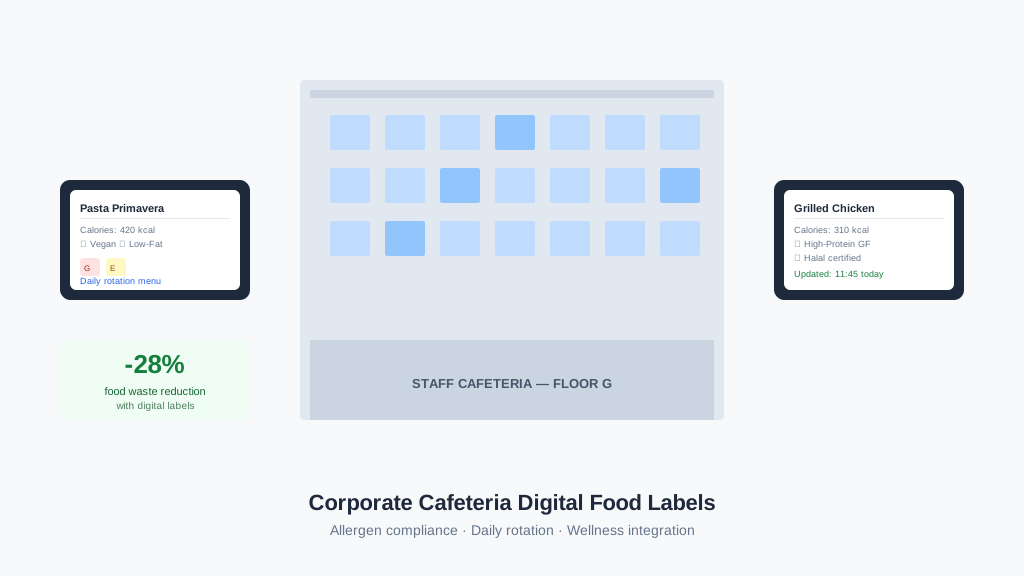
Digital e-ink labels replace all three with a single system that logs every change, updates instantly across all stations when a recipe is modified, and requires staff time only for verification (checking the displayed content matches the dish) rather than for production (printing, cutting, placing). For a 30-station cafeteria with daily rotation, this typically reduces daily label management time from 60-90 minutes to 10-15 minutes.
Nutritional Transparency and Wellness Program Integration
The most common wellness program integrations in corporate cafeteria digital label deployments:
Calorie and macronutrient display. Displaying calorie counts per portion at each dish position is a regulatory requirement in some jurisdictions (UK businesses with 250+ employees, US chain restaurants under FSMA) and a wellness program standard in many corporate catering contracts. Digital labels that pull nutritional data from the recipe system can display this automatically, with no additional staff input when menus change.
Healthy choice indicators. Many corporate wellness programs identify "balanced choices" or "recommended" dishes according to nutritional criteria agreed between the caterer and the employer. Digital labels with a dedicated healthy choice icon field allow these designations to be applied and updated at the recipe level, appearing automatically on the label without creating a separate label production process.
Carbon footprint labeling. A growing segment of corporate catering contracts, particularly in sustainability-committed organizations, specifies per-dish carbon footprint estimates. Digital labels that can carry a CO2 indicator field alongside allergens and nutrition support this requirement without requiring a different label format or additional print run.
Bring Digital Allergen Labels to Your Staff Cafeteria
BuffetDisplay e-ink labels bring hotel-grade allergen compliance and menu management to corporate cafeteria operations. Daily rotation support, full audit trail, and wellness data display in one system.
Frequently Asked Questions
Are corporate cafeterias required to display allergen information?
Yes. EU Regulation 1169/2011 and its national implementations apply to workplace catering in the same way as restaurant and hotel food service. Any food served to staff in a self-service or buffet format must have allergen information available at the point of service — not only on request. UK law post-Natasha has similar requirements. Employers operating corporate cafeterias are exposed to the same compliance and liability risks as hospitality operators.
What is the best allergen labeling system for a corporate staff cafeteria?
For cafeterias with daily menu rotation serving 200+ covers, digital e-ink labels are the most practical solution. They update automatically when recipes change, maintain a timestamped audit log for compliance defense, and reduce daily label management time from 60-90 minutes (paper) to 10-15 minutes (digital verification only). Systems originally designed for hotel buffets — such as BuffetDisplay — translate directly to corporate cafeteria environments.
Can corporate cafeteria labels display nutritional information alongside allergens?
Yes. Digital label systems that pull data from a central recipe management system can display calories, macronutrients, and dietary certifications (vegan, halal, kosher, low-calorie) alongside the 14 EU allergens. This makes a single label system suitable for both allergen compliance and corporate wellness program requirements — including calorie display mandates that apply to large UK and US employers.
How does digital labeling reduce food waste in corporate cafeterias?
Digital labels with clear dietary and allergen information allow employees with specific requirements to identify suitable dishes quickly, rather than avoiding dishes they cannot evaluate. This broader participation reduces the proportion of food produced for guests who effectively cannot access it. Freshness timestamps on labels also improve guest confidence in food condition, increasing consumption of properly fresh items rather than discarded as uncertain.
Related Articles
How to Set Up an Allergen Compliance System for Your Hotel Buffet
A 7-step guide for hotel F&B teams implementing an allergen compliance system from scratch: baseline audit, data source selection, display system choice, database configuration, change management, staff training, and go-live verification.
Read article →Digital Buffet Labels for All-Inclusive Resorts
All-inclusive resorts managing 6-12 dining venues need digital buffet labels that handle outdoor pool bar stations, automatic meal period transitions, and multilingual display for international guests — with one central management dashboard.
Read article →University and School Cafeteria Digital Food Labels: Student Dining Allergen Compliance
University cafeterias face unique allergen compliance pressures: students with severe allergies living away from home for the first time, high-volume rush service, and rotating daily menus. Digital e-ink food labels solve all three — updating allergens instantly across multiple dining halls without extra staff.
Read article →