Digital Buffet Labels for All-Inclusive Resorts
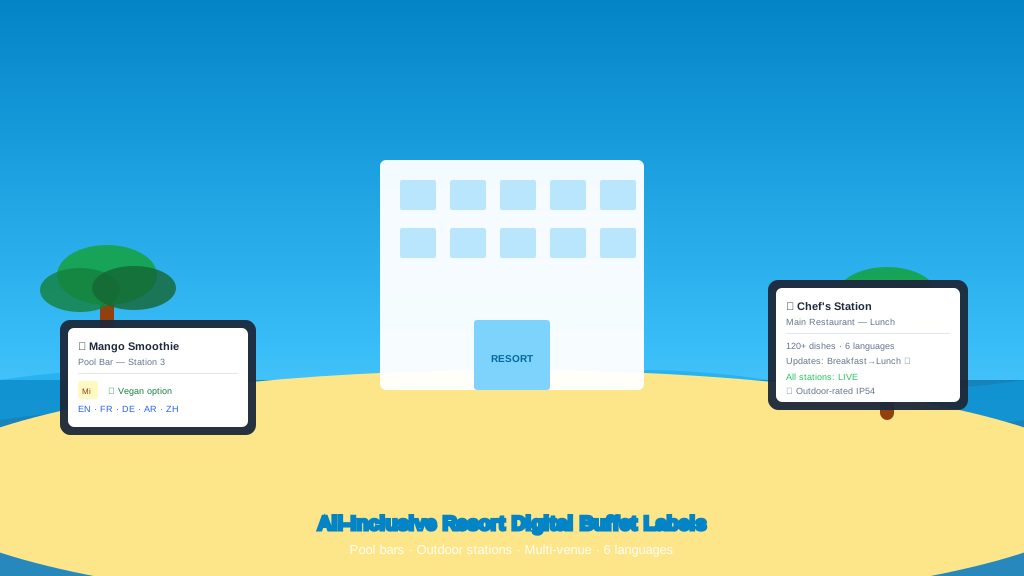
The All-Inclusive Buffet Challenge: Scale, Speed, and Languages
At 2 minutes per label (print, cut, place, check) for a daily rotation, this is 7-10 hours of F&B staff time daily — just for label management, before anything else is done. For a property with EUR 25/hour labor costs, this is EUR 63,750-90,000 per year in label labor alone. For a property running seasonal promotions, cocktail menus, and weekly theme nights on top of regular menus, the actual number is higher.
The language dimension adds another layer of complexity. All-inclusive guests from Germany, France, Russia, Brazil, and the UK at the same property expect to be able to read the buffet labels in their language. A paper label system printing in 4 languages runs 4x the paper and ink costs and requires label sets to be maintained independently for each language, with the risk that the French set is updated but the German set is not when a recipe changes.
Outdoor and Pool Bar Specific Requirements
Direct sunlight. A paper label in direct Caribbean or Mediterranean sun fades within hours. LCD and tablet screens wash out completely in direct sunlight — the screen becomes unreadable. E-ink displays use ambient light reflection (like paper) and are actually more readable in bright sunlight than in dim lighting. They maintain full contrast regardless of sunlight intensity.
Humidity and salt air. Laminated paper labels degrade at pool areas. The lamination peels, the paper absorbs humidity at the edges, and salt air accelerates adhesive failure. E-ink labels in IP54-rated housings are sealed against moisture and salt. The display element has no degradation mechanism related to humidity.
Wind. Paper labels in outdoor holders blow away, require weighted bases, and need manual checking after weather events. E-ink labels are passive sealed units — wind has no effect on them.
No power access at remote stations. Pool bars and beach stations typically have limited power access. Running power cables to label positions is expensive and creates safety hazards at wet areas. E-ink labels run for 3-5 years on battery — no power access needed at any label position.
All-Inclusive Menu Rotation and the Label Management Burden
The weekly rotation problem. A 4-week rotation means that every 7 days, every label in every venue changes. A paper label system must complete a full venue-wide label replacement weekly. With 6 venues and 35-50 positions per venue, this is 210-300 label replacements every Monday — a task that typically takes an F&B team 3-4 hours if organized efficiently.
The theme night problem. A Friday Caribbean night with different dishes at every station means every label changes from Thursday dinner to Friday dinner. If Saturday reverts to the regular menu, every label changes again. A property running theme nights twice weekly has effectively doubled its weekly label management workload.
The multi-venue synchronization problem. When a safety issue requires removing a dish from service (suspected contamination, supplier quality issue, ingredient unavailability), every label for that dish across all 6 venues must be updated immediately. In a paper system, this requires sending a team member to each venue to manually replace labels. In a digital system, the dish is removed from service in the management dashboard and all labels across all venues update within 60 seconds. The food safety response is faster, more complete, and documented with a timestamp.
The operational case for digital buffet labels at all-inclusive resorts is stronger than at any other property type precisely because the volume of changes is highest and the consequences of inconsistent labels — across multiple languages, multiple venues, multiple daily service periods — are most visible to guests.
Get BuffetDisplay for Your All-Inclusive Property
BuffetDisplay handles the entire all-inclusive label management workflow: 6 venues, 4 languages, daily rotation, outdoor stations, and food safety pull-from-service — all from one dashboard. One manager can update every label across every venue simultaneously.
Frequently Asked Questions
How do all-inclusive resorts manage buffet labels across multiple venues?
All-inclusive resorts with 6-12 dining venues face the most complex buffet label management challenge in hospitality. A digital label system with one central dashboard allows one F&B manager to update labels across all venues simultaneously. When a dish changes or a safety issue requires pulling an item from service, all labels across all venues update within 60 seconds — a task that would take 2-3 hours with paper labels.
Do e-ink labels work at outdoor pool bars and beach restaurants?
Yes. E-ink labels are better suited than any alternative for outdoor F&B environments. They are more readable in direct sunlight (e-ink uses reflected light like paper), sealed against humidity and salt air in IP54-rated housings, and require no power access at the station — battery life runs 3-5 years. Paper labels fade, peel, and blow away in outdoor conditions; LCD tablets wash out in sunlight and require daily charging.
How does multilingual buffet labeling work at all-inclusive resorts?
All-inclusive resorts serving guests from multiple countries typically display labels in 4-6 languages simultaneously. Digital e-ink labels support multilingual display with language-specific character sets on the same label. When a recipe changes, all language versions update together from one change in the central recipe database, eliminating the risk of one language version being outdated while others are current.
What is the ROI of digital buffet labels at an all-inclusive resort?
For an all-inclusive resort with 6 venues and 35-50 label positions per venue, digital labels typically achieve ROI within 8-12 months. The primary savings are staff time (210-300 label changes per day at paper label rates consumes 7-10 staff hours daily) and multilingual label printing costs. Properties with daily menu rotation and theme nights see the fastest payback because each menu change event costs the same in digital (seconds of manager time) versus paper (hours of staff time).
Related Articles
Digital Food Labels for Corporate Cafeterias
Corporate staff cafeterias face employer duty-of-care for allergen compliance under EU Regulation 1169/2011. Digital food label systems deliver the audit trail, daily rotation management, and dietary transparency that hotel buffets rely on — adapted for corporate catering scale.
Read article →The Hidden Cost of Handwritten Buffet Labels
Most hotels spend thousands each year on paper labels without realizing it. We break down the true cost of manual buffet labeling — and show when digital pays for itself.
Read article →How to Manage Multilingual Buffet Labels Without Creating an Allergen Risk
Multilingual labels sound simple until you consider character sets, allergen accuracy, screen size limits, and what happens when an automated translation gets a nut wrong. A practical guide for international hotels.
Read article →