EU Allergen Labeling Requirements for Hotels in 2026
Key Takeaways
- The EU LMIV framework has not changed materially in 2026, but enforcement intensity has increased — BVL inspections in Germany and cantonal audits in Switzerland are more frequent.
- Germany, Austria, and Switzerland implement LMIV through slightly different national instruments (BVL guidance, ÖNORM, LIV respectively) — the core requirements are the same but enforcement style differs.
- The documentation burden of LMIV compliance — specifically the allergen audit trail — is practically only achievable at scale with a digital system.
- Hotels with a documented digital allergen management system are materially better positioned in regulatory audits than those relying on manual records.
The Regulation Landscape
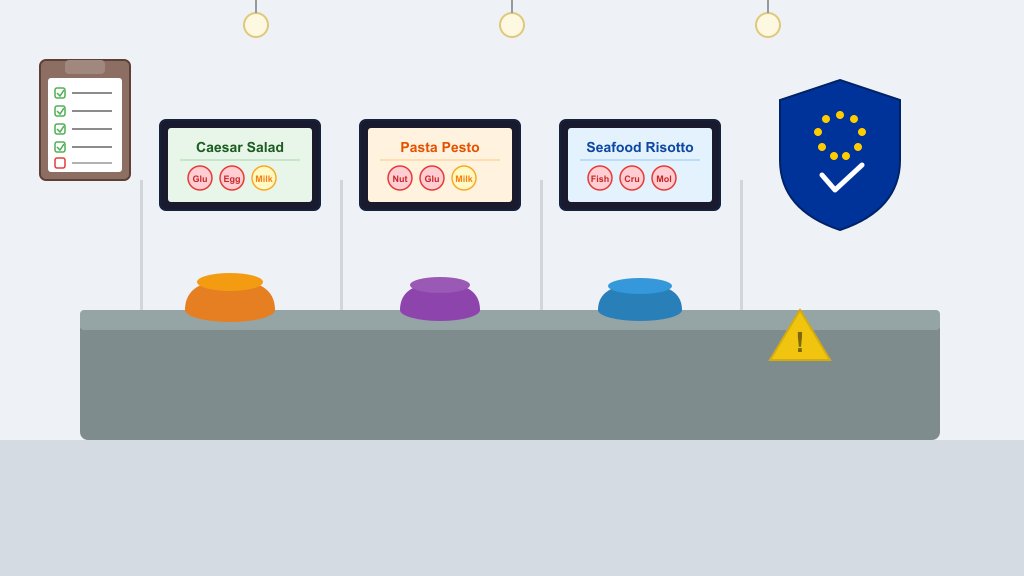
EU Regulation 1169/2011 (FIC) requires all food businesses — including hotels — to declare the presence of 14 major allergens for every dish served. This applies to buffets, room service, restaurants, and event catering. The regulation isn't new, but enforcement has intensified significantly since 2024, with inspectors now specifically checking buffet labeling during routine audits.
Aus der Praxis / From the field
BVL inspectors in Germany increasingly flag allergen-free items that lack the required declaration — not just mislabeled allergens. The LMIV requires that the absence of a mandatory allergen be communicated as clearly as its presence. An item with no gluten must say so; silence is not compliant. Digital systems pre-populate the full allergen matrix for every dish, including negative declarations.
The 14 Allergens You Must Declare
Every EU member state requires the same 14 allergens to be declared: cereals containing gluten, crustaceans, eggs, fish, peanuts, soybeans, milk, nuts, celery, mustard, sesame, sulphites, lupin, and molluscs. For buffets, this information must be available at the point where guests make their food choices — not hidden in a binder at the front desk.
Get the complete ROI calculator for your property
Enter your email and hotel name — we'll send the full cost-vs-paper breakdown with real numbers from comparable properties, plus a demo invite with no obligation.
No spam. Unsubscribe anytime. Your info is never shared.
What Inspectors Actually Check
Point-of-choice labeling
Allergen info must be visible where guests select food, not just available on request
Accuracy and currency
Labels must reflect today's actual menu — not yesterday's or a generic version
Language accessibility
Information should be understandable to international guests, not just in the local language
Staff knowledge
Staff must be able to answer allergen questions and know where to find accurate information
Country-Specific Requirements
While the EU regulation is harmonized, individual countries add their own requirements. Switzerland follows its own food law (LGV/LIV) with similar allergen requirements. Germany requires allergen declarations in written form. France mandates that allergen information be available in French. Austria requires specific signage formats. Hotels operating across borders must navigate all of these simultaneously.
The Paper Label Problem
Paper labels are a compliance nightmare. Menus change daily. Ingredients get substituted. Suppliers update their allergen declarations. A handwritten label from this morning might be inaccurate by lunch. And when an inspector arrives, there's no audit trail showing what was displayed when. Digital labels solve this by updating in real-time from your kitchen system and maintaining a complete compliance log.
Fines and Liability
Non-compliance penalties vary by country but can reach €50,000 or more per violation. More significantly, if a guest has an allergic reaction due to missing or incorrect labeling, the hotel faces potential criminal liability. Insurance claims for allergen incidents average €25,000-€100,000, and the reputational damage can cost far more in lost bookings.
"Since switching to digital labels, our allergen compliance went from a constant worry to a non-issue. The system updates automatically when the kitchen changes a recipe, and we have a complete audit trail for every inspection."
— Executive Chef, 5-star hotel in Vienna
How Digital Labels Ensure Compliance
For more information, see our hotel breakfast buffet display solution.
Country-Specific Enforcement: What Changed in 2025-2026
Germany (BVL/LAVES): Systematic unannounced inspections of hotel buffets are conducted in tourist-heavy regions. Inspectors have issued formal warnings and fines where allergen information was incomplete, inconsistent, or could not be produced in verifiable form on request. Digital audit trails have become a standard evidence point in inspections.
France (DGCCRF): Following several high-profile allergen incidents in food service across Europe, French food safety enforcement (DGCCRF) has focused attention on hotel restaurants and buffets. The DGCCRF specifically assesses whether the information system (paper or digital) provides reliable information at the point of service, not just on request at a counter.
UK (FSA/local authorities): Post-Brexit allergen requirements remained aligned with EU standards. Natasha's Law (2021) raised awareness significantly. The FSA has issued updated guidance for buffet-style service emphasising the need for consistent allergen information at each dish position.
Switzerland (FSVO/OSAV): Switzerland adopted equivalent allergen declaration requirements through the Food Information Ordinance (LIV). Cantonal food inspectors apply these during routine hotel inspections.
What a Food Safety Inspector Looks for at a Hotel Buffet
Completeness: Are all 14 allergens declared for each dish? Inspectors take photographs of buffet labels and cross-reference them against the recipe database provided on request.
Accuracy: Does the information on the label match what is in the recipe? Inspectors may request supplier specification sheets and compare them against the declared allergens.
Accessibility: Can a guest access allergen information at the point of serving without having to ask staff? Labels at each dish position satisfy this requirement; information only available on request does not consistently satisfy it.
Audit trail: If a guest reports an allergic reaction from a specific dish at a specific time, can the hotel demonstrate what was displayed on the label at that moment? Digital systems provide a timestamped audit log. Paper systems typically cannot provide this evidence.
Hotels that maintain a digital buffet label system with an audit trail are in a substantially stronger position on items 1, 3, and 4 above than those using paper labels.
Related Resources
Frequently Asked Questions
Quellen / Sources
Make Allergen Compliance Effortless
See how digital buffet labels automate allergen declarations across all your food service areas.
Frequently Asked Questions
What EU regulation governs allergen labeling in hotels?
EU Regulation No 1169/2011 on the provision of food information to consumers (FIC) requires food businesses including hotel restaurants and buffets to declare the 14 major allergens in any food they serve, whether packaged or unpackaged.
Do hotel buffets need to display allergen information?
Yes. Hotel buffets serving unpackaged food must provide clear allergen information for every dish. This applies to breakfast buffets, lunch buffets, dinner buffets, and catering events. Staff must be able to provide this information on request and it must be accessible without guest assistance.
What are the fines for allergen non-compliance in EU hotels?
Penalties vary by country but range from formal warnings to fines of 1,000-50,000 EUR per incident. More significantly, an allergen reaction causing injury can result in civil liability and reputational damage far exceeding any regulatory fine.
How are the UK allergen requirements different from EU requirements post-Brexit?
The UK maintained equivalent requirements through the Food Information for Consumers Regulation (FIC UK). Natasha Law (effective October 2021) added additional requirements for pre-packaged-for-direct-sale foods, but hotel buffet allergen requirements remain essentially equivalent to EU standards.
Related Articles
How to Set Up an Allergen Compliance System for Your Hotel Buffet
A 7-step guide for hotel F&B teams implementing an allergen compliance system from scratch: baseline audit, data source selection, display system choice, database configuration, change management, staff training, and go-live verification.
Read article →Allergen Compliance in the Digital Age
Learn how digital solutions are making allergen compliance easier and more reliable for food service establishments.
Read article →Digital Food Labels for Corporate Cafeterias
Corporate staff cafeterias face employer duty-of-care for allergen compliance under EU Regulation 1169/2011. Digital food label systems deliver the audit trail, daily rotation management, and dietary transparency that hotel buffets rely on — adapted for corporate catering scale.
Read article →