Natasha's Law for Hotels and Catering: Buffet Allergen Labeling Compliance Guide 2026
What Is Natasha's Law?
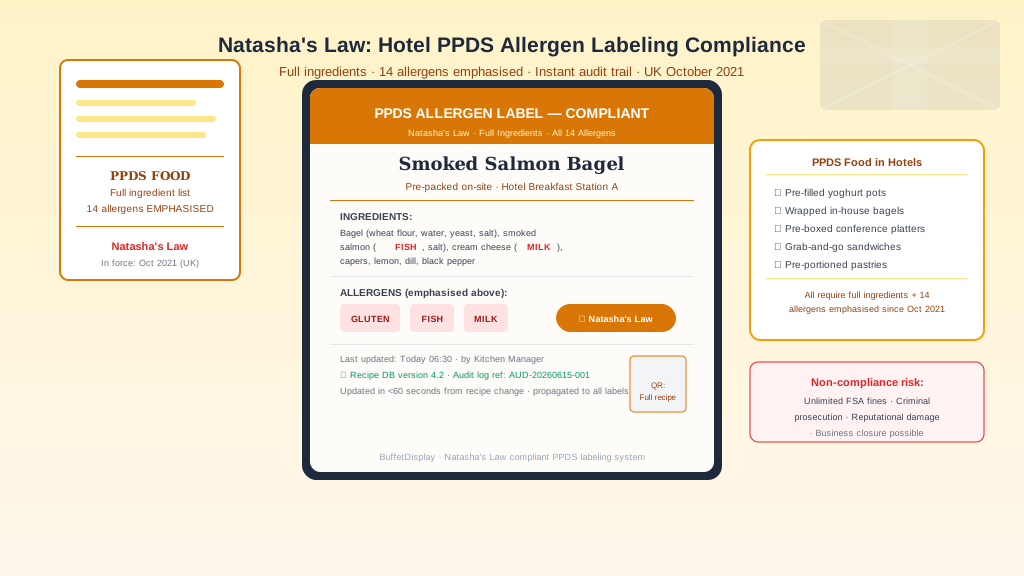
Natasha's Law is the informal name for the Food Information (Amendment) (England) Regulations 2019, which came into force on 1 October 2021. It was introduced following the death of Natasha Ednan-Laperouse, a teenager who suffered a fatal allergic reaction after eating a baguette that did not carry allergen information. The law requires that all Pre-Packed for Direct Sale food must carry full ingredient lists with the 14 major allergens emphasised — typically by bold text, colour, or capitalisation. PPDS food is defined as food that is packaged at the same site where it is sold before the customer places an order. This category includes: pre-filled bread rolls and sandwiches at hotel breakfast stations, pre-portioned pastries and individual cake slices at grab-and-go counters, catering platters pre-assembled for conference or banquet service, and any food item wrapped or boxed at the kitchen before being placed on a buffet or counter. The critical distinction from the previous law is that PPDS food previously required only allergen highlighting if any labeling was present at all — Natasha's Law made full ingredient listing mandatory.
Which Hotel Food Operations Are Affected?
The scope of Natasha's Law is broader than many hotel operators initially realised. Any food that is packaged at your kitchen and then placed out for self-selection falls into the PPDS category. In hotel contexts, this commonly includes: breakfast buffet items pre-portioned by kitchen staff (individual yoghurt pots filled on-site, pre-sliced fruit pots, pre-filled overnight oats jars), grab-and-go counters selling pre-wrapped sandwiches and snacks made in-house, conference and banquet catering where boxes or platters are pre-assembled before guests arrive, afternoon tea items prepared and packaged in advance, and in-room dining items packaged in the kitchen before delivery. Food that is not packaged — a hot buffet item served by staff directly from a chafing dish, for instance — falls under the looser allergen information rules rather than Natasha's Law PPDS requirements. However, the allergen information still needs to be available and accurate. The practical effect for most hotel F&B operations is that multiple stations and service styles require different levels of allergen documentation, managed simultaneously by the same kitchen team.
The Documentation Challenge: Why Paper Fails
Meeting Natasha's Law on paper creates a compliance risk at the point of recipe change. A hotel kitchen that changes a bread roll recipe — switching to a flour that contains sesame, or adding a dairy-based glaze — must update every PPDS label across every packaged item before that batch goes out. In practice, this means reprinting and relabelling every affected item. The failure mode is not deliberate non-compliance; it is the gap between a recipe change communicated by a chef and the label catching up with that change. For pre-portioned breakfast items, this gap can span an entire service period. Digital e-ink label systems eliminate this gap. When a recipe changes in the management dashboard, every label connected to that recipe updates simultaneously — whether displayed at the breakfast counter, the grab-and-go station, or the conference suite prep area. The system logs the timestamp of the update, creating the audit trail that environmental health officers increasingly request during inspections. This is not just operational efficiency; for Natasha's Law compliance, it is the difference between a defensible system and a liability.
Digital Labels and Natasha's Law: What the System Provides
Hotels operating in the United States face a parallel but distinct allergen framework: the FDA Big 9 under FALCPA (Food Allergen Labeling and Consumer Protection Act 2004), with sesame added as the ninth mandatory allergen under the FASTER Act, effective January 1, 2023. The US list differs from the UK/EU list — notably it does not include celery, lupin, molluscs, mustard, or sulphites, but does mandate sesame separately from the EU position. International hotel groups managing properties in both the UK and the US must configure their label systems for both frameworks simultaneously. For the full US regulatory picture, see our FDA Big 9 allergen labeling guide for US hotel buffets.
Staff Training and the Verbal Information Obligation
Natasha's Law compliance is not solely a labeling question. The Food Information Regulations also require that allergen information be provided verbally if a customer asks — regardless of what is written on a label. This means kitchen staff and front-of-house staff need to know the current allergen content of every dish, and to be able to answer accurately under time pressure during service. Digital label systems support this indirectly by ensuring the label is always current, meaning staff can refer a customer to the label with confidence rather than needing to check with the kitchen. When the label is accurate and up to date, it functions as a reliable reference point for staff and customers alike. Hotels that have implemented digital labeling systems report that staff confidence in allergen responses has improved significantly — not because the allergens changed, but because staff know the label can be trusted.
Quellen / Sources
- 1.EU-Verordnung Nr. 1169/2011 (LMIV)(EUR-Lex)
- 2.EFSA Lebensmittelsicherheit(EFSA)
Make Your Hotel Natasha's Law Compliance Audit-Ready
See how digital e-ink labels provide the PPDS allergen display, instant recipe-change propagation, and audit trail documentation that Natasha's Law compliance requires.
Frequently Asked Questions
What is Natasha's Law and which hotels does it affect?
Natasha's Law (Food Information (Amendment) (England) Regulations 2019) came into force on 1 October 2021. It requires full ingredient listing with the 14 major allergens emphasised on all Pre-Packed for Direct Sale (PPDS) food — food that is packaged at the same site where it is sold before the customer orders. For hotels, this covers: breakfast items pre-portioned by kitchen staff (filled yoghurt pots, wrapped pastries), grab-and-go counters with in-house sandwiches, pre-assembled conference catering boxes, and afternoon tea items packaged before service. Hot buffet items served directly by staff do not qualify as PPDS, but allergen information must still be available for those.
What does 'allergen emphasis' mean under Natasha's Law?
Under Natasha's Law, the 14 major allergens must be 'emphasised' relative to the surrounding ingredient list text. In practice, this means each allergen name within the full ingredient list must be visually distinct — typically achieved through bold text, a different colour, or capitalisation (e.g. 'wheat FLOUR' or 'cream cheese (MILK)'). The emphasis must appear within the ingredient list itself, not just as a separate allergen summary. Digital e-ink label systems allow the display format to be configured to automatically emphasise allergen terms when they appear in the ingredient text, removing the risk of inconsistent formatting across different label designs.
What audit documentation does Natasha's Law require for hotels?
Natasha's Law does not prescribe a specific audit format, but environmental health officers increasingly expect hotels to demonstrate: (1) that allergen information is accurate and matches the current recipe at the time the item is sold, (2) that there is a process for updating labels when recipes change, and (3) that staff are trained to provide accurate allergen information verbally on request. A digital label system with timestamped change logs provides documentation for points 1 and 2 automatically. For point 3, staff training records are kept separately. The combination of digital label logs and training records creates the kind of documented compliance trail that protects a business in the event of an incident or prosecution.
Does Natasha's Law apply to EU hotels or only UK?
Natasha's Law applies only in England (with equivalent laws in Scotland, Wales, and Northern Ireland). It is a post-Brexit UK regulation. EU hotels and catering businesses are governed by the EU Food Information to Consumers (FIC) Regulation (EU No. 1169/2011), which has different PPDS rules — EU law requires allergen information to be available for PPDS food but does not mandate full ingredient listing on the label itself (this may be provided verbally or via a menu). However, EU FIC requirements for open food (non-PPDS buffet items) apply equally, and many EU jurisdictions are moving toward stricter documentation requirements. A digital label system built for Natasha's Law compliance typically exceeds EU FIC requirements as well.
Related Articles
UK Natasha's Law & Hotel Buffet Food Labeling: PPDS Compliance Guide 2026
Natasha's Law (the UK Food Information (Amendment) Regulations 2019) came into force on 1 October 2021, requiring full ingredient and allergen labeling on Pre-Packed for Direct Sale (PPDS) food. For hotel buffets, breakfast operations, and grab-and-go stations, this guide covers what counts as PPDS vs loose food at a hotel, the 14 UK-retained allergens, how UK requirements differ from EU FIC post-Brexit, and how wireless e-ink BuffetDisplay labels help hotels maintain continuous Natasha's Law compliance.
Read article →University and School Cafeteria Digital Food Labels: Student Dining Allergen Compliance
University cafeterias face unique allergen compliance pressures: students with severe allergies living away from home for the first time, high-volume rush service, and rotating daily menus. Digital e-ink food labels solve all three — updating allergens instantly across multiple dining halls without extra staff.
Read article →