Natasha's Law: UK Hotel Buffet Allergen Labeling in 2026
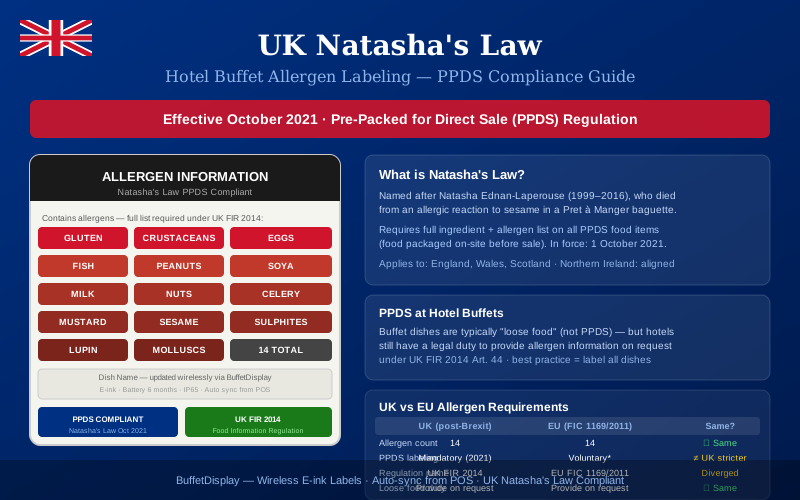
Natasha's Law — formally the Food Information (Amendment) Regulations 2019, which amended the UK Food Information Regulations 2014 (UK FIR) — became law on 1 October 2021. Named after Natasha Ednan-Laperouse, a 15-year-old who died in 2016 after an allergic reaction to sesame seeds in a Pret à Manger baguette that had no allergen label, the law requires full ingredient and allergen information on any food that is Pre-Packed for Direct Sale (PPDS).
For hotel operations — including buffet breakfast, afternoon tea stations, grab-and-go counters, and in-room dining — understanding the boundary between PPDS food and loose food determines your specific labeling duties under UK law.
What is PPDS Food at a Hotel?
Pre-Packed for Direct Sale (PPDS) food is food that is packaged at the same premises where it is sold directly to the consumer. At a hotel, common PPDS scenarios include:
PPDS food at hotels (full Natasha's Law labeling required):
- Individual pastries, muffins, or sandwiches wrapped in cling film or plastic packaging by hotel kitchen staff and placed on a buffet display or grab-and-go counter
- Pre-made portion pots of yoghurt, granola, or fruit salad wrapped in the hotel kitchen
- Boxed packed lunches prepared and packaged on-site for conference delegates
- Pre-wrapped afternoon tea sandwiches placed on a tiered stand
- Room service snack bags assembled and sealed in the hotel kitchen
Loose/unpackaged food at hotels (not PPDS — different rules apply):
- A live buffet where dishes are placed in serving trays open to the guest to serve themselves
- Plated breakfast items served to order by waiting staff
- Food cooked and plated in front of guests at a live station
- A breakfast bar where guests select individual fruit pieces, bread, or cheese from open display
The critical distinction: If the food is packaged BEFORE the customer chooses it — and the packaging happens in the same premises — it is PPDS and requires a full ingredient and allergen label under Natasha's Law. If the food is unpackaged or packaged only at the point of customer selection, it is loose food.
Loose food duty under UK FIR 2014 Article 44: Even for loose/unpackaged buffet food, hotels must be able to provide allergen information on request. The information must be accurate, available to customers before purchase, and can be provided verbally by trained staff, in writing on a menu or label, or digitally. Best practice — strongly recommended by the UK Food Standards Agency (FSA) — is to label all dishes with allergen information, even when not strictly required by the PPDS rule.
Aus der Praxis / From the field
Following Natasha's Law implementation, a UK Food Standards Agency survey found that 34% of hospitality businesses initially struggled with the 'prepacked for direct sale' definition in buffet contexts. Digital label systems that store full ingredient and allergen data centrally removed that ambiguity — the source of truth is always the database, not a manually-typed card.
The 14 UK-Retained Allergens (Post-Brexit)
When the UK left the EU, it retained the EU's 14 mandatory allergens under UK domestic food law (UK FIR 2014, as amended). These remain identical to the EU FIC list:
- Cereals containing gluten — wheat, rye, barley, oats, spelt, Kamut, and their hybridised strains
- Crustaceans — prawns, crab, lobster, crayfish, barnacles
- Eggs — including products made from eggs
- Fish — all fish species (not crustaceans or molluscs)
- Peanuts — including peanut oil and groundnut products
- Soybeans — soy, soya, tofu, tempeh, edamame
- Milk — including lactose, butter, cheese, cream, casein, whey
- Nuts — almonds, hazelnuts, walnuts, cashews, pecan nuts, Brazil nuts, pistachio, macadamia, Queensland nuts
- Celery — including celeriac and celery seed
- Mustard — including mustard seeds, mustard leaf, mustard oil
- Sesame seeds — including tahini, sesame oil (the allergen that killed Natasha Ednan-Laperouse)
- Sulphur dioxide and sulphites — where added at concentrations of more than 10 mg/kg or 10 mg/L expressed as SO₂
- Lupin — lupin seeds, lupin flour (used in gluten-free products)
- Molluscs — squid, octopus, scallops, oysters, clams, abalone, snails
UK vs EU post-Brexit divergence:
- The 14 allergens remain the same in both regimes
- Key difference: the UK's PPDS Natasha's Law (full labeling on all PPDS food) goes further than EU FIC Article 44, which only requires allergen info to be available on request for PPDS food — it does not mandate full ingredient labeling on PPDS
- The UK FSA has announced it is reviewing whether to add sesame to the gluten-free threshold rules and whether to tighten PPDS rules further post-2026
Scotland, Wales, and Northern Ireland: Natasha's Law applies across Great Britain (England, Scotland, Wales) — each devolved nation has equivalent legislation. Northern Ireland operates under the NI Protocol/Windsor Framework and applies EU FIC rules, which means NI is not subject to the Natasha's Law PPDS requirement in the same way — but in practice most NI food businesses apply the GB standard.
Hotel F&B Operations Most Affected by Natasha's Law
The Natasha's Law PPDS requirement creates compliance pressure in several specific hotel food service scenarios:
Breakfast buffet with pre-wrapped items:
Many hotel breakfast buffets include a mix of live food (open-display pastries, fruit, chilled items in open dishes) and PPDS items (individual portions wrapped in cling film or put into cups/pots). The PPDS items require full labeling. An e-ink label per PPDS item with full allergen declaration is the cleanest compliance solution.
Conference and events catering:
Boxed lunches, working lunch platters, and delegate snack bags assembled in the hotel kitchen are almost always PPDS. Full ingredient + allergen labeling is mandatory for every item. Hotels doing large conference volumes — 200+ delegates/day — typically use a print-on-demand or digital labeling system to apply per-item labels efficiently.
Grab-and-go stations:
Hotel lobby grab-and-go or retail areas selling pre-wrapped sandwiches, wraps, salads, and snacks assembled in the hotel kitchen are clearly PPDS. These require the highest compliance attention because customers select and consume these items without staff interaction.
In-room dining amenity trays:
Pre-assembled mini bar snacks, welcome amenity plates, or turn-down sweets assembled and wrapped in the hotel kitchen are PPDS if the guest hasn't yet ordered them.
Afternoon tea:
Pre-plated or pre-wrapped afternoon tea items are PPDS if wrapped before the guest orders. Traditional plated-to-order service is loose food.
Staff dining / associate restaurants:
Natasha's Law technically applies to all PPDS food sold to consumers — UK enforcement agencies take the position that staff canteens are included where pre-wrapped food is sold. Hotels operating staff dining facilities with pre-wrapped options should apply the same labeling standards.
FSA Enforcement and Penalties for Non-Compliance
Natasha's Law enforcement in the UK is handled by local authority Environmental Health Officers (EHOs) and Trading Standards departments. The Food Standards Agency (FSA) provides national oversight and publishes enforcement data.
Enforcement approach (2021–2026):
Following the October 2021 implementation date, the FSA indicated an initial "education-first" approach for the first 12–18 months. By 2023, enforcement shifted to active compliance checks. EHOs inspect food businesses during routine visits and can conduct unannounced inspections of hotel kitchens and food service areas.
What inspectors look for at hotel buffets:
- Accurate allergen information available for all loose food (verbal, written, or digital)
- Full ingredient + allergen labeling on all identifiable PPDS items
- Staff training records demonstrating allergen awareness
- Cross-contamination controls and HACCP documentation referencing allergen management
- Consistency between what is labeled and what ingredients are actually in the food
Penalties:
- Under the Food Safety Act 1990 (as amended) and Food Information Regulations 2014: providing misleading allergen information is a criminal offence
- Maximum penalty: unlimited fine and/or up to 2 years imprisonment for serious offences
- Minor non-compliance: formal improvement notice, followed by prosecution if not remedied
- Local authority discretion: most EHOs will work with hotels to achieve compliance rather than immediately prosecute first-time, low-risk non-compliance
Food Hygiene Rating Scheme (FHRS):
Allergen management is assessed as part of the FHRS (the star rating visible on the front door of UK food businesses). Poor allergen documentation can reduce a hotel's star rating — directly visible to guests. This reputational risk is a significant driver for hotel compliance investment.
The audit trail requirement:
The UK FSA guidance states that businesses should maintain records that can demonstrate how they obtain, store, and communicate allergen information. Digital labeling systems like BuffetDisplay provide a time-stamped audit trail of every allergen declaration change — exactly the documentation format preferred by EHOs during inspection.
How Digital E-ink Labels Help Hotels Meet Natasha's Law
Wireless e-ink digital labels address the core operational challenge of Natasha's Law compliance for hotel buffets: keeping allergen information accurate, current, and consistently displayed across a high-volume food service operation.
The paper label compliance problem:
Many UK hotels initially responded to Natasha's Law by printing paper allergen cards or labels. This creates persistent problems:
- When a recipe changes, multiple paper labels must be reprinted and physically replaced — during live service
- Paper labels can fall off, get wet, become illegible, or be replaced incorrectly
- There is no audit trail of when information was last updated
- High-volume buffets (200-bed hotels serving 3 meal periods) require reprinting and replacing dozens of labels daily
E-ink label advantages for Natasha's Law compliance:
- Instant wireless updates: when a dish recipe changes, allergen information updates across all labels simultaneously from the central management dashboard — no physical label replacement required during service
- Audit trail: every allergen change is time-stamped and logged — the exact documentation format that FSA guidance recommends for due diligence
- Consistency: the same allergen declaration appears identically on every label — no handwritten variations, no transcription errors
- Legibility: e-ink displays maintain clear, high-contrast text in all lighting conditions, including outdoor terraces and dark atmospheric dining rooms
- Battery life: 6-month battery life means labels remain operational through extended service periods without maintenance
- Water resistance: IP65-rated labels withstand condensation and cleaning near buffet stations
CalcMenu integration for UK hotels:
Hotels using CalcMenu (EGS's recipe management system) benefit from native integration: allergen data flows automatically from CalcMenu recipe level → BuffetDisplay label. When a chef modifies a recipe in CalcMenu — changing an ingredient, substituting a sauce, adding a topping — the allergen recalculation happens automatically and propagates to BuffetDisplay labels within seconds. This is the most robust Natasha's Law compliance architecture available: the allergen data at the label originates from the recipe database, not from manual data entry.
UK Hotels vs EU Hotels: What Changes Post-Brexit
For hotel chains operating across both the UK and EU (e.g., Marriott, Hilton, IHG, Accor properties), understanding where UK requirements now diverge from EU FIC is operationally important.
| Requirement | UK (UK FIR + Natasha's Law) | EU (FIC 1169/2011) |
|---|---|---|
| Number of major allergens | 14 | 14 |
| PPDS full ingredient labeling | ✅ Mandatory (Natasha's Law 2021) | ❌ Not required — allergen info on request |
| Loose food allergen provision | On request or proactively | On request |
| Regulation governing | UK FIR 2014 (as amended 2019) | EU FIC Regulation No. 1169/2011 |
| Enforcement body | Local authority EHOs + FSA | Member state food authorities |
| Allergen list changes | Requires UK Parliament/FSA | Requires EU Commission amendment |
What this means in practice:
- A hotel in Paris has the same 14 allergens but does NOT have Natasha's Law — PPDS food needs allergen info available on request, not necessarily a full label
- A hotel in London with the same PPDS sandwich must display a full ingredient list AND allergen declaration directly on the packaging
- Hotel chains can use a single allergen database (same 14 allergens) but need to apply different labeling rules at UK vs EU properties
Scotland and Wales notes:
- Scotland and Wales have equivalent legislation — the same Natasha's Law requirement applies across Great Britain
- Scotland has been more proactive in FSA allergen enforcement; Scottish EHOs have issued improvement notices to hospitality businesses for allergen non-compliance at higher rates than England
- Welsh Language Act considerations: Welsh food businesses may choose to provide allergen information in Welsh, though English is always acceptable
Practical Natasha's Law Compliance Checklist for Hotel F&B
A practical checklist for UK hotel Food & Beverage teams to assess and achieve Natasha's Law compliance:
Step 1: Classify all your food formats
- ✅ Walk through every F&B outlet and service point
- ✅ Identify every food item — is it PPDS, loose, or pre-packed by someone else (not PPDS)?
- ✅ Document the classification with photos — your evidence if inspected
Step 2: Label all PPDS food
- ✅ Every PPDS item must display: name of food, full ingredient list, allergens highlighted (bold, italic, or different colour)
- ✅ The allergen highlight must be clearly distinguishable from the rest of the ingredient list
- ✅ Labels must be accurate and up-to-date at the point of sale
Step 3: System for loose food allergen provision
- ✅ Every menu item (buffet dishes, plated service, breakfast stations) must have allergen information available
- ✅ If using verbal provision: all front-of-house staff must be allergen-trained and able to answer questions accurately
- ✅ If using written/digital provision: labels or menus must be accurate and current
- ✅ Keep written records of allergen information (allergen matrix per dish)
Step 4: Cross-contamination controls
- ✅ Document cross-contamination risks in your HACCP plan
- ✅ Train kitchen team on cross-contamination prevention (separate utensils, separate preparation areas, sequencing)
- ✅ Establish a procedure for handling allergen requests during service
Step 5: Training records
- ✅ All food handlers: basic allergen awareness training
- ✅ All front-of-house staff who interact with guests: allergen query training
- ✅ Supervisors and head chefs: comprehensive allergen management training (e.g., Highfield Level 2 or 3 Award in Food Allergen Awareness)
- ✅ Keep training completion records with dates — FSA inspectors will ask to see these
Step 6: Audit trail
- ✅ Record every allergen information change: what changed, when, who made the change
- ✅ Digital labeling systems with automatic change logs satisfy this requirement automatically
- ✅ If using paper: maintain a dated allergen matrix version history
Quellen / Sources
- 1.Natasha's Law — UK Food Information Amendment Regulations 2019(Food Standards Agency)
- 2.EU-Verordnung Nr. 1169/2011 (LMIV) — EU-Referenzrahmen(EUR-Lex)
Ready to Achieve Natasha's Law Compliance at Your Hotel?
BuffetDisplay wireless e-ink labels provide the audit trail, instant-update capability, and consistent display quality that UK hotels need for Natasha's Law compliance. Labels update in under 30 seconds when allergen information changes — with a time-stamped log of every change. Used by hotels across the UK, Europe, and worldwide.
Frequently Asked Questions
What is Natasha's Law and which UK hotel food operations does it apply to?
Natasha's Law (formally the Food Information (Amendment) Regulations 2019, amending UK FIR 2014) came into force on 1 October 2021. It requires a full ingredient list with allergens emphasised on all Pre-Packed for Direct Sale (PPDS) food — food packaged at the same premises where it is sold before the customer requests it. At a hotel, Natasha's Law applies to: pastries or sandwiches wrapped in cling film by kitchen staff and placed on a breakfast buffet, pre-portioned grab-and-go items (yoghurt pots, fruit salad cups), pre-assembled conference lunch boxes, and afternoon tea items packaged before service. It does NOT apply to live buffet dishes placed in serving trays or plated-to-order service — those are "loose food" under UK FIR 2014 Article 44, which requires allergen information to be available on request rather than pre-labeled. However, the UK Food Standards Agency strongly recommends labeling all buffet dishes proactively regardless of whether they are technically PPDS or loose.
What are the 14 allergens required under UK food law post-Brexit?
The UK retained the EU's 14 major allergens under UK domestic food law (UK FIR 2014) post-Brexit. The 14 are: (1) cereals containing gluten (wheat, rye, barley, oats, spelt, Kamut), (2) crustaceans, (3) eggs, (4) fish, (5) peanuts, (6) soybeans, (7) milk (including lactose, butter, cheese, cream, casein, whey), (8) nuts (almonds, hazelnuts, walnuts, cashews, pecan, Brazil, pistachio, macadamia), (9) celery (including celeriac), (10) mustard (including mustard seeds), (11) sesame seeds (the allergen that killed Natasha Ednan-Laperouse — now prominently required), (12) sulphur dioxide and sulphites (at >10 mg/kg or 10 mg/L as SO₂), (13) lupin (used in gluten-free products), (14) molluscs (squid, octopus, oysters, clams, scallops). The number remains 14 — the same as EU FIC — but UK and EU rules have diverged on PPDS: the UK requires full ingredient labeling on PPDS food under Natasha's Law, while EU FIC only requires allergen information to be "available on request" for PPDS, not a full label.
How does Natasha's Law differ from EU FIC for hotel buffets?
For hotel buffets, the key Natasha's Law vs EU FIC difference is the PPDS labeling obligation. In the UK, if your hotel kitchen pre-wraps pastries, sandwiches, or portion pots before display, those items must carry a full ingredient list with allergens highlighted — Natasha's Law, mandatory since October 2021. In the EU, PPDS food only needs allergen information to be available on request; a full label is not required (though many EU hospitality groups apply it voluntarily as best practice). Both UK and EU require the same 14 allergens to be declarable and both require allergen information to be available for loose/open buffet food on request. The enforcement context also differs: UK hotels are inspected by local authority Environmental Health Officers (EHOs) and receive a Food Hygiene Rating (the star rating on the door) that reflects allergen compliance — poor allergen management can reduce a hotel's star rating, creating direct reputational pressure. EU enforcement varies by member state but similarly ties allergen compliance to food business registration.
What is the best digital labeling solution for Natasha's Law compliance at hotel buffets?
Wireless e-ink digital labels are the most operationally practical Natasha's Law compliance solution for hotel buffets. The compliance challenge with Natasha's Law is not knowing which dishes are affected — it is keeping allergen information accurate and current across a high-volume food service operation where dishes change daily. Paper labels require reprinting and physical replacement during live service every time a recipe changes, creating gaps in accuracy. E-ink labels solve this: when a dish allergen profile changes, the update propagates wirelessly to the display within 30 seconds from the central management dashboard — no physical label replacement, no service disruption. BuffetDisplay also provides a time-stamped audit trail of every allergen change, which is precisely the due diligence documentation format recommended by the UK FSA. For hotels using CalcMenu (EGS's recipe management system), allergen data flows from CalcMenu recipe ingredients automatically to BuffetDisplay labels — so when a chef changes an ingredient, allergen recalculation and label update happen automatically with zero manual input. This is the most robust available architecture for Natasha's Law continuous compliance.