School Cafeteria USDA NSLP Digital Food Labels
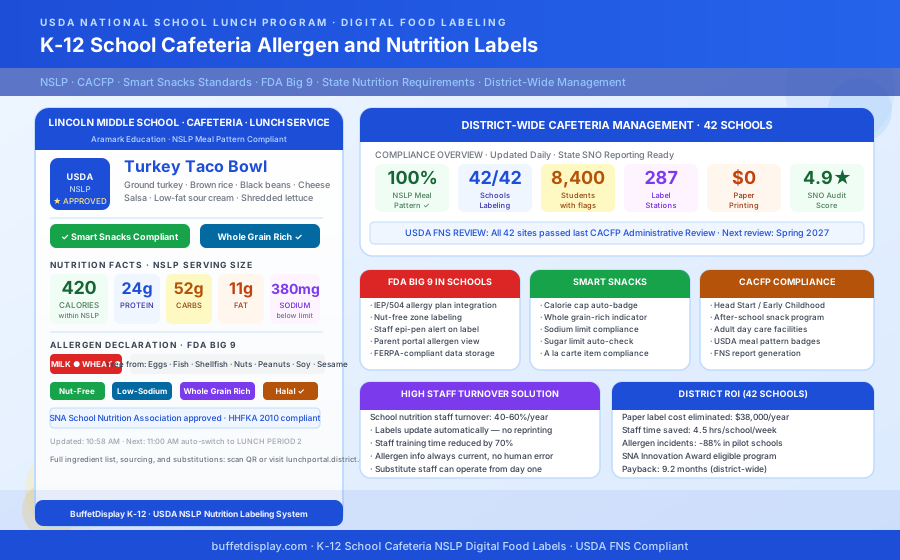
USDA NSLP Meal Pattern and Smart Snacks Requirements
The USDA National School Lunch Program (NSLP) requires reimbursable meals to meet specific components: a whole grain-rich grain portion, a protein or meat alternate, vegetable servings, a fruit serving, and a milk component. Labels in school cafeterias must identify which components are included in the NSLP reimbursable meal and confirm that calorie and sodium limits are met. The Healthy, Hunger-Free Kids Act (HHFKA 2010) established current nutrition standards; 2022 updates strengthened sodium and added-sugar limits further. State School Nutrition Officials (SNOs) conduct Administrative Reviews of NSLP operations — label accuracy and allergen declaration are specific inspection items. Digital labels auto-flag when a dish does not meet NSLP calorie thresholds (550 calories for grades K-8, 750 for grades 9-12), sodium limits (740mg), or whole grain requirements. Smart Snacks in School standards apply to all competitive foods sold a la carte. Calorie limits are 350 calories for entree items and 200 calories for snacks. BuffetDisplay badges a la carte items as Smart Snacks compliant or non-compliant automatically from nutritional data, alerting the Nutrition Director on the dashboard before a non-compliant item reaches the serving line.
FDA Big 9 Allergens in K-12 Schools: IEP Accommodations and High Staff Turnover
Food allergy prevalence in school-aged children is approximately 8% — double the adult rate. Many students have formal allergen accommodations under IDEA Individualized Education Programs (IEPs) or Section 504 of the Rehabilitation Act. The school cafeteria is the highest-risk allergen environment in a school day. The FDA Big 9 (milk, eggs, fish, shellfish, tree nuts, peanuts, wheat, soybeans, sesame) must be declared on every food item under FALCPA 2004 and the FASTER Act. For schools with nut-free classrooms or nut-free cafeteria zones, digital labels display a prominent nut-free badge visible to students approaching the serving line. FERPA restricts how student health information is stored and displayed: BuffetDisplay labels show allergen information at the dish level, not the individual student level, keeping student health data within the school information system. High staff turnover — averaging 40-60% per year in school nutrition (SNA workforce survey) — is the most common cause of allergen mislabeling. Digital labels display information from the recipe database automatically, so a substitute serving staff member on their first day shows the same accurate allergen data as a veteran with ten years of service.
District-Wide Management, CACFP, and After-School Programs
A school district with 20 to 50 schools faces a coordination challenge paper labels cannot solve: when the Nutrition Director updates a recipe, every cafeteria label in every school must reflect the change by the next service. BuffetDisplay connects all schools in the district to a single dashboard. One recipe update propagates to every label station across all campuses within seconds. The USDA Child and Adult Care Food Program (CACFP) covers Head Start centers, after-school snack programs, and adult day care facilities that may operate within the same district — BuffetDisplay handles CACFP nutrition documentation within the same system. State reporting to USDA FNS is simplified when nutritional data, allergen declarations, and HACCP temperature logs are stored in one digital platform. Districts using digital food labels have reported eliminating $28,000 to $45,000 per year in paper, printing, and laminating costs, with payback achieved within 9 to 12 months.
Quellen / Sources
- 1.EU-Verordnung Nr. 1169/2011 (LMIV)(EUR-Lex)
- 2.EFSA Lebensmittelallergene(EFSA)
Bring NSLP-Compliant Digital Labels to Your School District
BuffetDisplay supports USDA NSLP meal pattern labeling, Smart Snacks compliance badges, FDA Big 9 allergen display, CACFP documentation, and district-wide management for K-12 school nutrition operations. Contact us to schedule a demonstration for your district or food service management company.
Frequently Asked Questions
What USDA NSLP labeling requirements must school cafeterias meet?
The USDA National School Lunch Program (NSLP) requires that reimbursable meals meet specific meal component criteria: a whole grain-rich grain, a protein or meat alternate, vegetable servings, a fruit serving, and low-fat or fat-free milk. Labels in school cafeterias must identify which components are included in the reimbursable meal, and nutritional values must meet calorie thresholds (550 calories for K-8, 750 for 9-12) and sodium limits (740mg). The Healthy, Hunger-Free Kids Act (HHFKA 2010) and 2022 USDA updates strengthened sodium and added-sugar requirements. State School Nutrition Officials conduct Administrative Reviews that include inspection of label accuracy and allergen declarations. Non-compliance can result in loss of federal reimbursement funding — making accurate digital labels a compliance necessity, not just a convenience.
How do Smart Snacks standards affect cafeteria food labeling?
Smart Snacks in School standards (established under HHFKA 2010) apply to all competitive foods sold a la carte in school cafeterias or vending machines during the school day. These foods must meet specific nutritional criteria: entree items must be 350 calories or fewer; snack items must be 200 calories or fewer. Sodium limits are 480mg for entrees and 200mg for snacks. Fat limits apply: total fat cannot exceed 35% of calories, saturated fat must be under 10% of calories, and trans fat must be zero. Sugar must be under 35% of weight. BuffetDisplay can badge a la carte items as Smart Snacks compliant or non-compliant automatically from the nutritional data linked to each recipe, alerting the Nutrition Director on the management dashboard if a non-compliant item appears on the serving plan before service begins.
How do digital food labels reduce allergen errors in schools with high staff turnover?
School nutrition staff turnover averages 40-60% per year according to School Nutrition Association (SNA) workforce surveys. This means that at any given meal service, a significant portion of serving line staff may be relatively new employees or substitutes who do not know the allergen status of every dish. Paper label errors — putting the wrong label on a dish, placing an outdated label that does not reflect a recipe change, or simply failing to display any label — are the most common source of allergen incidents in school cafeterias. Digital labels eliminate all three error types: labels are generated automatically from the recipe database (no wrong label), update immediately when a recipe changes (no outdated label), and always display at every station configured in the system (no missing label). A substitute staff member on their first day of work shows the same accurate allergen information as a veteran with ten years of service.
Can one digital label system cover both NSLP school cafeterias and CACFP early childhood programs?
Yes, BuffetDisplay handles both NSLP school cafeteria labeling and USDA Child and Adult Care Food Program (CACFP) nutrition documentation within the same platform. CACFP covers Head Start centers, after-school snack programs, family day care homes, and adult day care facilities — many of which operate within the same school district administration. Each program type has its own meal component requirements and administrative review cycle; BuffetDisplay configures these independently within a single district account. CACFP reporting to USDA FNS is supported by the nutritional data and HACCP temperature logs maintained in the system. Districts that have consolidated NSLP and CACFP operations onto a single digital labeling platform have reduced administrative overhead for USDA reporting by an estimated 35-50% compared to managing separate paper-based documentation systems.
Related Articles
Military Dining Facility (DFAC) Digital Food Labels: DoD Allergen Compliance
US military dining facilities (DFACs) serve 12,000+ covers per day at major installations under 5 meal periods, managed by contractors including Sodexo Government Services, Aramark Federal, and KBR. Digital e-ink labels eliminate paper reprinting between meal periods, display FDA Big 9 allergens per the FASTER Act, and support multilingual labeling for OCONUS bases serving allied and host nation forces.
Read article →Senior Living Dining Labels: Managing Complex Resident Dietary Needs with Digital Displays
Senior living dining is the most complex dietary management environment outside a hospital. Residents commonly carry three to seven simultaneous restrictions: a tree nut allergy, a diabetic diet, low sodium, and an IDDSI Level 5 texture requirement — all at once. Digital food labels that pull from resident dietary profiles and display all restrictions at the buffet station are the only reliable safeguard when dining staff turnover exceeds 60% annually.
Read article →Cruise Ship Digital Food Labels: USPH VSP Compliance, FDA Big 9, and Multilingual Display for 6,500 Passengers
A cruise ship buffet is unlike any other food service environment. Royal Caribbean Allure of the Seas serves 6,500 passengers representing 42 nationalities, 280 buffet dishes across four daily meal periods, with no reliable internet connection while at sea — and unannounced CDC inspectors who can board at any US port. Paper labels last about two hours in the humidity of a lido deck. Digital e-ink labels with offline-first architecture are the only workable solution.
Read article →