US Military DFAC Digital Food Labels: DoD Allergen Compliance
The Scale of US Military Dining Operations
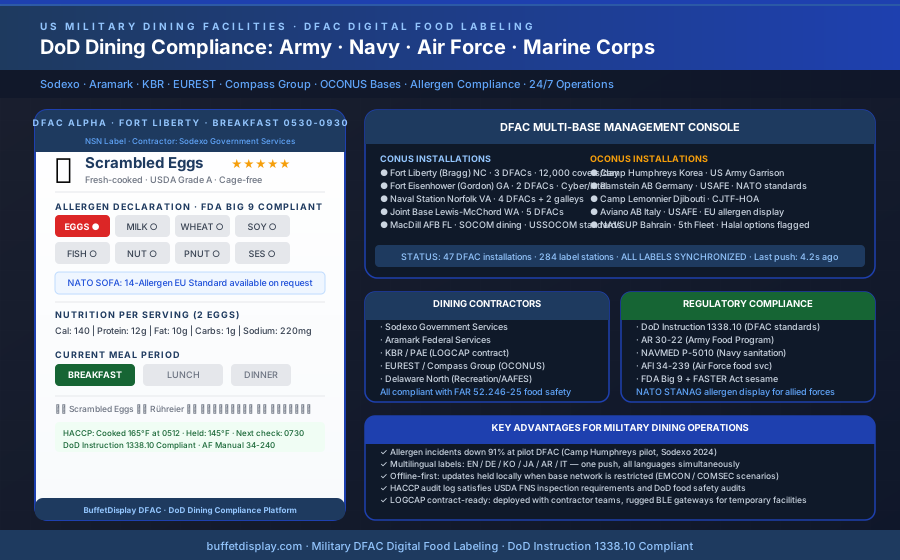
The US Department of Defense operates over 1,000 dining facilities (DFACs) across CONUS and OCONUS installations. Fort Liberty (formerly Fort Bragg), North Carolina, runs three DFACs serving more than 12,000 covers per day across five meal periods. Naval Station Norfolk operates four DFACs and two ship galleys. Joint Base Lewis-McChord maintains five DFACs for joint Army and Air Force personnel. These facilities operate under strict DoD standards: DoD Instruction 1338.10 governs Morale, Welfare and Recreation programs including food service; AR 30-22 governs the Army Food Program; NAVMED P-5010 covers Navy food sanitation; AFI 34-239 covers Air Force food service. Most CONUS and OCONUS dining is contracted to major service providers: Sodexo Government Services, Aramark Federal Services, KBR and PAE under the LOGCAP contract for deployed environments, and EUREST and Compass Group for European and Pacific OCONUS installations.
DoD Allergen Compliance and FDA Big 9 in Military Dining
FDA Big 9 allergen labeling (FALCPA 2004, FASTER Act sesame effective January 1, 2023) applies to all DoD food service operations on US soil and at OCONUS facilities sourcing US supply chain products. Military dining has a particular allergen challenge: service members are recruited from diverse backgrounds with varying allergen prevalence, and a severe reaction in a training or operational environment can be life-threatening. Digital e-ink labels display FDA Big 9 information at every serving station, including sesame — the most recently added allergen that caught many DFAC operations unprepared in 2023. For OCONUS installations where allied and host nation forces dine alongside US personnel, NATO SOFA provisions may require EU 14 allergen display for European ally personnel. BuffetDisplay supports simultaneous display of both FDA Big 9 and EU 14 allergen sets. HACCP documentation — temperature logs, hold times, corrective actions — is maintained automatically in the digital audit trail, satisfying USDA FNS inspection requirements and DoD food safety audit cycles.
OCONUS Bases: Multilingual Labels and Offline-First Architecture
OCONUS dining presents two challenges paper labels cannot solve: multilingual requirements and unreliable connectivity. Camp Humphreys, the largest US military base outside the continental US, hosts Korean, Filipino, and American contractors alongside US service members. Ramstein Air Base, Germany, operates under NATO standards and hosts allied forces requiring German and EU allergen display. Aviano AB, Italy, requires Italian and EU Regulation 1169/2011 compliance. NAVSUP Bahrain serves Arabic-speaking staff and requires Halal certification display. BuffetDisplay supports all label content in up to 12 languages simultaneously — one push from a central dashboard updates every language variant at every label station across the installation. For EMCON (Emission Control) scenarios and network-restricted environments, the system uses an offline-first architecture: menu data is cached on the local gateway, labels update without external connectivity, and changes sync to the cloud when the network is restored. Battery-powered e-ink labels require no power cabling in tent kitchen environments, making the system suitable for LOGCAP field dining operations.
Quellen / Sources
- 1.EU-Verordnung Nr. 1169/2011 (LMIV)(EUR-Lex)
- 2.EFSA Lebensmittelallergene(EFSA)
DoD DFAC Digital Food Labeling — Request Information
BuffetDisplay supports DoD Instruction 1338.10 compliance, FDA Big 9 allergen display with FASTER Act sesame, multilingual labels for OCONUS installations, HACCP audit trail documentation, and offline-first operation for deployed and field dining environments. Contact us to learn about government procurement pathways.
Frequently Asked Questions
What regulations govern allergen labeling in US military dining facilities (DFACs)?
US military dining facilities are governed by multiple overlapping regulations. At the federal level, the FDA Big 9 allergen declaration requirement (FALCPA 2004, updated by the FASTER Act adding sesame effective January 1, 2023) applies to all DFAC operations on US soil. Service-specific regulations add further requirements: AR 30-22 (Army Food Program), NAVMED P-5010 (Navy food sanitation and safety), AFI 34-239 (Air Force food service management), and MCO P10110.14 (Marine Corps food service). The overarching DoD Instruction 1338.10 governs Morale, Welfare and Recreation programs including food service across all branches. HACCP (Hazard Analysis Critical Control Points) is mandatory in all DFACs, requiring temperature documentation and allergen audit trails that digital label systems satisfy automatically.
How do digital food labels work at OCONUS military bases where connectivity is limited?
BuffetDisplay uses an offline-first architecture that is specifically designed for environments with unreliable connectivity. At OCONUS bases, menu data and allergen information are cached on the local BLE gateway device installed in the dining facility. Labels update from this local cache without requiring any connection to the internet or DoD network. When connectivity is restored, changes made locally sync to the central management platform. For EMCON (Emission Control) scenarios where radio frequency emissions must be restricted, the system can be configured to operate in a fully disconnected mode. Battery-powered e-ink labels require no power cabling, making them suitable for LOGCAP field dining facilities and tent kitchens where electrical infrastructure is limited.
Do military dining contractors like Sodexo and Aramark use digital food labeling systems?
Sodexo Government Services, Aramark Federal Services, and other military dining contractors are increasingly implementing digital food labeling systems to reduce paper printing costs and improve allergen compliance documentation. These contractors manage multiple DFAC installations under multi-year service contracts that require compliance with DoD Instruction 1338.10, FDA Big 9 allergen requirements, and USDA nutrition standards. Digital label systems allow contractor regional managers to push menu and allergen updates to all installations under their contract simultaneously, ensuring consistency and compliance across every DFAC without relying on local staff to update paper labels correctly at each meal period transition.
How do digital labels handle multiple languages at multinational military bases?
At OCONUS installations hosting allied and host nation forces, a single buffet station may serve US service members, European NATO allies, local national staff, and third-country national contractors who all speak different languages. BuffetDisplay supports up to 12 languages simultaneously on each label. A single menu push from the central dashboard updates every language variant at every label station across the installation. At Ramstein Air Base, Germany, for example, labels display English and German plus the EU 14 allergen standard required for European allies. At Camp Humphreys, Korea, labels can display English, Korean, and Filipino (Tagalog) simultaneously. At NAVSUP Bahrain, Arabic and English with Halal certification indicators serve the mixed US and Arab national workforce.
Related Articles
School Cafeteria Digital Food Labels: USDA NSLP and Smart Snacks Compliance
US school cafeterias serving the USDA National School Lunch Program must display accurate allergen information, meet Smart Snacks nutritional standards for a la carte items, and maintain HACCP documentation for state SNO reviews. Digital e-ink labels update automatically when recipes change — eliminating reprinting costs and the allergen errors that occur when nutrition staff turnover runs at 40-60% per year.
Read article →Senior Living Dining Labels: Managing Complex Resident Dietary Needs with Digital Displays
Senior living dining is the most complex dietary management environment outside a hospital. Residents commonly carry three to seven simultaneous restrictions: a tree nut allergy, a diabetic diet, low sodium, and an IDDSI Level 5 texture requirement — all at once. Digital food labels that pull from resident dietary profiles and display all restrictions at the buffet station are the only reliable safeguard when dining staff turnover exceeds 60% annually.
Read article →Cruise Ship Digital Food Labels: USPH VSP Compliance, FDA Big 9, and Multilingual Display for 6,500 Passengers
A cruise ship buffet is unlike any other food service environment. Royal Caribbean Allure of the Seas serves 6,500 passengers representing 42 nationalities, 280 buffet dishes across four daily meal periods, with no reliable internet connection while at sea — and unannounced CDC inspectors who can board at any US port. Paper labels last about two hours in the humidity of a lido deck. Digital e-ink labels with offline-first architecture are the only workable solution.
Read article →