Digital Menu Display for Hotel Breakfast: Why Breakfast Is the Hardest Service to Label
Breakfast Is Not Just Another Meal Service
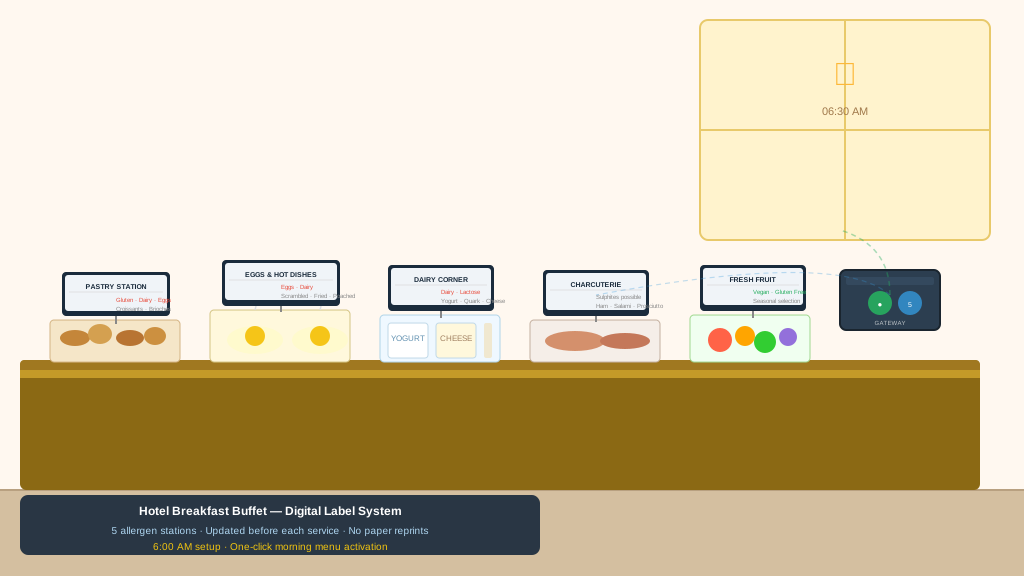
Hotel breakfast is the most complex food labeling challenge in hospitality. It starts at 5:30 or 6am when guests begin arriving — often before kitchen staff have finished the final prep. It serves the largest number of allergen-sensitive dishes (dairy, eggs, gluten, and nuts appear in almost every section of a breakfast buffet). It runs in multiple languages simultaneously because business and leisure guests arrive together. And it must be fully labeled before the first guest reaches the buffet. Paper labels written under this time pressure are inevitably wrong somewhere. Digital displays that are preconfigured and update automatically are the only reliable solution at that scale.
The 6am Problem
The label writing window for a hotel breakfast is typically 30-40 minutes — from when the buffet begins to be set up to when the first guests arrive. For a 60-dish buffet, that is less than 45 seconds per label to write, verify, and place. Under real conditions (kitchen staff also plating food, time pressure, handwriting legibility), errors are nearly inevitable. Digital displays remove this entirely: the labels are preconfigured in the system the night before, and the team activates them at setup with a single action. Changes from the kitchen update automatically without anyone touching the labels.
Breakfast-Specific Requirements for Digital Displays
Pre-shift configuration
Labels must be configured the previous evening and activatable in one step at setup — not requiring individual label entry at 5:30am
High allergen density
Breakfast has the highest allergen density of any meal service. The display system must show all 14 EU allergens clearly for every dish, not just the common ones
Rapid update capability
When a dish runs out and is replaced, the label must update in under 60 seconds. A staff member waiting at a terminal for 3 minutes to change a label is not acceptable during peak breakfast
Multilingual priority
Business hotels often have guest mixes that change by day of week — Monday may be 70% domestic, Thursday 70% international. The system must allow language priority to be adjusted without reconfiguring every label
The Allergen Density of Breakfast
Breakfast is disproportionately dangerous from an allergen perspective. The cold section alone typically contains dairy in multiple forms (butter, cheese, yoghurt, cream), eggs in several preparations, bread and pastries containing gluten, and nuts in muesli, nut butter, and granola. The hot section adds more dairy, more eggs, and often soy in vegetarian items. A guest with a dairy allergy needs to identify safe items across 20-30 dishes, many of which contain dairy in non-obvious forms. Clear, accurate allergen information on every label is not optional — and in a 6am rush, paper labels are where this most often fails.
What Changes During the Service
For more information, see our hotel breakfast buffet display solution.
"We had a table of three guests last year — one with a gluten intolerance, one dairy-free, one avoiding eggs. They were at breakfast for 45 minutes and could only eat about a third of the buffet because they had to ask staff about every dish. Since installing digital labels, that conversation has become much faster. Guests can see exactly what they can eat without waiting for someone to check."
— Guest Relations Manager, 4-star city hotel
Breakfast Operationally: Where Label Problems Are Worst
Earliest start, fewest staff. Breakfast setup begins at 5:30-6:00 AM. The team setting up labels is typically the smallest of the day — one or two people who are also completing cold station assembly, hot well checks, and mise en place simultaneously. Label accuracy is the lowest-priority task when a team member is also trying to get the eggs benedict station ready before first guests arrive at 7:00 AM.
Menu variability from day to day. Hotels that rotate their breakfast menu (as most do) have different label requirements every day. The team at 5:30 AM must identify what changed from yesterday, print or retrieve the correct labels, and place them correctly under time pressure. This is where labels get mixed up — yesterday labels at today stations, or two similar dishes with their labels swapped.
Cross-contamination risk at the station level. Breakfast buffets typically have the highest cross-contamination complexity of any meal period: dairy and non-dairy milk at the same station, gluten and gluten-free toast from adjacent slots, nut-containing granola adjacent to plain oats. The label for each item must communicate not just the item allergens but the cross-contamination context. Paper labels typically cannot carry this nuance; digital labels with dedicated cross-contamination warning fields can.
Highest complaint volume in F&B. Breakfast is when most allergen complaints from hotel guests occur. Guests with allergies are most vigilant at breakfast because it is their first meal of the day and they have not yet established trust with the kitchen team. Labels that are wrong, missing, or illegible generate immediate complaints.
Pre-Service Setup: From 45 Minutes to 8 Minutes
Paper label setup (45-60 minutes): Print label set for today menu. Review printed labels for accuracy. Cut labels if not pre-cut. Laminate if required. Locate holders for each station. Insert labels. Check placement matches station contents. Dispose of or file yesterday labels.
Digital label setup (5-10 minutes): Tap the breakfast menu schedule in the management app to confirm it activated correctly (it should have activated automatically). Walk the breakfast line and spot-check 3-4 labels at random against the station contents. Done.
The savings are not only in time but in cognitive load. The paper process requires active attention to match each label to each station under time pressure. The digital process requires only verification — the label already displays the right content, and the team is checking that the right dish is under it, which is a different and easier task.
Properties that have made this transition report that their breakfast team reliably completes setup 30-40 minutes earlier than before, and uses that time for additional quality checks (hot holding temperatures, freshness checks on cold items, station hygiene checks) that previously did not happen because time ran out. The guest experience improvement is therefore compounded: better labels plus better food condition checks at the point when guests most notice both.
Related Resources
Quellen / Sources
- 1.hotelleriesuisse(hotelleriesuisse)
- 2.DEHOGA Bundesverband(DEHOGA)
See Digital Breakfast Labels in Action
Book a demo to see how the pre-shift configuration workflow and morning label activation work for hotel breakfast operations.
Frequently Asked Questions
What is the best digital display solution for a hotel breakfast buffet?
E-ink labels at each dish position are the most effective digital solution for hotel breakfast buffets. They provide per-dish allergen information exactly where guests need it — next to the food — without requiring any scanning or phone use. E-ink is readable in bright morning light, updates silently, and requires no cables at the buffet. A central menu board LCD is a useful supplement but cannot replace per-dish labeling for allergen compliance.
Should hotel breakfast buffets use e-ink labels or LCD screens?
The two serve different purposes. E-ink labels belong at each dish position and show individual allergen data, ingredients, and dish details. LCD screens work at the room or station level for overview menus, live cooking station announcements, and promotional content. Hotels with complete digital systems typically use both: e-ink at dish level, LCD for room-level communication. E-ink is the higher compliance priority.
How do hotel breakfast buffet digital labels update when the menu changes?
When a kitchen manager changes a dish in the management system, all affected labels update wirelessly through the gateway in under 30 seconds. The update happens silently — no staff need to visit the buffet station. For scheduled menu changes (e.g., hot dishes swapping from 8am to 10am), transitions can be pre-programmed to happen automatically at the configured time without any manual action.
Can digital breakfast buffet labels display allergen information in multiple languages?
Yes. BuffetDisplay labels support multilingual allergen and ingredient display. For a city hotel serving diverse international guests, labels can cycle through English, German, French, Mandarin, and Arabic on a timed interval. The allergen icon set is language-neutral, so the 14 EU allergen icons communicate correctly regardless of which language text the guest reads.