Brazil ANVISA and Latin America Allergen Standards for Hotel and Resort Buffets
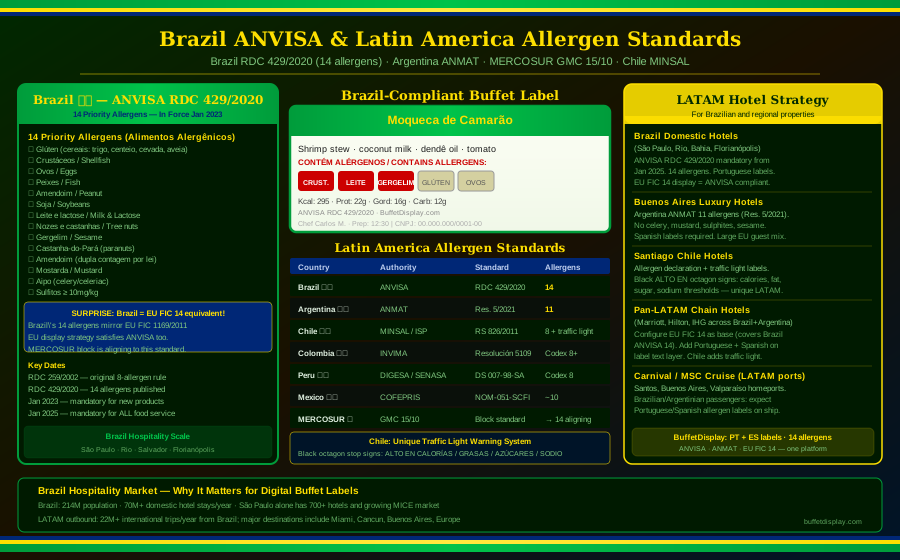
Brazil ANVISA RDC 429/2020: 14 Priority Allergens — The Surprise Standard
Brazil's food safety authority ANVISA (Agência Nacional de Vigilância Sanitária) published Resolution RDC 429/2020, which introduced a comprehensive 14-priority food allergen declaration requirement that took full mandatory effect for food service operations in January 2025. The scope of Brazil's 14 allergens is surprising to most hospitality professionals: it mirrors the EU FIC Regulation 1169/2011 almost exactly. Brazil mandates gluten-containing cereals (wheat, rye, barley, oats), crustacean shellfish, eggs, fish, peanuts, soybeans, milk and lactose, tree nuts, sesame, Brazil nuts (castanha-do-Pará), mustard, celery/celeriac, and sulphites at 10mg/kg or above. The practical implication for hotel and resort buffet labeling is significant: an international hotel chain that has already implemented EU FIC 14 allergen display in its European properties can deploy the same allergen dataset in its Brazilian properties without any modification. The Portuguese-language label text changes (leite for milk, ovos for eggs, gergelim for sesame, etc.) but the allergen data structure is identical. For Brazilian hotel groups operating domestically, ANVISA RDC 429/2020 compliance is now mandatory — buffet labels that do not declare all 14 allergens risk regulatory action by Vigilância Sanitária (VISA) inspectors.
Argentina ANMAT, Chile Traffic Light, and MERCOSUR Harmonisation
Argentina's food safety authority ANMAT (Administración Nacional de Medicamentos, Alimentos y Tecnología Médica) mandates 11 allergens under Resolution 5/2021, covering the Codex Core 8 plus peanuts, soybeans, and tree nuts declared explicitly, but excluding celery, mustard, sulphites, and sesame that Brazil's ANVISA requires. For hotel chains operating in both Argentina and Brazil, this means maintaining two slightly different allergen profiles: Brazil requires 14, Argentina 11. The practical solution for chain operations is to display Brazil's 14-allergen set across all LATAM properties — the additional 3 allergens declared in Brazil (celery, mustard, sesame) are not harmful to declare in Argentina, and the simplified approach eliminates complexity at the property level. Chile's food labeling framework (Resolución Sanitaria 826/2011 and the 2016 Law 20.606) is unique in Latin America: in addition to allergen declaration requirements (Codex 8), Chile requires black octagon warning labels for foods high in calories, total fat, saturated fat, sugar, or sodium (the "ALTO EN" system). This warning label system, targeting chronic disease prevention, is prominent on restaurant menus and buffet items in Chile. Hotels in Santiago must display both allergen information and the ALTO EN nutritional warning symbols. BuffetDisplay supports the Chilean warning badge system as configurable nutritional alert icons that display alongside the allergen declaration on the same e-ink label.
Quellen / Sources
- 1.EU-Verordnung Nr. 1169/2011 (LMIV)(EUR-Lex)
- 2.EFSA Lebensmittelallergene(EFSA)
Configure Brazil ANVISA and LATAM Allergen Labels for Your Hotel
BuffetDisplay supports Brazil ANVISA RDC 429/2020 (14 allergens in Portuguese), Argentina ANMAT (11 allergens in Spanish), Chile ALTO EN nutritional warning badges, and MERCOSUR-aligned allergen display. One platform for hotel chains across Brazil, Argentina, Chile, Colombia, and Peru.
Frequently Asked Questions
What allergen labeling does Brazil ANVISA require for hotel buffets?
Brazil's ANVISA Resolution RDC 429/2020 requires mandatory declaration of 14 allergen categories for all food served in Brazil, including hotel buffets. The required allergens are: wheat and other gluten-containing cereals (rye, barley, oats), crustaceans, eggs, fish, peanuts, soybeans, milk, tree nuts (almonds, hazelnuts, cashews, walnuts, pecans, pistachios, macadamia, Brazil nuts), celery, mustard, sesame, sulfites above 10 ppm, lupins, and molluscs. Brazil's list is broader than the EU FIC 14 allergens in that it covers all tree nut species individually and includes molluscs as a separate category. For buffet display, the Portuguese allergen terminology applies: "GLÚTEN" (gluten), "CRUSTÁCEOS" (crustaceans), "OVOS" (eggs), "PEIXE" (fish), "AMENDOIM" (peanuts), "SOJA" (soy), "LEITE" (milk), "NOZES" (tree nuts), "AIPO" (celery), "MOSTARDA" (mustard), "GERGELIM" (sesame). BuffetDisplay supports Portuguese-language allergen labels natively, with the full ANVISA 14 allergen set configurable per dish.
How does Brazil's RDC 429/2020 compare to the EU FIC 14-allergen standard?
Brazil's ANVISA RDC 429/2020 and the EU Food Information to Consumers (FIC) Regulation 1169/2011 both require declaration of 14 allergen categories, but with notable differences in scope and implementation. Both frameworks cover the same core 8 (Codex): gluten cereals, crustaceans, eggs, fish, peanuts, soybeans, milk, and tree nuts. Brazil and the EU both add celery, mustard, sesame, sulfites, and lupins. The EU FIC does not separately list molluscs as a mandatory allergen (it is included within shellfish/crustaceans by some interpretations), while Brazil explicitly requires mollusc declaration as a distinct category. In practice for hotel buffets, a buffet compliant with both EU and Brazilian requirements needs to label: gluten, crustaceans, eggs, fish, peanuts, soy, milk, tree nuts, celery, mustard, sesame, sulfites, lupins, and molluscs — 14 categories. The main operational difference is language: Brazil requires Portuguese-language allergen declarations, while the EU requires the local official language(s) of each member state. Multi-national hotel chains operating across Brazil and Europe can use BuffetDisplay's multi-language label system to configure ANVISA-compliant Portuguese labels in Brazilian properties and EU FIC-compliant labels in European properties from the same management dashboard.
How do Argentina ANMAT and Chile allergen requirements differ from Brazil ANVISA?
Argentina and Chile each maintain independent allergen labeling frameworks that differ from Brazil's ANVISA RDC 429/2020 in meaningful ways. Argentina's ANMAT (Administración Nacional de Medicamentos, Alimentos y Tecnología Médica) requires declaration of 8 mandatory allergens under the MERCOSUR Resolution GMC 26/03 framework: cereals containing gluten, crustaceans, eggs, fish, peanuts, soybeans, milk, and tree nuts — the Codex Core 8. Argentina does not yet mandate celery, mustard, sesame, sulfites, lupins, or molluscs as Brazil does, making its requirement significantly less comprehensive. Chile's requirements under the Ministry of Health regulations align more closely with the Codex Core 8 as well, with mandatory labeling focused on gluten-containing cereals (with particular emphasis on wheat), peanuts, tree nuts, milk, eggs, fish, shellfish, and soybeans. A key Chile-specific addition is that the country's "Ley de Alimentos" (Food Law 20.606 and its implementing regulations) introduced front-of-pack warning labels ("EXCESO EN GRASAS SATURADAS", "EXCESO EN AZÚCARES", etc.) — though these are nutritional warnings rather than allergen declarations. For hotel buffets operating across Latin America, the practical minimum to achieve regional compliance is Brazil's 14-allergen standard, which encompasses Argentina and Chile requirements entirely. BuffetDisplay supports a single LATAM compliance configuration that satisfies all three countries simultaneously.
What is the recommended allergen display strategy for hotel chains operating across Brazil, Argentina, and Chile?
For hotel chains operating properties across Brazil, Argentina, and Chile, the recommended strategy is to implement Brazil's ANVISA RDC 429/2020 14-allergen standard across all LATAM properties — this satisfies or exceeds the requirements of all three countries simultaneously while creating operational consistency across the region. The LATAM implementation framework: (1) Configure all buffet dishes in BuffetDisplay with the full ANVISA 14-allergen attribute set, using Portuguese terminology as the primary label language. (2) Enable Spanish-language allergen labels for Argentine and Chilean properties — the allergen set is identical, only the language changes. (3) Prioritize the "Big 5" allergens for LATAM guest populations: peanuts ("AMENDOIM"/"MANÍ"), tree nuts ("NOZES"/"FRUTOS SECOS"), fish ("PEIXE"/"PESCADO"), shellfish ("CRUSTÁCEOS"), and milk ("LEITE"/"LECHE") — these account for the majority of serious allergic reactions in the region. (4) Add QR code links on buffet labels to a full ingredients list, as several LATAM jurisdictions are moving toward ingredient transparency requirements beyond the 14-allergen declaration. The key advantage of this unified approach: culinary teams across properties learn a single allergen protocol, procurement teams apply consistent supplier disclosure requirements, and brand standards documentation covers all three countries in one policy document.