Electronic Buffet Labels for Hotel Events: How the Gateway Model Works in Practice
The Event Labeling Challenge Hotels Do Not Anticipate
Hotel events create a labeling challenge that the restaurant does not. The restaurant has a fixed layout and a fixed set of food stations. An event space has a different layout every week — a wedding may need labels in three languages, a corporate lunch may need allergen information for a bespoke menu, and a gala dinner may have 20 action stations spread across a ballroom that was a conference room yesterday. The labels must travel with the food, update in real time, and be ready for an event that was confirmed 48 hours ago. Paper labels are manageable for a small recurring setup. For any property with an active events business, they become a bottleneck.
How the Gateway Coverage Model Works
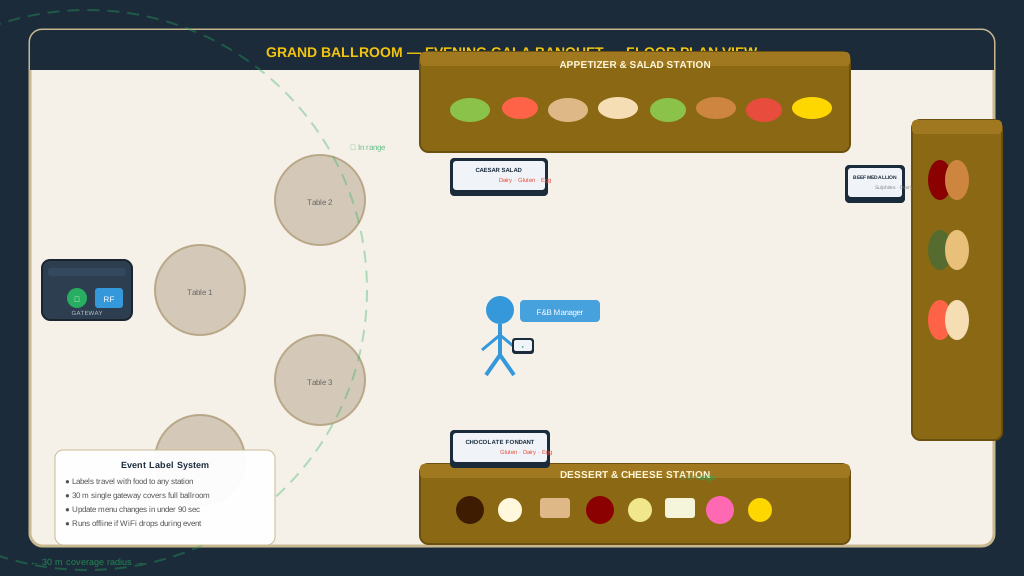
Electronic buffet labels communicate wirelessly with a central gateway — a small device that can be mounted in your F&B office, a back-of-house corridor, or any convenient location. The standard range is approximately 30 metres through typical hotel construction: one or two stud walls, standard hotel interior doors, and moderate furniture density. This range is sufficient to cover the main restaurant, an adjacent banquet room, and service corridors simultaneously from a single gateway. Labels do not need a gateway in the same room — they need to be within range of the network, which in most hotel layouts covers the main event spaces from the F&B office.
What the 30-Metre Range Covers in Practice
Main restaurant and adjacent dining room
A single gateway in the F&B office typically covers the primary restaurant and one adjacent private dining or banquet space within 30m
Service corridors and back-of-house staging
Labels can be updated in the staging area before dishes are carried out — the gateway covers back-of-house as well as front-of-house
Outdoor terrace (warm climate)
Terraces directly adjacent to the F&B area are usually within range, though outdoor walls with insulation may reduce effective range to 20-25m
Second gateway for distant ballrooms
For ballrooms on different floors or more than 40m from the F&B office, a second gateway extends coverage at no additional software cost — it simply adds another access point to the same system
Labels Travel With the Food
One of the key advantages of electronic buffet labels for events is that the labels themselves are lightweight, portable, and do not need to be fixed to a structure. A staff member can carry a set of labels to a ballroom for a wedding setup, place them at the relevant stations, and they will receive updates from the gateway without any room-specific installation. When the wedding ends and the space is reset for a corporate lunch, the same labels are reassigned to different dishes in the management system and updated instantly. No new hardware, no installation, no printed cards to produce.
Managing Multiple Events on the Same Day
A busy hotel may run a morning conference, an afternoon wedding buffet, and an evening gala dinner in overlapping time windows across different spaces. The management system handles this by grouping labels by event and allowing simultaneous management of separate menus. The morning conference labels show the corporate lunch menu; the wedding labels show the reception menu — both updated and managed from the same platform, with changes taking effect instantly on the relevant labels without affecting others.
Special Considerations for Event Catering
Events are higher-stakes than regular F&B service in several ways. Custom menus mean guests cannot rely on familiarity. Large group bookings often include guests with specific dietary requirements that the organizer has pre-communicated. Last-minute menu changes (the client switches from salmon to sea bass two hours before the event) must be reflected on labels immediately. And for regulated events — healthcare conferences, corporate dinners with legal clients — the audit trail of what was labeled, when, and with what allergen information may be requested. A digital system handles all of these automatically; a paper system does not.
"We run 120 events a year, from small working lunches to 400-person gala dinners. Before digital labels, setting up a large event meant two staff members writing labels for two hours. Now one person configures the event labels in the system the day before, and the team activates them during setup. We use the saved time for decoration and guest communication."
— Events & Catering Manager, conference hotel
Related Resources
Quellen / Sources
- 1.hotelleriesuisse(hotelleriesuisse)
- 2.DEHOGA Bundesverband(DEHOGA)
See How Events Work in the System
Book a demo to see how event label management, gateway coverage, and multi-event scheduling work in practice.
For more information, see our conference and events catering display solution.
Frequently Asked Questions
What allergen labeling is required for hotel banquet and event catering?
Hotel banquet and event catering falls under the same allergen regulations as the main restaurant. Every served dish — whether at a buffet, food station, or passed hors d'oeuvres tray — must have allergen information available. For buffet-style events, labels at each dish position are the most compliant approach. For plated service, the information must be accessible to waitstaff and provided on request.
Can digital e-ink labels be used for temporary event buffet setups?
Yes. E-ink labels for events are placed on portable label holders that move with the buffet setup. The labels receive their content wirelessly and display independently without any cabling to the temporary station. When the event ends, labels can be reassigned to different dish content for the next event. For hotels running multiple events simultaneously, a single gateway covers all labels in the event space.
How do hotels manage allergen labeling across multiple simultaneous catering events?
BuffetDisplay allows assigning labels to specific events or zones within the management system. When a kitchen prepares for three simultaneous events in different conference rooms, each event has its own label group with its own menu assignment. One kitchen manager can configure all three events' label content from a single dashboard, with each room's labels updating independently.