Why Chefs Are Hacking Digital Buffet Labels on Reddit (And What That Tells Us)
Key Takeaways
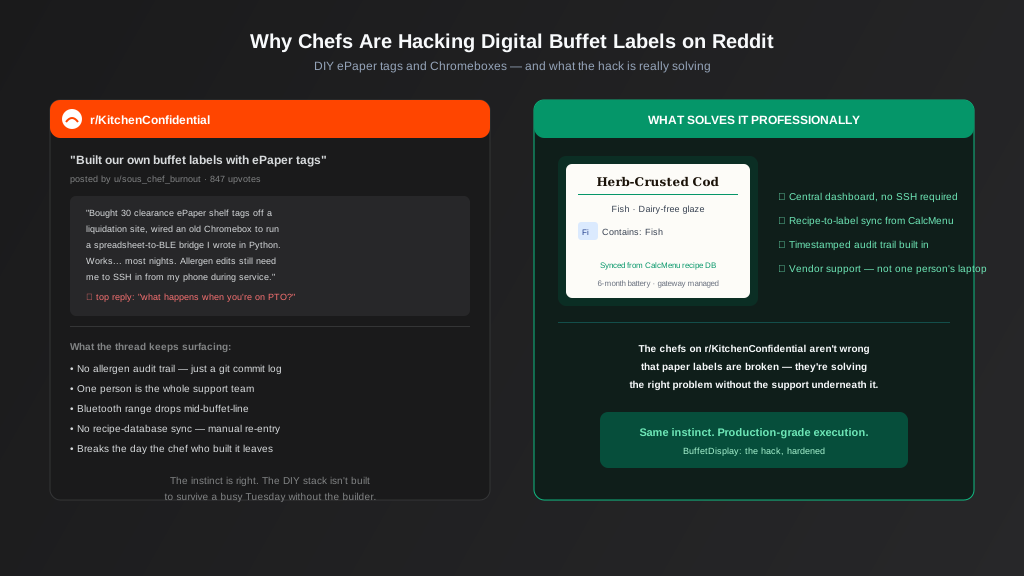
- DIY buffet label solutions (Raspberry Pi, retail ePaper tags) fail predictably at scale — no allergen audit trail, no firmware support, no hospitality-grade hardware.
- The Reddit DIY community builds these systems because commercial solutions were historically too expensive or too retail-focused — that gap has now closed.
- Professional systems designed for hospitality handle steam, condensation, and cleaning chemicals that destroy retail-grade hardware within months.
- The real cost of DIY is not hardware — it is maintenance, compliance risk, and the IT time required when something breaks mid-service.
Aus der Praxis / From the field
Provenance display is growing as a guest expectation in DACH markets, particularly at Alpine and urban luxury properties. The digital label format supports it directly: supplier name, region of origin, and production method display on the same label as allergen information, without adding any physical space requirements.
"We spend an inordinate amount of time sorting & searching for the right buffet signs for every catering. So I got a bunch of ePaper tags and geeked out."
— r/KitchenConfidential
Get the complete ROI calculator for your property
Enter your email and hotel name — we'll send the full cost-vs-paper breakdown with real numbers from comparable properties, plus a demo invite with no obligation.
No spam. Unsubscribe anytime. Your info is never shared.
"Up to 40 buffet signs. We have to print new ones every day."
In r/CommercialAV, a user described how their team prints 40+ allergen and ingredient signs daily. That's exactly what BuffetDisplay replaces with a synced digital system.
"We're doing breakfast and dinner buffets. Menu changes every day. We need to print signs for each dish showing ingredients and allergens. It's time-consuming and error-prone."
— r/CommercialAV
The DIY Chef Is Not the Exception — They're the Signal
For more information, see our luxury resort buffet solution page.
The Most Common DIY Buffet Signage Approaches
ePaper shelf labels repurposed from retail — cheap to buy but requiring technical setup, custom firmware, and no allergen-specific software built in. These are retail inventory tags being reverse-engineered for food labeling.
Raspberry Pi dashboards with custom scripts — flexible for one kitchen but requiring an IT-literate person to deploy, maintain, and update whenever the kitchen changes a recipe. A single Python dependency update can break the entire system.
Google Slides on a TV monitor — zero cost but entirely manual, with no real-time syncing, no allergen tracking, and no scheduling. Someone must open the slides and press Update before every service.
Off-the-shelf digital signage for retail — functional but built for price tags and product promotions, missing the food safety features that hospitality requires. No allergen icon sets, no meal period scheduling, no integration with kitchen management systems.
Each approach solves one part of the problem while ignoring another. The Reddit community is resourceful, but these solutions remain fragile, non-compliant, and impossible to scale.
Why DIY Systems Break Down at Hotel Scale
No central management. When a dish changes, every display must be updated individually. At scale, a single menu update across 3 venues takes 15 to 30 minutes of manual work, and errors inevitably occur.
No allergen audit trail. EU Regulation 1169/2011 and its national implementations require hospitality businesses to document allergen information and be able to prove accuracy at any given time. A Google Slides file or a custom script provides zero legal protection if a guest has an allergic reaction.
Hardware fragmentation. Mixing ePaper tags from multiple vendors, tablets of various sizes, and Chromeboxes creates an unpredictable maintenance burden. A firmware update from one vendor can break compatibility with another component in the stack.
No PMS or POS integration. DIY systems operate in complete isolation. When the kitchen updates a recipe in the property management system, the buffet labels still show the old allergen information until someone manually makes the change.
What the Reddit Phenomenon Tells the Industry
BuffetDisplay was designed specifically to fill this gap. Every feature that Reddit chefs attempt to build manually — wireless updates, allergen icons, multi-language display, automatic scheduling by meal period — is standard in BuffetDisplay, deployed in under one day, and maintained without any technical expertise from the kitchen team.
The DIY movement is correct about the problem. It has identified a genuine operational cost that amounts to thousands of hours per year in manual label work across a typical hotel. The distinction is that a purpose-built professional system eliminates the maintenance burden, provides legally defensible allergen documentation, and scales from a boutique hotel to a 1,000-room resort without additional complexity or IT involvement.
BuffetDisplay = What Reddit Chefs Are Building (But Better)
Real-Time Updates
Edit once in the kitchen — updates everywhere instantly.
Clear Allergen Icons
Compliant with EU and Swiss labeling — shown with icons or letters.
Multilingual Support
Perfect for international buffets and cruise operations.
Works with Tablets or ESL Screens
Use existing displays or Solum ESL — it just works.
Frequently Asked Questions
Quellen / Sources
Try BuffetDisplay — No Printing, No Stress
If your team is still printing buffet signs daily, you're not alone. Chefs on Reddit are trying to solve this manually — BuffetDisplay solves it professionally.
Referenced Reddit Threads
Frequently Asked Questions
Why are chefs building their own buffet label systems on Reddit?
Professional kitchens face a real operational gap: no purpose-built, allergen-compliant buffet label system existed for hospitality at an accessible price. Chefs on r/KitchenConfidential and r/CommercialAV are using ePaper shelf tags, Raspberry Pi dashboards, and Google Slides because commercial alternatives were either built for retail or too expensive for smaller properties.
What are the problems with DIY ePaper buffet label systems?
DIY ePaper systems lack central management, allergen audit trails, PMS integration, and hospitality-specific features like meal period scheduling and multilingual display. They require ongoing technical maintenance, cannot scale across multiple outlets, and provide no legal documentation for allergen compliance inspections.
Is there a professional alternative to DIY digital buffet signs?
Yes. BuffetDisplay was designed specifically for hospitality, providing the same e-ink display technology used in DIY setups but with allergen compliance, real-time wireless updates, multilingual support, and PMS integration included. It deploys in under one day without any technical expertise from the kitchen team.
How does BuffetDisplay compare to a Raspberry Pi buffet display setup?
A Raspberry Pi setup requires developer time to build, maintain, and update. BuffetDisplay is a managed SaaS platform: menus are edited through a web interface, updates push wirelessly to all labels instantly, and the system scales from 8 labels to hundreds without additional infrastructure. No coding required.