China GB 7718 Allergen Labeling for Hotel Buffets
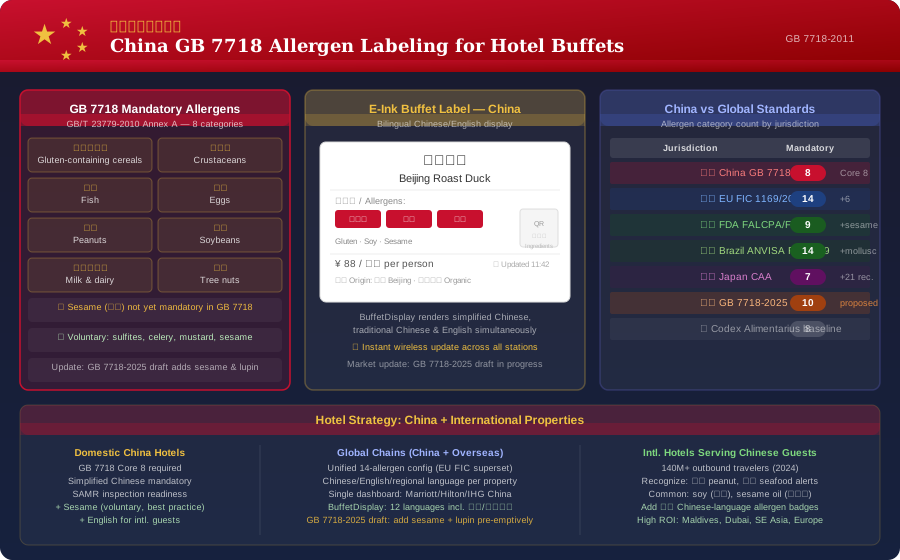
China's GB/T 23779-2010 and GB 7718-2011 establish the national allergen labeling framework for all food served in mainland China. For international hotel chains operating in China and for properties worldwide serving Chinese outbound travelers, understanding and implementing GB 7718-compliant bilingual labeling is both a regulatory necessity and a significant guest experience differentiator.
GB 7718 Core 8: China's Mandatory Allergen Framework
China's national food labeling standard GB 7718-2011, together with voluntary guidance GB/T 23779-2010, establishes 8 mandatory allergen categories — the Codex Alimentarius Core 8. For hotel buffets in mainland China, these must be declared in simplified Chinese (简体中文). SAMR (State Administration for Market Regulation) is the enforcement authority for food service allergen compliance.
Important: Sesame (芝麻) is NOT yet mandatory under GB 7718-2011, despite being widely used in Chinese cuisine (sesame oil, sesame paste). The proposed GB 7718-2025 draft adds sesame and lupin to the mandatory list — declare sesame voluntarily now to stay ahead of the regulatory update.
The 8 Mandatory Allergens Under GB 7718-2011
含麸质谷物 · Gluten Cereals
Wheat (小麦), rye (黑麦), barley (大麦), oats (燕麦). Found in noodles, dumplings (饺子), soy sauce, and most wheat-based buffet items.
甲壳类 · Crustaceans
Shrimp (虾), crab (蟹), lobster (龙虾). Central to seafood stations, dim sum fillings, and congee toppings at Chinese buffets.
鱼类 · Fish
All fish species: steamed whole fish, fish balls (鱼丸), fish sauce (鱼露) in dressings, and dried fish condiments.
蛋类 · Eggs
Chicken eggs and products. Fried rice (炒饭), egg drop soup (蛋花汤), custard tarts (蛋挞), and many bao fillings.
花生 · Peanuts
Peanuts and peanut-derived products including oil. Kung Pao dishes (宫保鸡丁), satay sauce, Sichuan cold noodles (凉面).
大豆 · Soybeans
Soy sauce (酱油), tofu (豆腐), fermented soy paste (豆瓣酱). Near-universal in Chinese cuisine — treat as baseline cross-contamination risk in all marinades.
乳及乳制品 · Milk & Dairy
Cow's milk and derivatives. Butter pastries, cream desserts, milk tea (奶茶), and Western-style buffet stations.
坚果 · Tree Nuts
Cashews (腰果), walnuts (核桃), almonds (杏仁), pine nuts (松子). Found in stir-fries, cold appetizers, and Chinese desserts.
GB 7718 vs EU FIC 14 vs FDA Big 9: Key Differences for Hotel Chains
For international hotel chains operating buffets across multiple continents, understanding how China's allergen framework compares to other major jurisdictions is essential for building a unified compliance configuration.
| Jurisdiction | Mandatory Count | Unique additions vs Core 8 |
|---|---|---|
| China GB 7718-2011 | 8 | None (= Codex Core 8) |
| EU FIC 1169/2011 | 14 | Celery, mustard, sesame, sulfites, lupins, molluscs |
| US FDA FALCPA/FASTER | 9 | Sesame (added 2023 under FASTER Act) |
| Brazil ANVISA RDC 429 | 14 | As EU + explicit molluscs category |
| Japan CAA | 7 mandatory + 21 recommended | Soba/buckwheat, walnut mandatory; soy removed from mandatory |
| GB 7718-2025 (proposed draft) | ~10 | Adds sesame + lupin |
Key difference: Sesame. Chinese cuisine makes heavy use of sesame oil (芝麻油) and sesame paste (芝麻酱) in dressings, marinades, and dim sum fillings. Despite this, sesame is not currently mandatory under GB 7718-2011. Hotel buffets in China should voluntarily declare sesame as best practice — and should plan to do so mandatorily if/when GB 7718-2025 is enacted.
Key difference: Soy in Chinese cuisine. Soybeans (大豆) are mandatory under GB 7718, and this is particularly important in Chinese hotel buffets where soy sauce (酱油), tofu (豆腐), and fermented soy products appear in nearly every dish category. Unlike the EU, where soy is less pervasive in traditional cuisine, Chinese buffet operators must treat soy as a cross-contamination risk in virtually every sauce and marinade.
Implementation recommendation for global chains: Configure BuffetDisplay with the EU FIC 14-allergen set plus sesame as the global baseline. This satisfies GB 7718 (8 of 14 overlap), EU FIC (14), and US FDA Big 9 simultaneously. Add voluntary GB 7718-2025 draft allergens (sesame, lupin) to be ahead of the upcoming Chinese regulatory update.
Bilingual Chinese/English Buffet Labels: Implementation Requirements
For hotel buffets operating in mainland China, the SAMR and local health department requirements specify that food labels must be in simplified Chinese (简体中文). English-only labels are not compliant. For international five-star hotels and resort properties, bilingual simplified Chinese + English is the standard that satisfies both Chinese regulatory requirements and international guest expectations.
Label language requirements:
- Mainland China (PRC): Simplified Chinese (GB/T 13000-2010 encoding) — mandatory
- Hong Kong SAR: Traditional Chinese (繁體中文) — standard; English also widely used
- Macau SAR: Portuguese and Traditional Chinese — both official languages
- Taiwan: Traditional Chinese; English widely used in hospitality
Allergen terminology in simplified Chinese:
- Gluten: 麸质 / 含麸质谷物
- Peanut: 花生
- Soy: 大豆 / 黄豆 / 豆类
- Milk: 牛奶 / 乳制品
- Egg: 鸡蛋 / 蛋类
- Tree nuts: 坚果 (cashew: 腰果; walnut: 核桃; almond: 杏仁; hazelnut: 榛子)
- Sesame: 芝麻 (sesame oil: 芝麻油; sesame paste: 芝麻酱)
- Fish: 鱼类
- Shellfish/crustaceans: 甲壳类 / 贝类
BuffetDisplay supports simplified Chinese, traditional Chinese, and English on the same e-ink label. Staff configure allergens once in the management dashboard; the correct language renders automatically based on the property's language configuration. This eliminates the operational complexity of maintaining separate Chinese and English label systems.
QR code integration: Chinese hotel guests are comfortable scanning QR codes for detailed information (WeChat usage in China is near-universal). Adding a QR code to buffet labels linking to a full Chinese-language ingredient list and allergen declaration aligns with both regulatory transparency best practice and Chinese guest behavior patterns.
Quellen / Sources
- 1.EU-Verordnung Nr. 1169/2011 (LMIV)(EUR-Lex)
- 2.EFSA Lebensmittelallergene(EFSA)
Implement GB 7718-Compliant Bilingual Buffet Labels
BuffetDisplay supports simplified Chinese, traditional Chinese, and English allergen labels — GB 7718 Core 8 plus voluntary sesame declaration, SAMR-ready documentation, and single-dashboard management for your China and international properties.
Frequently Asked Questions
What allergens does China GB 7718 require for hotel buffets?
China's national food labeling standard GB 7718-2011, together with GB/T 23779-2010, establishes 8 mandatory allergen categories that must be declared on food products served in mainland China, including hotel buffets. The 8 required allergens (in Chinese and English) are: 含麸质谷物 (gluten-containing cereals including wheat, rye, barley, oats), 甲壳类 (crustaceans including shrimp, crab, lobster), 鱼类 (fish), 蛋类 (eggs), 花生 (peanuts), 大豆 (soybeans including soy sauce and tofu), 乳及乳制品 (milk and dairy products), and 坚果 (tree nuts including cashews, walnuts, almonds). Importantly, sesame (芝麻) is NOT yet mandatory under GB 7718-2011 despite being widely used in Chinese cuisine — this differs from the EU FIC 14-allergen list and the US FASTER Act. However, the proposed GB 7718-2025 revision draft would add sesame and lupin as mandatory categories. Food labels in mainland China must use simplified Chinese (简体中文). SAMR (State Administration for Market Regulation) is the enforcement authority and may audit hotel food service allergen practices.
How does China GB 7718 compare to EU FIC 14 allergens and FDA Big 9?
China's GB 7718-2011 requires the same 8 allergen categories as the Codex Alimentarius Core 8 (the international baseline). The EU FIC Regulation 1169/2011 extends this to 14 mandatory allergens by adding: celery (芹菜), mustard (芥末), sesame (芝麻), sulfites above 10 ppm (亚硫酸盐), lupins (羽扇豆), and molluscs (软体动物). The US FDA FALCPA/FASTER Act requires 9 allergens — the Codex Core 8 plus sesame (added January 2023). A critical practical difference: sesame is mandatory in the EU and the US but not yet mandatory in China despite sesame oil (芝麻油) and sesame paste (芝麻酱) being ubiquitous in Chinese cuisine. For hotel chains operating across China and internationally, the recommended approach is to configure the full EU FIC 14-allergen set plus sesame as the global baseline — this satisfies GB 7718 (as 8 of the 14 overlap), EU FIC 14, and FDA Big 9 simultaneously, and positions the property for the proposed GB 7718-2025 update that would add sesame.
Do hotel buffet labels in China need to be in Chinese?
Yes. Food labels in mainland China must include simplified Chinese (简体中文) text for all mandatory allergen declarations and ingredient information under GB 7718-2011 and related SAMR regulations. English-only labels are not compliant. The standard requirement for international five-star hotels and resort properties in China is bilingual simplified Chinese + English, which satisfies both the Chinese regulatory requirement and international guest expectations. The language requirements vary by Chinese territory: mainland China requires simplified Chinese (GB/T 13000-2010 encoding); Hong Kong SAR uses traditional Chinese (繁體中文) as standard with English widely used; Macau SAR has both Portuguese and traditional Chinese as official languages; Taiwan uses traditional Chinese. BuffetDisplay supports simplified Chinese, traditional Chinese, English, and up to 12 languages simultaneously on e-ink labels, with the correct language rendering automatically based on property configuration. This eliminates the need to maintain separate Chinese and English label systems.
What allergen strategy should international hotels use for Chinese outbound travelers?
With over 140 million Chinese outbound travelers recorded in 2024, international hotels in destinations like the Maldives, Thailand, Japan, Dubai, Switzerland, and major European cities benefit significantly from adding Chinese-language allergen labels to buffet stations. The highest-priority allergens to communicate to Chinese guests are: 花生 peanuts (frequently hidden in Southeast Asian sauces and snacks), 甲壳类/贝类 shellfish (common allergen across East Asian populations), 大豆 soy (ubiquitous in Asian sauces — though Chinese guests may be more tolerant of soy itself, soy-based cross-contamination is a key communication point), and 芝麻 sesame (sesame oil is a recognized allergen trigger and Chinese guests understand the risk). Practical minimum for hotels with significant Chinese guest segments: add 中文 Chinese allergen badge text alongside English on e-ink buffet labels. QR codes linking to full Chinese-language ingredient declarations align with Chinese guest digital behavior (WeChat, Alipay QR scanning is near-universal). BuffetDisplay supports this dual-language display with no additional hardware — staff configure allergens once and both languages appear on the label automatically.