Dubai & GCC Luxury Hotel Buffet Digital Labels: Halal, Arabic, and GSO Compliance
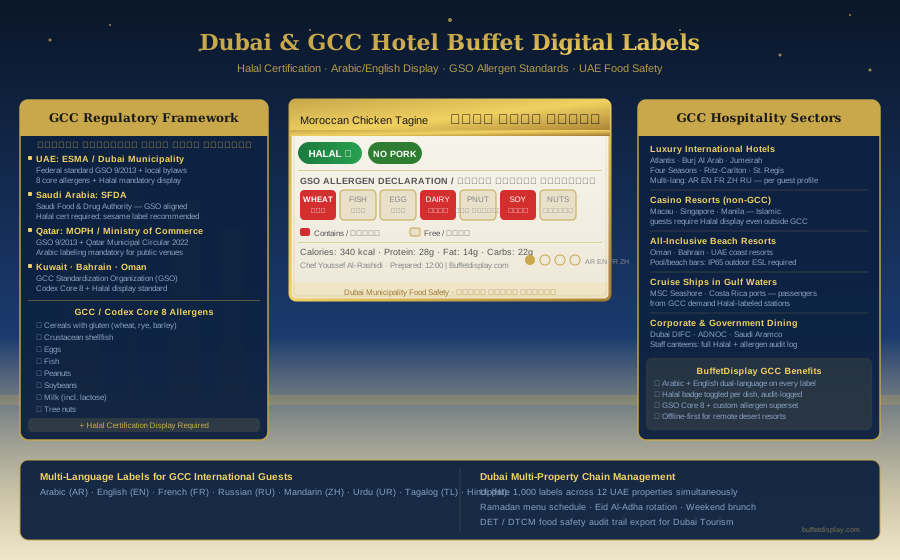
GCC Allergen and Food Safety Framework: GSO, UAE ESMA, Saudi SFDA, and Qatar MOPH
The Gulf Cooperation Council (UAE, Saudi Arabia, Qatar, Kuwait, Bahrain, Oman) operates a unified food labeling framework through the GCC Standardization Organization (GSO). The core allergen standard is GSO 9/2013, which follows the Codex Alimentarius Core 8 allergens: cereals containing gluten, crustacean shellfish, eggs, fish, peanuts, soybeans, milk, and tree nuts. At the country level, each GCC member adds specific requirements. In the UAE, the Emirates Authority for Standardization and Metrology (ESMA) and Dubai Municipality enforce food safety in F&B establishments. Dubai's Department of Economy and Tourism (DET) and Dubai Tourism (DTCM) require food safety documentation for licensed food establishments including hotel restaurants. In Saudi Arabia, the Saudi Food and Drug Authority (SFDA) enforces GSO 9/2013 with additional Halal certification requirements. Qatar's Ministry of Public Health (MOPH) added Arabic-language mandatory labeling for all public food service venues in 2022. For any hotel operating across multiple GCC countries, a single allergen display platform that handles GSO Core 8, Halal badge, and Arabic language is the only practical solution.
Halal Certification Display: What GCC Hotels Must Show
Halal certification is not an optional badge in the GCC — it is a market expectation for the overwhelming majority of guests and a regulatory requirement in many contexts. For hotel buffets serving Muslim guests, every dish must communicate its Halal status clearly. Dishes containing pork or non-Halal meat must be clearly marked as non-Halal or separated into a designated section. Dishes using Halal-certified ingredients must display the certification authority: for UAE, the Emirates Authority for Standardization (ESMA Halal); for Malaysia-certified suppliers, JAKIM; for Indonesian suppliers, MUI. International hotels in Dubai typically serve three populations simultaneously: Muslim guests from the GCC and broader Muslim world who require Halal certainty; international tourists (US, European, Russian, East Asian) who may have allergen requirements from their home jurisdiction (FDA Big 9, EU 14); and business travelers from South Asia who require both Halal and specific allergen information for vegetarian diets. BuffetDisplay handles this by displaying the Halal badge as an independent attribute per dish, separate from the allergen declaration, so a dish can show both its Halal status and its EU 14-compatible allergen profile simultaneously on a single e-ink label.
Arabic-English Bilingual Labels and Ramadan Menu Scheduling
Arabic is a mandatory display language in Qatar, Saudi Arabia, and Oman for public food service, and is the dominant preference language for GCC national guests throughout the region. E-ink labels from BuffetDisplay support right-to-left (RTL) Arabic text rendering natively — dish names, allergen declarations, and Halal status can all be displayed in Arabic script. Properties can configure the label to show Arabic on the right side and English on the left, matching the natural reading direction of both languages. For Ramadan, buffet operations shift significantly: Iftar and Suhoor menus replace standard meal period schedules, and the volume of guests during Iftar hours (sunset) can exceed standard dinner service by 3-5x. BuffetDisplay's scheduling system supports Ramadan calendar-based transitions, automatically switching label content to Iftar menus at the calculated sunset time each day throughout the holy month, without staff intervention. Eid Al-Adha and Eid Al-Fitr celebration menus can be pre-loaded and scheduled weeks in advance. Dubai hotel chains managing 12+ properties across the UAE can update all Iftar menus simultaneously from a single corporate dashboard at precisely the right moment each evening.
Quellen / Sources
- 1.EU-Verordnung Nr. 1169/2011 (LMIV)(EUR-Lex)
- 2.EFSA Lebensmittelallergene(EFSA)
Configure Your GCC Hotel Buffet Labels
BuffetDisplay supports GSO Core 8 allergens, Halal certification badge display, Arabic and English (and 10 more languages), Dubai Municipality food safety documentation, and Ramadan Iftar menu auto-scheduling. Purpose-built for luxury hotels and resorts throughout the UAE, Saudi Arabia, Qatar, and the broader GCC.
Frequently Asked Questions
What allergen labeling standard applies to hotel buffets in Dubai and the UAE?
Hotel buffets in Dubai and the UAE operate under the GCC Standardization Organization (GSO) allergen standard GSO 9/2013, which follows the Codex Alimentarius Core 8 allergens: cereals containing gluten, crustacean shellfish, eggs, fish, peanuts, soybeans, milk, and tree nuts. ESMA and Dubai Municipality enforce food safety compliance in hotel F&B establishments. In practice, international luxury hotels in Dubai that serve European and American guests also display EU FIC 14-allergen or FDA Big 9 profiles — and because EU 14 is a superset of GSO 8, displaying EU 14 satisfies GCC requirements automatically while also covering US and Canadian guests.
Is Halal certification display mandatory for hotel buffets in Dubai?
In Dubai, Halal certification display is not mandated by a single specific regulation for all hotel buffets, but it is a practical and commercial necessity. The vast majority of hotel guests in Dubai require Halal status confirmation before consuming food. Dubai Municipality requires that food establishments serving Halal food be licensed and display their Halal certification. For buffets, each dish must have its Halal status clearly communicated. Non-Halal items (dishes containing pork, non-Halal meat, or alcohol in cooking) must be separately identified. In Saudi Arabia, Halal certification is strictly mandatory for all food products and food service establishments. BuffetDisplay supports a Halal badge per dish showing the certifying authority (ESMA, JAKIM, MUI, or generic Halal), displayed independently of the allergen declaration.
How do digital buffet labels handle Arabic right-to-left text in the UAE?
Arabic is a right-to-left (RTL) language and requires specific rendering support that most generic digital signage systems do not provide natively. BuffetDisplay supports Arabic Unicode text rendering with proper RTL display on e-ink labels. Dish names, allergen declarations, Halal status, and nutritional information can all be displayed in Arabic script. The typical layout for UAE hotels shows Arabic text on the right portion of the label and English on the left, matching the natural reading direction of both languages simultaneously. The management dashboard supports Arabic text input for dish names and descriptions. Properties in Qatar (where Arabic labeling is mandatory since 2022), Saudi Arabia, and Oman require this capability. French, Russian, Mandarin, Urdu, Tagalog, and Hindi are also supported for the diverse workforce and guest populations in Dubai and Abu Dhabi hotels.
How does BuffetDisplay handle Ramadan Iftar buffet scheduling in UAE hotels?
Ramadan Iftar buffet scheduling is one of the most operationally demanding tasks for Dubai hotel F&B teams. During Ramadan, the standard meal period structure is replaced by Suhoor (pre-dawn meal) and Iftar (breaking of the fast, at sunset — which changes by approximately 1-2 minutes each day). The Iftar buffet must be labeled exactly at sunset; premature display of food labels before the fast breaks is considered disrespectful. BuffetDisplay's scheduling engine supports time-based transitions calculated from astronomical sunset data for any GCC location. Iftar menus are pre-loaded into the system, and at the calculated local sunset time the system automatically updates all labels across the property from the Ramadan daytime display to the Iftar display — without any staff action required at that moment. Eid Al-Fitr and Eid Al-Adha celebration menus can similarly be pre-scheduled to activate automatically on the correct dates.