India FSSAI Green Dot, Red Dot, and Jain Dietary Labels for Hotel Buffets
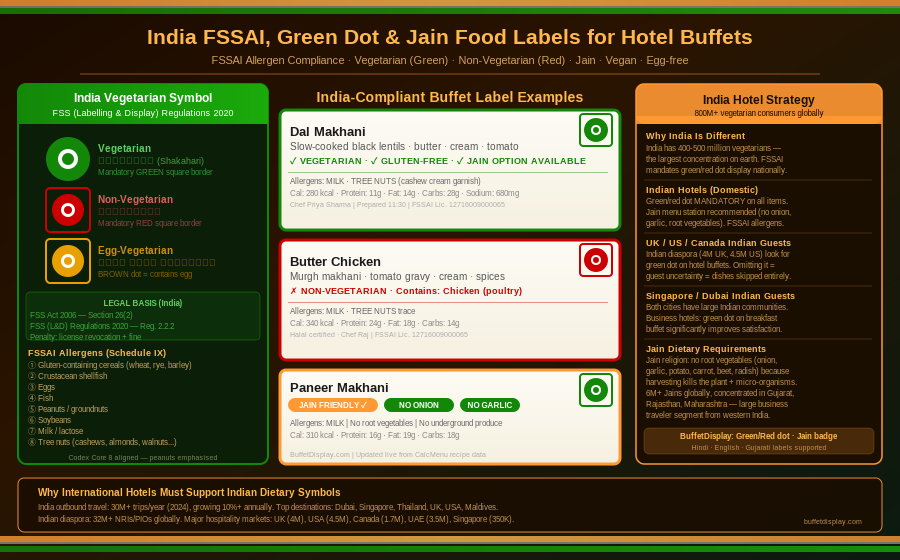
FSSAI Green Dot and Red Dot: India's Mandatory Vegetarian Symbol System
The Food Safety and Standards Authority of India (FSSAI) is the only national food safety authority in the world that mandates a visual symbol to distinguish vegetarian from non-vegetarian food. Under the Food Safety and Standards (Labelling and Display) Regulations 2020, Section 2.2.2, every packaged food product and food service item in India must display: a green square border with a green filled circle inside (the "green dot") for vegetarian items, and a brown square border with a brown filled circle (the "brown dot") for items containing eggs (egg-vegetarian category). These symbols were introduced by FSSAI in 2006 and are now legally mandated. For hotel buffets, every labeled dish must display the appropriate symbol. A hotel that serves a mixed menu of vegetarian and non-vegetarian items on the same buffet line must use these symbols so that vegetarian guests — who may be Hindu, Jain, Buddhist, or simply vegetarian by personal choice — can immediately identify safe dishes without asking staff. The penalty for non-compliance includes license revocation, fines, and potential prosecution under the FSS Act 2006. Indian hotel inspections by local municipal authorities and FSSAI field officers check for these symbols as part of standard compliance reviews.
Jain Dietary Requirements: No Root Vegetables, No Onion, No Garlic
Jainism is one of the world's oldest religions, practiced by approximately 6 million people concentrated primarily in Gujarat, Rajasthan, and Maharashtra — the three Indian states that produce the most business travelers and high-net-worth leisure travelers in India. Jain dietary restrictions go beyond standard vegetarianism: Jains do not consume root vegetables including onion, garlic, potato, carrot, beet, radish, and other underground produce, because harvesting these items kills the plant and disturbs micro-organisms in the soil. Many Jains are also "paryushan" observers who follow even stricter seasonal restrictions. For hotel buffets in India, particularly in Mumbai, Ahmedabad, Surat, and Jaipur (cities with large Jain communities), offering a clearly labeled "Jain" station or badging individual dishes as "Jain Friendly" is not optional — it is a competitive differentiator that drives significant repeat business from this high-value segment. A Jain-friendly dish that is also labeled as such retains customers who would otherwise skip the buffet entirely when they cannot quickly verify compliance. BuffetDisplay supports a "Jain" badge as a configurable attribute per dish, displayed alongside the FSSAI green dot symbol and allergen icons on the same e-ink label.
India FSSAI Allergens, Halal Labeling, and International Hotels Serving Indian Guests
FSSAI Schedule IX to the Food Safety and Standards (Labelling and Display) Regulations 2020 lists 8 mandatory allergens for declaration: cereals containing gluten (wheat, rye, barley, oats), crustacean shellfish, eggs, fish, peanuts/groundnuts, soybeans, milk, and tree nuts. This aligns with the Codex Core 8 framework with a particular emphasis on peanuts, which are consumed extensively across Indian cuisine and are one of the most common allergy triggers in India. For international hotels outside India that serve large numbers of Indian guests, displaying the FSSAI green/red dot system is an unofficial but highly valued practice. Hotels in Dubai (3.5 million Indian residents), Singapore (350,000), the UK (4 million), and the USA (4.5 million) that add green dot symbols to vegetarian breakfast buffet items see measurably improved satisfaction scores from Indian guests in post-stay surveys. The symbol is instantly recognized across linguistic and educational backgrounds — it does not require reading English. BuffetDisplay supports the FSSAI green and red dot symbols as graphical attributes that appear on the label independently of language setting, making them visible to Indian guests regardless of which language the label is displaying.
Quellen / Sources
- 1.EU-Verordnung Nr. 1169/2011 (LMIV)(EUR-Lex)
- 2.EFSA Lebensmittelallergene(EFSA)
Configure FSSAI Green Dot and Jain Labels for Your Hotel Buffet
BuffetDisplay supports FSSAI green dot / red dot vegetarian symbols, Jain dietary badges (no onion/garlic/root vegetables), FSSAI Schedule IX allergen declarations, Halal certification display, and Hindi + English bilingual label rendering. Available for hotels in India and for international properties serving Indian guests.
Frequently Asked Questions
What is the FSSAI green dot and red dot symbol requirement for hotel buffets in India?
The Food Safety and Standards Authority of India (FSSAI) mandates under the Food Safety and Standards (Labelling and Display) Regulations 2020, Section 2.2.2, that all food items display a mandatory symbol: a green square border with a green filled circle inside (the "green dot") for vegetarian items, and a brown square border with a brown filled circle (the "brown dot") for items containing eggs (egg-vegetarian). Non-vegetarian items (containing meat, poultry, or seafood) display a brown/red square with a red filled circle. These symbols were introduced in 2006 and are the only national-level legally mandated vegetarian symbol system in the world. For hotel buffets in India, every labeled dish must display the correct symbol. Non-compliance can result in license revocation, fines, and prosecution under the FSS Act 2006. Municipal inspectors and FSSAI field officers check these symbols during routine inspections of hotel F&B operations.
What are Jain dietary requirements and why do they matter for hotel buffets?
Jainism is practiced by approximately 6 million people in India, primarily in Gujarat, Rajasthan, and Maharashtra — the three states that produce India's most active business travelers and high-net-worth leisure travelers. Jain dietary restrictions go significantly beyond standard vegetarianism: Jains do not consume root vegetables including onion, garlic, potato, carrot, beet, radish, and other underground produce, because harvesting these items kills the entire plant and disturbs micro-organisms in the soil. Many observant Jains also avoid eating after sunset and follow stricter restrictions during the Paryushan festival period. For hotel buffets in Mumbai, Ahmedabad, Surat, and Jaipur (cities with large Jain communities), offering a clearly labeled "Jain Friendly" station or badging individual dishes is a significant competitive differentiator. A Jain guest at a buffet without clear Jain labels must ask staff about every single dish — a stressful process that creates negative experiences. BuffetDisplay supports a "Jain" badge as a configurable attribute per dish, shown alongside the FSSAI green dot on the same e-ink label.
What allergens does FSSAI require for hotel food service in India?
FSSAI Schedule IX to the Food Safety and Standards (Labelling and Display) Regulations 2020 lists 8 mandatory allergens for declaration in India: cereals containing gluten (wheat, rye, barley, oats), crustacean shellfish, eggs, fish, peanuts/groundnuts, soybeans, milk, and tree nuts. This aligns with the Codex Core 8 framework. A particular emphasis applies to peanuts, which are consumed extensively across Indian cuisine (in chutneys, cooking oils, snacks, and garnishes) and represent one of the most common allergy triggers in the Indian population. For hotel buffets in India, allergen declaration is required on all prepackaged foods and is best practice on all buffet items. Dishes that are vegetarian (green dot) but contain peanuts or tree nuts still require explicit allergen labeling — these are separate compliance requirements that operate in parallel.
How should international hotels outside India handle Indian guest dietary preferences?
For international hotels serving large numbers of Indian guests — properties in Dubai (3.5 million Indian residents), Singapore (350,000), UK (4 million Indian diaspora), USA (4.5 million), UAE, and Southeast Asian resort destinations — adding FSSAI-style green dot symbols to vegetarian breakfast and buffet items significantly improves Indian guest satisfaction. The green dot is instantly recognized across linguistic and educational backgrounds — it does not require reading English or any other language. Indian guests who encounter a buffet without vegetarian symbols must ask staff about every dish, creating friction and anxiety about food safety. The practical minimum recommendation for hotels outside India with significant Indian guest traffic: mark all vegetarian breakfast buffet items (eggs, dairy, cereal, fruit) with a green dot or a "VEG" badge, and offer at least one Jain-friendly option (no onion, garlic, or root vegetables) that is clearly labeled. BuffetDisplay supports both the green/red dot symbols and Jain badge as configurable display attributes that appear on e-ink labels regardless of the displayed language.