Asia-Pacific Allergen Standards for Hotel and Resort Buffets
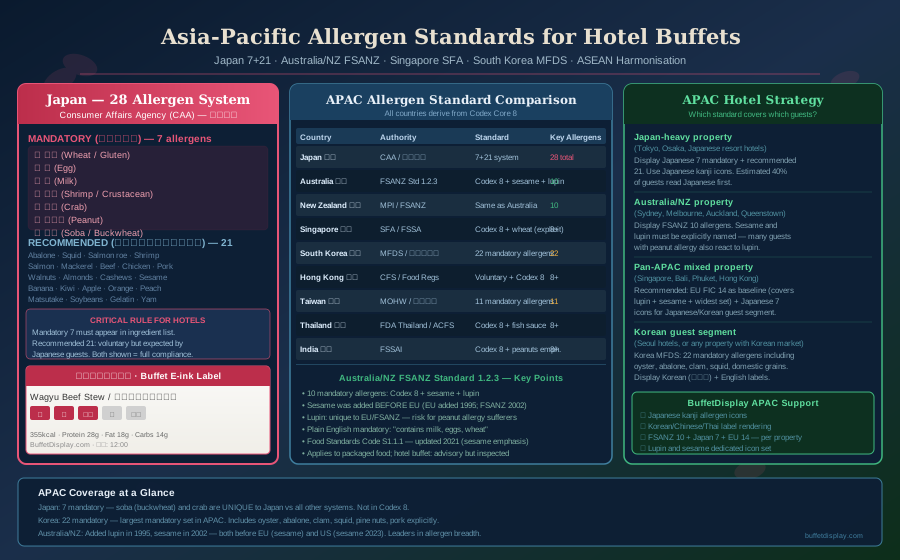
Japan's Unique 7+21 Allergen System: What Hotel Buffets Must Display
Japan operates the world's most complex allergen declaration system for hospitality. The Consumer Affairs Agency (CAA, 消費者庁) mandates 7 specific allergens: wheat, egg, milk, shrimp (crustacean), crab, peanut, and soba (buckwheat). The inclusion of soba and crab as separate mandatory allergens is unique — no other national system in the world singles out crab and soba at the mandatory tier. Beyond the 7 mandatory allergens, the CAA publishes a list of 21 recommended allergens that food businesses are strongly encouraged to declare: abalone, squid, salmon roe, shrimp (separate from mandatory shrimp category), salmon, mackerel, beef, chicken, pork, walnuts, almonds, cashews, sesame, banana, kiwi, apple, orange, peach, matsutake mushroom, soybeans, and gelatin. The combination gives hotels the option to display up to 28 distinct allergen categories. For hotel buffets in Japan — or any property with significant Japanese guest traffic (a Las Vegas integrated resort, a luxury Hawaii property, a Singapore business hotel) — displaying the Japanese 7 mandatory allergens in Japanese kanji alongside the English or local-language declaration is considered essential customer service. Japanese guests are highly allergen-aware and specifically look for the kanji symbols on food service labels.
Australia & New Zealand: FSANZ Standard 1.2.3 with Lupin and Sesame
Food Standards Australia New Zealand (FSANZ) sets the allergen labeling standard for both countries through Standard 1.2.3 of the Australia New Zealand Food Standards Code. FSANZ mandates 10 allergens: the Codex Core 8 (gluten-containing cereals, crustacean shellfish, eggs, fish, peanuts, soybeans, milk, tree nuts) plus sesame and lupin. Australia and New Zealand were pioneers in allergen regulation — sesame was added to FSANZ requirements in 2002, more than two decades before the US FASTER Act sesame mandate (2023), and lupin was added in 1995, three years before the EU FIC included it. Lupin deserves special attention: it is a legume derived from the lupin plant, and people with peanut allergies have a significantly elevated risk of also reacting to lupin due to cross-reactivity. Lupin flour is commonly used in bakery products, pasta, and some sauces — making it particularly relevant for hotel breakfast buffets and pastry stations. For hotel and resort buffet labeling in Australia and New Zealand, displaying all 10 FSANZ allergens is the minimum standard. Properties also serving Japanese tourists (a major inbound market for both countries) should add Japanese kanji allergen icons or a parallel Japanese-language declaration.
South Korea MFDS and the Broader APAC Guest Mix Strategy
South Korea's Ministry of Food and Drug Safety (MFDS, 식품의약품안전처) mandates the largest allergen set in the Asia-Pacific region: 22 required allergens. These include all Codex Core 8 plus oyster, abalone, clam, squid, pine nuts, pork, chicken, beef, peach, tomato, walnuts, and peanuts explicitly broken out. For hotels in Seoul, Jeju, or any property with significant Korean guest traffic (common in Southeast Asia), displaying Korean-language allergen information is essential. Singapore's Singapore Food Agency (SFA) enforces the Singapore Food Safety Standards Act 2019, which follows Codex 8 with additional wheat specificity. For MICE venues and business hotels in Singapore — which serve guests from Japan, Korea, Australia, India, and Europe simultaneously at conference buffets — the practical strategy is to display EU FIC 14 as the broadest base, add sesame and lupin explicitly (already in EU 14), and add Japanese kanji icons as a secondary language layer. This covers the maximum number of APAC regulatory frameworks with a single label design. BuffetDisplay supports this layered approach: the base allergen set is configured at the property level (EU 14 or custom APAC superset), language icons are added as a secondary visual layer, and specific markets like Korea or Japan can add their mandatory symbols through the label template system.
Quellen / Sources
- 1.EU-Verordnung Nr. 1169/2011 (LMIV)(EUR-Lex)
- 2.EFSA Lebensmittelallergene(EFSA)
Configure APAC Allergen Standards for Your Hotel or Resort
BuffetDisplay supports Japan CAA 7+21, Australia/NZ FSANZ 10, South Korea MFDS 22, Singapore SFA, and EU FIC 14 allergen sets simultaneously. Japanese kanji icons, Korean and Chinese label rendering, lupin and sesame dedicated icons, and per-property standard configuration for pan-APAC hotel chains.
Frequently Asked Questions
What allergens does Japan require on hotel buffet labels?
Japan mandates 7 specific allergens under Consumer Affairs Agency (CAA) regulations: wheat, egg, milk, shrimp (crustacean), crab, peanut, and soba (buckwheat). This makes Japan unique globally — crab and soba buckwheat are mandatory allergens in Japan that no other national system requires at the mandatory tier. Beyond the 7 mandatory allergens, the CAA publishes 21 recommended allergens that food businesses are strongly encouraged to declare: including beef, chicken, pork, salmon, mackerel, walnut, almond, cashew, sesame, banana, kiwi, apple, orange, peach, abalone, squid, salmon roe, matsutake mushroom, soybeans, and gelatin. For hotel buffets in Japan or any property serving significant Japanese guest traffic, displaying the 7 mandatory allergens in Japanese kanji is considered essential — Japanese guests are highly allergen-aware and look specifically for the kanji symbols (卵 for egg, 乳 for milk, etc.) on food service labels.
What is FSANZ Standard 1.2.3 and how does it affect Australian hotel buffets?
FSANZ Standard 1.2.3 is the Food Standards Australia New Zealand food allergen labeling standard, which mandates declaration of 10 allergens: the Codex Core 8 (gluten cereals, crustacean shellfish, eggs, fish, peanuts, soybeans, milk, tree nuts) plus sesame and lupin. Australia and New Zealand are global pioneers in allergen regulation — sesame was required under FSANZ since 2002 (21 years before the US FASTER Act), and lupin was added in 1995. Lupin is particularly important for hotel buffets: it is a legume used in bakery products, pasta, and sauces, and people with peanut allergies have an elevated risk of cross-reaction to lupin. Hotel buffets in Australia and New Zealand displaying FSANZ 10 allergens must explicitly name sesame and lupin even when their guest mix is primarily domestic — and properties with Japanese or Korean inbound tourists should add language-specific allergen icons as a secondary display layer.
How many allergens does South Korea require and how does this affect hotel buffet labels?
South Korea's Ministry of Food and Drug Safety (MFDS, 식품의약품안전처) mandates the largest allergen set in the Asia-Pacific region: 22 required allergens. In addition to the Codex Core 8, Korean law mandates explicit declaration of oyster, abalone, clam, squid, pine nuts, pork, chicken, beef, peach, tomato, walnut, and peanuts as distinct categories. This means Korean hotel guests — and properties serving Korean outbound tourists (a major market in Bali, Vietnam, Japan, and Southeast Asia) — expect detailed allergen declarations that go significantly beyond the EU 14 or FDA Big 9. For hotels in Seoul, Jeju, or properties on Korean tourist routes, displaying Korean-language (한국어) allergen labels alongside English or local-language labels is recommended. BuffetDisplay supports Korean language rendering on e-ink labels and can configure a 22-allergen set matching MFDS requirements.
What is the recommended allergen display strategy for a hotel in Singapore serving APAC guests?
For MICE hotels and business properties in Singapore serving a mix of Japanese, Korean, Australian, Indian, and European guests at conference buffets, the recommended strategy combines EU FIC 14 as the broadest base allergen declaration with Japanese kanji icons as a secondary visual language layer. This covers: all 10 FSANZ Australian allergens (EU 14 includes sesame and lupin); the FDA Big 9 for American guests; the GCC Codex 8 for Middle Eastern guests; and 6 of the 7 Japanese mandatory allergens (soba/buckwheat and crab require specific icons). Korean guest service is best addressed by adding a Korean-language line showing the key MFDS allergens. Singapore SFA (Singapore Food Agency) itself follows Codex 8 with additional wheat specificity. BuffetDisplay handles this layered configuration: EU 14 base set + Japanese kanji icons + Korean-language secondary declaration, configured once at the property level and applied to all label stations.