Digital Buffet Labels for Ski Resorts and Mountain Hotels
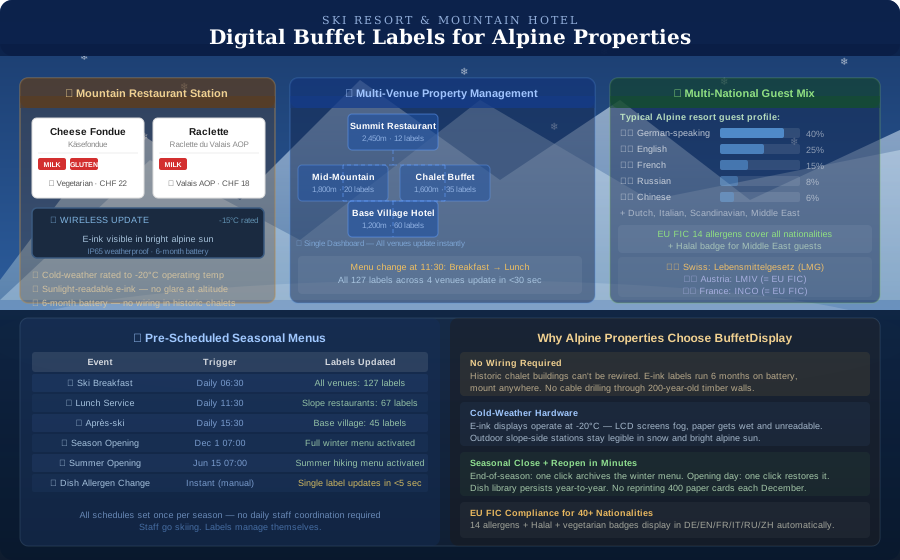
Alpine hospitality presents buffet labeling challenges that simply don't exist in urban hotels. A ski resort buffet station may be at 2,500 meters altitude, in a 200-year-old timber chalet with no cable infrastructure, serving 40 different nationalities simultaneously at -15°C, with menus that change not just daily but between breakfast, après-ski, and dinner service — and entirely between December and June. Paper labels don't survive these conditions. LCD screens fog and fail in extreme cold. E-ink wireless labels were built for exactly this environment.
The Alpine Hardware Challenge: Cold, Altitude, and Historic Buildings
The physical environment of mountain hospitality creates hardware requirements that eliminate most digital signage solutions:
Temperature performance: Standard LCD and OLED displays fail below -10°C — screens freeze, glass cracks, and batteries drain within hours. E-ink displays have no liquid crystal elements and operate reliably to -20°C operating temperature. The display retains its content even when powered off, meaning a label left in a cold chalet overnight shows the correct menu in the morning without any power draw.
Sunlight readability: Alpine environments at altitude feature intense UV and sunlight, particularly on south-facing terraces and outdoor slope-side stations. Backlit LCD screens wash out completely in direct alpine sun. E-ink's reflective display technology is actually more readable in bright light — the same principle as paper.
Battery life: Wiring slope-side stations, outdoor terraces, and historic chalets is expensive, disruptive, or outright impossible. E-ink labels update wirelessly and run on battery for 6 months between charges — a single 5-minute battery swap per label twice a year is the only maintenance required.
Historic building preservation: Many iconic Alpine chalets and mountain restaurants are heritage-listed or have timber construction where drilling cable runs would damage structural elements or require planning permissions. Battery-operated wireless labels mount with adhesive or minimal-impact brackets and require no cable infrastructure.
IP65 weatherproofing: Outdoor station labels must withstand snow, condensation, and cleaning with damp cloths. BuffetDisplay's e-ink hardware meets IP65 weatherproofing standards, making them suitable for outdoor terrace installation and slope-side buffet stations.
Multi-Venue Management: Summit to Base Village
A mid-sized Alpine resort typically operates 4–8 food service venues at different altitudes: a summit panorama restaurant, one or more mid-mountain self-service stations, a slope-side chalet buffet, après-ski bars, and a base village hotel restaurant. Traditionally, each venue operates its buffet labels independently — staff at each location print or handwrite labels for their specific menu, with no coordination between venues.
The coordination problem: A dish that appears at both the mid-mountain station and the base village hotel — say, the resort's signature beef stew — may have its allergen declaration updated if the supplier changes an ingredient. Under a paper system, this update requires manually notifying staff at each venue, reprinting labels at each location, and physically replacing them. In a busy ski resort during peak season with 500+ guests, this process takes hours and creates a window where different venues show inconsistent allergen information.
The BuffetDisplay approach: All venues across the resort connect to a single management dashboard. A chef or F&B manager at any location — or remotely — updates a dish's allergen information once, and all labels showing that dish across all venues update within 30 seconds. The same applies to menu changes, price updates, and dish additions.
Typical Alpine resort deployment:
- Summit restaurant (2,400m): 12–20 e-ink labels
- Mid-mountain self-service (1,800m): 18–30 labels
- Slope-side chalet (1,600m): 30–50 labels
- Après-ski bar (1,200m): 15–25 labels
- Base village hotel buffet (1,100m): 40–80 labels
- Total property: 115–205 labels, all managed from one tablet
The wireless gateway at each venue connects labels to the cloud platform. Labels operate on 868MHz radio frequency — the same spectrum used in building automation — which provides reliable signal penetration through stone and timber construction.
Seasonal Menu Automation: Winter Ski and Summer Hiking Seasons
Alpine resorts operate two distinct seasons with largely different menus, and the transition between them is one of the most labor-intensive operational moments of the year. A resort closing in April and reopening in June has six weeks to prepare the summer menu — historically meaning reprinting 200+ paper buffet cards, manually updating any digital signage, and briefing staff at multiple venues on the new menu.
Pre-scheduled seasonal transitions: BuffetDisplay allows F&B teams to build the summer menu in advance and schedule its activation for a specific date and time. June 15th at 7:00am: the system automatically switches all 127 labels across the property from the winter ski menu to the summer hiking menu. No staff action required on the day.
Daily meal period scheduling in ski season:
- 06:30 — Ski Breakfast: High-calorie alpine breakfast — muesli, eggs, cold cuts, pastries. Labels show nutritional information and allergens.
- 11:30 — Slope Lunch: Hot food at mountain stations — fondue, raclette, pasta, soup. Après-ski specials pre-loaded.
- 15:30 — Après-ski: Casual food, drinks, snacks. Beer brand labels, charcuterie, cheese boards.
- 19:00 — Hotel Dinner Buffet: Formal evening service at base village hotel. Labels switch to table-service format.
Each transition is pre-programmed once at the start of season. The daily staffing requirement for label management drops to zero — labels switch automatically while staff focus on food preparation.
Seasonal dish library: Dishes are never deleted — they are archived at season close and restored at season open. The resort's signature fondue dish, with its allergen configuration, pricing, and multilingual names, is stored in the dish library and reactivated each December. Year-on-year operational continuity without manual rebuild.
EU FIC Allergen Compliance in Alpine Resorts: 14 Allergens, 10 Languages
A typical Alpine ski resort in Switzerland, Austria, or France serves guests from Germany (35–45%), UK (15–25%), France (10–20%), Netherlands (8–12%), Russia (5–10%), Italy (5%), Scandinavia (5%), and increasingly China and Middle Eastern visitors. This guest profile creates a multilingual allergen communication challenge that paper labels cannot adequately address.
Regulatory framework for Alpine countries:
- Switzerland: Lebensmittelgesetz (LMG) and Lebensmittelkennzeichnungsverordnung (LKV) — aligned with EU FIC 14 allergens. Swiss resorts must declare the same 14 allergens as EU properties.
- Austria: EU FIC Regulation 1169/2011 directly applies — 14 mandatory allergens in German or the language of service.
- France: EU FIC (INCO — Information des Consommateurs) — 14 mandatory allergens, declaration in French required.
- Italy (Aosta Valley/South Tyrol): EU FIC applies — German and Italian both used in South Tyrol properties.
The 14 EU FIC allergens for Alpine menus:
The most frequently triggered EU FIC allergens in Alpine cuisine are: milk (fondue, raclette, cream soups, butter, cheese), gluten (bread, pasta, pastries, beer batter), eggs (quiche, scrambled eggs, pasta, sauces), nuts (walnut bread, hazelnut desserts, marzipan), and sulfites (wine, dried fruits, charcuterie). Celery appears in many Swiss and Austrian meat stocks and soups — an allergen that surprises guests unfamiliar with European cuisine.
Multilingual display in 10 languages: BuffetDisplay displays allergen information in German (DE), English (EN), French (FR), Italian (IT), Russian (RU), Dutch (NL), Chinese (ZH), Arabic (AR), Norwegian (NO), and Swedish (SV) — all from the same label configuration. A Russian-speaking guest and a British guest can both read their allergen information in their preferred language on the same e-ink display.
Quellen / Sources
- 1.EU-Verordnung Nr. 1169/2011 (LMIV)(EUR-Lex)
- 2.EFSA Lebensmittelallergene(EFSA)
Equip Your Alpine Property with Wireless Buffet Labels
BuffetDisplay's cold-weather e-ink hardware, multi-venue management dashboard, and seasonal scheduling automation are purpose-built for ski resort and mountain hotel operations. EU FIC 14-allergen compliance in 10 languages, no wiring required, 6-month battery life.
Frequently Asked Questions
Do e-ink digital buffet labels work in cold temperatures at ski resorts?
Yes — e-ink displays are specifically suited to cold alpine environments where conventional LCD and OLED screens fail. E-ink displays operate reliably down to -20°C operating temperature because they use no liquid crystal elements that can freeze or fog. The display technology is reflective (like paper) rather than backlit, which means it is actually more readable in bright alpine sunlight than LCD screens that wash out in direct light. E-ink labels also retain their displayed content when powered off — a label left in a cold chalet overnight shows the correct menu in the morning without power draw. The hardware used by BuffetDisplay meets IP65 weatherproofing, making it suitable for outdoor terrace and slope-side station installations. Battery life is approximately 6 months between charges, meaning the only maintenance required is a 5-minute battery swap twice a year per label — a significant advantage in remote mountain locations where rewiring is expensive or impossible.
How do ski resorts manage buffet labels across multiple venues at different altitudes?
Modern ski resorts typically operate 4–8 food service venues across multiple altitudes: summit panorama restaurant, mid-mountain self-service stations, slope-side chalet buffet, après-ski bars, and base village hotel restaurant. BuffetDisplay connects all venues to a single management dashboard — a dish allergen update made at any location pushes to all labels showing that dish across all venues within 30 seconds. This solves the core coordination problem in resort F&B: when a supplier changes a sauce ingredient and triggers an allergen update, staff update the dish once rather than coordinating separate teams at each venue. Wireless coverage uses 868MHz radio gateways at each location (the same spectrum as building automation), with reliable signal through stone and timber chalet construction. A typical Alpine resort deployment manages 115–205 labels across all venues from a single tablet — one F&B manager can run the entire property's label system remotely.
How do ski resorts handle seasonal menu changes between winter and summer seasons?
Alpine resorts face dramatic seasonal transitions: a property that closes in April for ski season end and reopens in June for summer hiking needs to switch from winter menus (fondue, raclette, hot soups, heavy alpine dishes) to summer menus (salads, cold plates, lighter fare) across all venues. BuffetDisplay's pre-scheduled menu system allows F&B teams to build the complete summer menu in advance and schedule its activation for a specific date and time — for example, June 15th at 7:00am the system automatically activates the summer menu across all 127 labels property-wide. The same applies to daily meal period transitions: ski breakfast at 06:30, slope lunch at 11:30, après-ski food at 15:30, hotel dinner at 19:00 — all pre-programmed at the start of season. Dishes are archived at season close and restored at season open rather than deleted, so the resort's dish library (including allergen configurations) persists year-to-year. This eliminates the need to manually rebuild the entire menu and allergen setup each December.
What allergen regulations apply to hotel buffets at Alpine ski resorts?
Alpine ski resorts across Switzerland, Austria, France, and Italy all fall under EU FIC-equivalent frameworks requiring declaration of 14 mandatory allergens. Switzerland's Lebensmittelgesetz (LMG) and Lebensmittelkennzeichnungsverordnung (LKV) align directly with EU FIC 14 allergens. Austria and France are EU member states where EU FIC Regulation 1169/2011 applies directly. Italy's South Tyrol and Aosta Valley (key ski regions) likewise follow EU FIC. The 14 allergens most relevant to Alpine cuisine are: milk (fondue, raclette, cream soups, cheese, butter — ubiquitous in Alpine menus), gluten (bread, pasta, pastries, beer batter), eggs (quiche, scrambled eggs, pasta, sauces), tree nuts (walnut bread, hazelnut cake, marzipan), and sulfites (wine, charcuterie, dried fruit). Celery is a frequently overlooked allergen that appears in many Swiss and Austrian meat stocks and soups. Given that a typical Alpine resort serves guests from Germany, UK, France, Netherlands, Russia, Italy, Scandinavia, China, and the Middle East simultaneously, EU FIC-compliant labels in 10+ languages are both a regulatory necessity and a guest experience investment.