Canada CFIA: 15 Priority Food Allergens for Hotel Buffets in 2024+
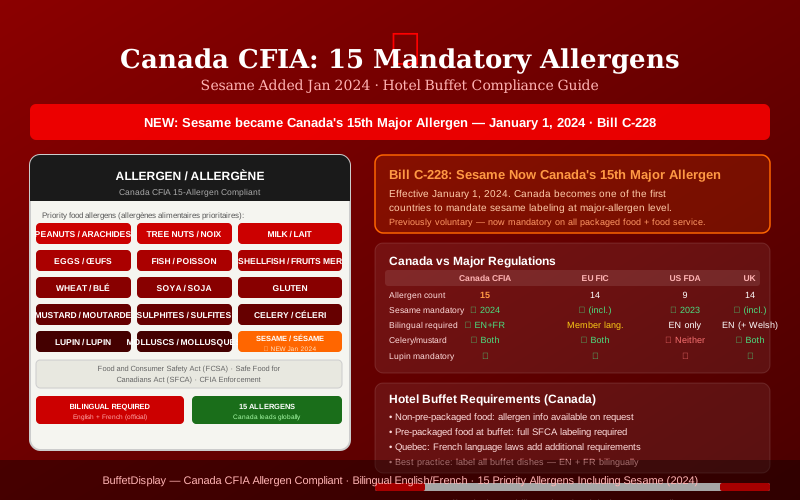
Canada's Canadian Food Inspection Agency (CFIA) requires declaration of 15 priority food allergens on food sold in Canada under the Safe Food for Canadians Act (SFCA) and Food and Drug Regulations. As of January 1, 2024, sesame is Canada's newest mandatory allergen — making Canada one of the world's most comprehensive allergen labeling regimes alongside South Korea (22 allergens) and ahead of the EU (14) and UK (14).
For hotel buffets across Canada — from Toronto and Vancouver luxury hotel properties to Montreal resort F&B, Quebec City historic hotel dining, and ski resort buffets in Whistler and Mont Tremblant — understanding the full 15-allergen CFIA requirement, the bilingual English/French obligation, and Quebec's additional language requirements is essential for compliance and guest safety.
The 15 Priority Food Allergens Required by Canada CFIA
Under Schedule M of the Food and Drug Regulations and the Safe Food for Canadians Regulations, Canada requires declaration of 15 priority food allergens (allergènes alimentaires prioritaires) on all food sold in Canada:
- Peanuts (arachides) — including peanut oil, groundnut products, and mixed nut products containing peanuts
- Tree nuts (noix) — almonds (amandes), Brazil nuts (noix du Brésil), cashews (noix de cajou), hazelnuts (noisettes), macadamia nuts, pecans (pacanes), pine nuts (pignons), pistachios (pistaches), walnuts (noix de Grenoble)
- Sesame seeds (graines de sésame) — ★ NEW as of January 1, 2024, including tahini, sesame oil, and sesame-containing products
- Milk (lait) — including lactose, butter, cheese, cream, casein, whey protein, and all dairy products
- Eggs (œufs) — including egg white, egg yolk, egg albumin, and products made with eggs
- Fish (poisson) — all fish species including freshwater and saltwater fish, not including shellfish
- Crustaceans (crustacés) — shrimp, crab, lobster, crayfish, barnacles
- Shellfish (mollusques) — clams, oysters, mussels, scallops, squid, octopus, snails, abalone
- Wheat (blé) — and products containing wheat including wheat flour, wheat starch, wheat bran
- Triticale (triticale) — a hybrid of wheat and rye (unique to Canada, not listed in EU or US)
- Gluten sources (sources de gluten) — from wheat, triticale, barley, rye, oats, or their hybridized strains
- Soy/Soya (soja) — soybean, tofu, tempeh, edamame, soy sauce, miso
- Mustard (moutarde) — including mustard seeds, mustard oil, prepared mustard, mustard flour
- Sulphites (sulfites) — sulphur dioxide and all sulphite compounds when present at ≥10 ppm (mg/kg)
- Celery (céleri) — including celeriac, celery seeds, celery salt
Important note on Triticale: Canada specifically lists triticale as a separate priority allergen — a cereal grain that is a wheat-rye hybrid. This is unique to Canadian regulations; the EU FIC lists cereals containing gluten broadly, and the US FDA does not list triticale separately. Hotel buffets serving bread, grain dishes, or products that may contain triticale should declare this allergen specifically for Canadian compliance.
Note on Lupin: Unlike EU FIC and UK FIR which list lupin as a mandatory allergen (the 14th in both EU and UK lists), Canada does not currently list lupin as a priority food allergen. However, lupin flour is widely used in gluten-free products, and hotels may wish to declare it voluntarily as best practice for guests with EU food allergy training.
Sesame: Canada's Newest Mandatory Allergen (January 2024)
Sesame became Canada's 15th mandatory priority allergen on January 1, 2024, following the passage of Bill C-228 (the Food Allergen Labelling Act). This regulatory change positions Canada alongside the United States (where sesame became mandatory under the FASTER Act, effective January 1, 2023) and ahead of many other countries that still do not mandate sesame separately.
Why sesame was added:
- Sesame allergy affects approximately 0.5–1.5% of the Canadian population
- Sesame reactions are among the most severe food allergies, with a high rate of anaphylaxis requiring epinephrine
- Sesame is increasingly common in Canadian food service due to the popularity of Middle Eastern cuisine, hummus, tahini dressings, sushi (sesame garnish), Asian stir-fry dishes, and baked goods with sesame seeds
- Unlike other allergens (such as peanuts, which are usually declared), sesame was often present in products without clear labeling
What this means for hotel buffets:
- Sesame seeds as a garnish on rolls or salads must now be declared
- Tahini-based dressings and hummus must declare sesame
- Asian-inspired buffet dishes with sesame oil must declare sesame
- Sushi station items with sesame seeds must declare sesame
- Any cross-contact risk from sesame in shared cooking equipment must be documented
Transition period: A 2-year transition period ran from January 1, 2022 to December 31, 2023. Since January 1, 2024, sesame must be declared on all food products and in food service settings. There is no longer a grace period — full compliance is required.
Canadian vs US sesame timing: The US mandated sesame under the FASTER Act effective January 1, 2023 — one year before Canada. Both countries now require sesame at the major-allergen level. The EU includes sesame in its 14-allergen list under the historic context of EU FIC 2011 as an inclusion within "sesame seeds" — sesame was always in the EU list; it was newly added to the US and Canada lists in 2023 and 2024 respectively.
Bilingual English/French Allergen Labeling Requirements
Canada's Official Languages Act requires that food labels on packaged food sold in Canada display information in both English and French. This bilingual requirement applies to all priority allergen declarations and extends to food service settings.
Official bilingual allergen terminology (English / French):
- Peanuts → Arachides
- Tree nuts → Noix (followed by specific species: amandes, noix de cajou, etc.)
- Sesame seeds → Graines de sésame
- Milk → Lait
- Eggs → Œufs
- Fish → Poisson
- Crustaceans → Crustacés
- Shellfish → Mollusques
- Wheat → Blé
- Triticale → Triticale
- Gluten → Gluten
- Soy → Soja
- Mustard → Moutarde
- Sulphites → Sulfites
- Celery → Céleri
Quebec language requirements (additional):
In Quebec, the Charter of the French Language (Charte de la langue française, also known as Bill 101) requires that all commercial documents — including food menus and labels — available to consumers in Quebec must be available in French. This means:
- Hotel buffet labels in Quebec must display allergen information in French (at minimum)
- English may be added alongside French, but French must be equally prominent or more prominent
- This applies to all Quebec hotel properties including Montreal, Quebec City, Gatineau, and resort destinations such as Mont Tremblant
Practical bilingual label format for hotel buffets:
For hotels operating across Canada (English Canada + Quebec), a bilingual format with both languages on every label is the most practical compliance approach. BuffetDisplay supports simultaneous display of English and French allergen information on the same e-ink label — configured once in the management dashboard and displayed consistently across all buffet stations in bilingual format.
Canada CFIA vs US FDA vs EU FIC: Key Differences for Hotel Chains
For hotel chains operating across Canada, US, and Europe, understanding where CFIA diverges from FDA and EU FIC determines additional compliance work per region:
| Allergen | Canada CFIA | US FDA (FASTER Act 2023) | EU FIC (14) | UK FIR (14) |
|---|---|---|---|---|
| Sesame | ✅ Mandatory (2024) | ✅ Mandatory (2023) | ✅ Included | ✅ Included |
| Triticale | ✅ Mandatory (unique to Canada) | ❌ Not listed | ✅ Under gluten grains | ✅ Under gluten grains |
| Celery | ✅ Mandatory | ❌ Not listed | ✅ Mandatory | ✅ Mandatory |
| Mustard | ✅ Mandatory | ❌ Not listed | ✅ Mandatory | ✅ Mandatory |
| Lupin | ❌ Not listed | ❌ Not listed | ✅ Mandatory | ✅ Mandatory |
| Molluscs | ✅ Listed separately | Under shellfish | ✅ Listed separately | ✅ Listed separately |
| Shellfish/Crustaceans | ✅ Separate categories | "Shellfish" covers both | ✅ Crustaceans (separate) | ✅ Crustaceans (separate) |
| Total count | 15 | 9 | 14 | 14 |
Key insight for Canadian hotel chains: Canada requires celery, mustard, and sulphites (all of which the US does not mandate separately), plus triticale (unique to Canada), plus sesame (now aligned with US). A hotel chain managing compliance simultaneously in Canada and the US needs to add 4 allergens to its Canadian labeling that are not required by US FDA: celery, mustard, triticale, and sulphites.
Canada and EU alignment: Canada's 15-allergen list overlaps significantly with EU FIC's 14 — the main differences are (a) Canada adds sesame as a separate item (EU includes it within sesame seeds from the start), (b) Canada lists triticale specifically (EU covers it under "cereals containing gluten"), and (c) Canada does not list lupin (EU mandates it). For European hotel chains with Canadian properties, the allergen databases are largely compatible with minor additions.
CFIA Enforcement and Food Business Responsibilities in Canada
The Canadian Food Inspection Agency (CFIA) is the federal authority responsible for food labeling enforcement. Provincial health departments handle restaurant and food service inspections, including hotel buffet operations.
Who enforces allergen labeling at Canadian hotel buffets:
- Federal (CFIA): Packaged food on shelves, imported products, products crossing provincial boundaries
- Provincial health authorities: Restaurant and food service operations, including hotel dining rooms, buffets, and banquet operations
- Examples by province: Alberta Health Services, BC Centre for Disease Control (BCCDC), Ontario Public Health (MOHLTC), Santé Montréal, Quebec inspecteurs en alimentation
What is required of hotel food service operations:
- Priority food allergen information must be available to guests — this applies to all non-pre-packaged food service food
- Information may be provided on menus, at point of service, digitally, or verbally by trained staff
- The information must be accurate and must match what is actually in the food
- Staff serving food must be knowledgeable enough to answer allergen questions or direct guests to accurate information
Pre-packaged food at hotel buffets (e.g., pre-wrapped pastries, individual portion items):
- Full SFCA labeling requirements apply — full ingredient list with all 15 priority allergens declared and highlighted
- Bilingual English/French labeling required
- This parallels the UK's Natasha's Law PPDS requirement for packaged food prepared on-site
Provincial variations:
- Ontario: DineSafe program — restaurants (including hotels) receive letter grades (A/B/C) visible on the door. Allergen mislabeling can affect this rating
- British Columbia: FoodSafe — provincial food handling certification required for food handlers
- Quebec: Inspecteurs en alimentation check French language compliance in addition to allergen accuracy
Penalty risk for allergen non-compliance:
Under the Safe Food for Canadians Act, penalties can range from administrative monetary penalties ($0–$15,000 for individuals) to criminal prosecution for serious violations. The CFIA has published enforcement action records showing recalls and compliance orders related to allergen mislabeling. For hotel operations, the reputational risk of an allergen-related incident exceeds the regulatory penalty risk significantly.
Digital Labels for Canadian Hotel Buffet CFIA Compliance
Wireless e-ink digital labels simplify CFIA compliance at Canadian hotel buffets by addressing the core operational challenge: maintaining accurate, bilingual, 15-allergen-compliant information across high-volume food service operations where menus change seasonally or daily.
How BuffetDisplay supports CFIA compliance:
15-allergen configuration per dish:
All 15 CFIA priority allergens (including sesame as of 2024) are configurable per dish in the BuffetDisplay management dashboard. When setting up a new buffet dish, F&B managers select which of the 15 allergens are present — the label automatically displays the correct allergen declaration in both English and French simultaneously.
Bilingual display (English + French):
BuffetDisplay supports simultaneous display of English and French on the same e-ink label. For each dish, English and French names, descriptions, and allergen terms are stored in the system. The bilingual format is configurable — common display options include a top-English/bottom-French split, an icon-based approach with bilingual text, or a full French-first format for Quebec properties.
Sesame (2024 update) already included:
The sesame allergen is included in BuffetDisplay's standard 15-allergen configuration for Canadian deployments. No system update is needed — hotels that had BuffetDisplay before January 2024 and wanted to add sesame declarations simply enabled the sesame allergen toggle per dish in the existing configuration.
Audit trail for CFIA/provincial inspections:
Every allergen configuration change in BuffetDisplay is time-stamped and logged. When a provincial health inspector asks "when did you last update your allergen information for this dish?" the BuffetDisplay audit log provides exact timestamps, user attribution, and the previous vs current allergen state. This is the exact documentation format that CFIA enforcement guidance recommends for food service due diligence.
CalcMenu integration for recipe-level accuracy:
Hotels using CalcMenu (EGS's recipe management system) benefit from automatic allergen propagation: when a recipe changes in CalcMenu, allergen recalculation happens automatically and updates BuffetDisplay labels within seconds. For Canadian hotel chains with multiple properties using CalcMenu, a single recipe change at the corporate level propagates the allergen update across all properties simultaneously.
Quellen / Sources
- 1.EU-Verordnung Nr. 1169/2011 (LMIV)(EUR-Lex)
- 2.EFSA Lebensmittelallergene(EFSA)
Ready for CFIA-Compliant Allergen Labeling at Your Canadian Hotel?
BuffetDisplay wireless e-ink labels display all 15 CFIA priority allergens bilingually (English/French) — including sesame (mandatory since January 2024). Labels update wirelessly in under 30 seconds when allergen information changes, with a time-stamped audit trail for CFIA and provincial health inspections.
Frequently Asked Questions
How many mandatory allergens does Canada require and what is new in 2024?
Canada requires 15 priority food allergens under the Safe Food for Canadians Act (SFCA) and Food and Drug Regulations — more than the US (9) and the same count as the EU (14) plus one. The 15 Canadian allergens are: peanuts, tree nuts (8 species listed), sesame seeds, milk, eggs, fish, crustaceans, shellfish, wheat, triticale (unique to Canada — a wheat-rye hybrid not listed separately in EU or US), gluten sources, soy, mustard, sulphites, and celery. The most recent addition is sesame, which became Canada's 15th mandatory allergen on January 1, 2024, following the passage of Bill C-228. Canada joins the United States (where sesame became mandatory under the FASTER Act in January 2023) in mandating sesame at the major-allergen level. For hotel buffets, this means that any dish containing sesame — including sesame-seed-garnished rolls, tahini dressings, sesame oil in Asian dishes, and sushi with sesame — must now clearly declare sesame as a priority allergen.
Does Canada require bilingual English and French allergen labeling?
Yes — Canada's Official Languages Act requires bilingual English/French labeling on all packaged food sold in Canada. For hotel buffets, the bilingual requirement extends to all allergen information provided to guests, whether on physical labels, digital displays, menus, or verbally (where both language communities may be served). In Quebec specifically, the Charter of the French Language (Charte de la langue française, Bill 101) requires that all commercial materials available to consumers — including restaurant menus and buffet labels — must be available in French. English may be added alongside, but French must be present. Practical standard for Canadian hotel buffets: bilingual English/French allergen labels at all buffet stations, with allergens listed using official bilingual terminology: peanuts/arachides, tree nuts/noix, sesame seeds/graines de sésame, milk/lait, eggs/œufs, fish/poisson, crustaceans/crustacés, shellfish/mollusques, wheat/blé, triticale/triticale, gluten/gluten, soy/soja, mustard/moutarde, sulphites/sulfites, celery/céleri. BuffetDisplay supports simultaneous English + French display on a single e-ink label — configured once in the management dashboard and applied consistently across all buffet stations.
How does Canada CFIA differ from US FDA allergen requirements for hotel buffets?
Canada and the US share most major allergens but differ in three key areas relevant to hotel buffet labeling. First, count: Canada requires 15 priority allergens; the US FDA requires 9 (the Big 9: peanuts, tree nuts, milk, eggs, fish, shellfish, wheat, soy, sesame). Second, allergens in Canada but NOT the US: Canada mandates celery, mustard, sulphites, triticale, and separately lists crustaceans and molluscs — allergens the US does not require hotels to declare. This means a hotel buffet in Toronto must declare celery and mustard that the same hotel chain's property in New York is not federally required to label. Third, bilingual requirement: US FDA requires English only; Canada requires English and French. For cross-border hotel chains (particularly US chains with Canadian properties and Canadian chains with US properties), the recommended approach is to adopt the Canadian 15-allergen standard as the baseline for North American operations — it covers all 9 US FDA requirements plus 6 additional Canadian requirements, eliminating the need to manage separate allergen databases per country.
What is triticale and why is it on Canada's allergen list?
Triticale is a hybrid grain created by crossing wheat (Triticum) and rye (Secale), combining the yield advantages of wheat with the disease resistance and cold tolerance of rye. Canada specifically lists triticale as a separate priority allergen because triticale is commercially grown in Canada (particularly in Saskatchewan and Alberta) and is increasingly used in bread, flour blends, and health foods marketed as high-protein whole grain alternatives. Importantly, triticale is not listed as a separate allergen by the US FDA (US law covers it under the general wheat allergen declaration since triticale contains wheat protein sequences) or by the EU FIC (which covers triticale under "cereals containing gluten"). For hotel buffets in Canada, if any dish contains triticale flour, triticale grain, or triticale-derived ingredients, the allergen must be declared separately as "triticale" — not simply as "wheat" or "gluten." This is particularly relevant for health-focused buffet stations, grain salad bars, artisan bread stations, and any dishes using health grain blends. The allergy mechanism: people with wheat or rye allergies may react to triticale due to overlapping protein sequences.