Codex Alimentarius and International Allergen Standards for Hotel Buffets
What is Codex Alimentarius?
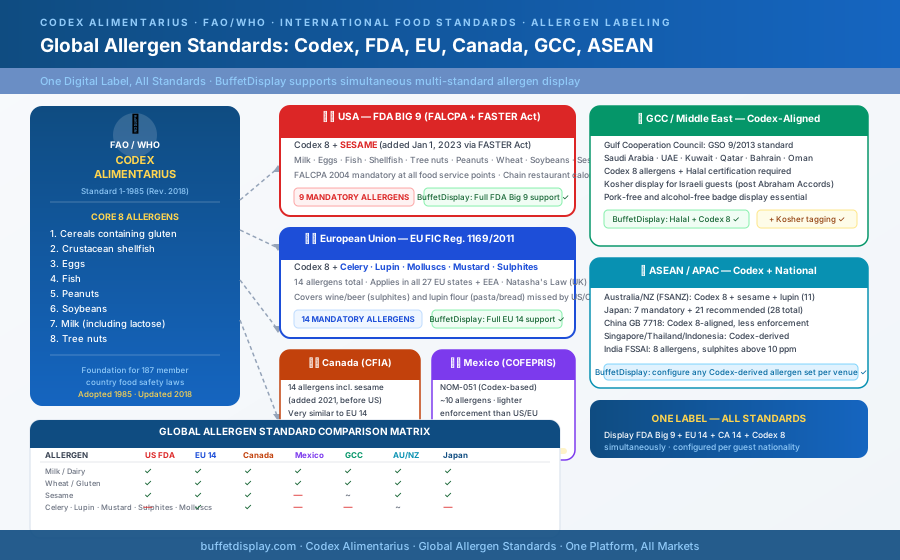
Codex Alimentarius ("Food Code" in Latin) is the collection of international food safety standards published jointly by the United Nations Food and Agriculture Organization (FAO) and the World Health Organization (WHO). Established in 1963, it now has 188 member countries. The Codex General Standard for the Labelling of Prepackaged Foods (CODEX STAN 1-1985, revised 2018) established the original 8-allergen declaration framework: cereals containing gluten (wheat, rye, barley, oats), crustacean shellfish, eggs, fish, peanuts, soybeans, milk (including lactose), and tree nuts. This Codex Core 8 is the common ancestor of every national allergen law in force today. Countries do not adopt Codex standards automatically — they each legislate their own version, adding allergens relevant to their population. The result is a family of standards that share a common core but differ at the edges. For a hotel or resort serving guests from 40 countries at the same buffet, understanding this family tree is essential to choosing an allergen display strategy that satisfies everyone.
From Codex Core 8 to National Laws: FDA, EU, Canada, Mexico, GCC, ASEAN
The US FDA Big 9 (FALCPA 2004, FASTER Act sesame effective January 1, 2023) added sesame as the ninth mandatory allergen — the first major deviation from Codex 8. The EU Food Information Regulation 1169/2011 went further, expanding to 14 allergens by adding celery, lupin, molluscs, mustard, and sulphites above 10 mg/kg. Canada (CFIA Safe Food for Canadians Regulations) closely mirrors EU 14 and added sesame in 2021 — two years before the US. Mexico NOM-051 (COFEPRIS) stays closest to the Codex baseline, covering approximately 10 allergens with lighter enforcement. The Gulf Cooperation Council (GCC standard GSO 9/2013) follows Codex 8 but adds the practical requirement for Halal certification display. Australia and New Zealand (FSANZ Standard 1.2.3) follow Codex 8 and add sesame and lupin — matching EU on those two additions. Japan is the most detailed: 7 mandatory allergens plus 21 recommended ones, for up to 28 total. For any hotel or resort hosting guests from these markets simultaneously — a Caribbean all-inclusive, a Las Vegas integrated resort, a Geneva luxury hotel, a Dubai palm resort — the EU 14 standard is the broadest common denominator that satisfies the widest guest mix. Displaying EU 14 covers US, Canadian, European, and GCC guests in a single declaration. Japanese guests are additionally served by the 7-mandatory overlap.
One Label, All Standards: Multi-Jurisdiction Allergen Display
A property serving guests from multiple regulatory jurisdictions has three options for allergen labeling. Option one: display the most restrictive standard (EU 14) for everyone. This satisfies all guests but may display allergens irrelevant to some markets. Option two: configure language-specific displays — when a label is shown in English/US context it shows FDA Big 9; in French or German context it shows EU 14. This is precise but complex to manage. Option three: display a merged superset — all allergens from both FDA Big 9 and EU 14, covering 14 + sesame, which is already covered by EU 14. In practice, EU 14 already covers the FDA Big 9 sesame because EU 14 includes sesame within its "other cereals containing gluten" and sesame is independently tracked. BuffetDisplay supports all three approaches. The system can be configured per property, per venue, or per label station to display the appropriate allergen set for the guest mix. Corporate F&B teams managing chains across multiple regulatory zones configure the master standard once at the company level and override per-property where local law differs. This is the recommended approach for international hotel groups operating in the US, EU, and GCC simultaneously.
Quellen / Sources
- 1.EU-Verordnung Nr. 1169/2011 (LMIV)(EUR-Lex)
- 2.EFSA Lebensmittelallergene(EFSA)
Configure Your International Allergen Standard Today
BuffetDisplay supports FDA Big 9, EU FIC 14, Canada CFIA, Codex Alimentarius core 8, GCC Halal certification display, and custom allergen sets for ASEAN and APAC markets. One platform for every regulatory jurisdiction your guests come from.
Frequently Asked Questions
What is Codex Alimentarius and how does it relate to hotel allergen labeling?
Codex Alimentarius is the collection of international food safety standards published jointly by the United Nations FAO and WHO since 1963. Its General Standard for the Labelling of Prepackaged Foods (CODEX STAN 1-1985) established the original 8-allergen declaration framework: cereals containing gluten, crustacean shellfish, eggs, fish, peanuts, soybeans, milk, and tree nuts. This Codex Core 8 is the common ancestor of every national allergen law in force today — FDA Big 9, EU FIC 14, Canada CFIA, Mexico NOM-051, GCC standard GSO 9/2013, and Australia/New Zealand FSANZ all derive from this baseline. For hotels and resorts, understanding Codex Alimentarius means understanding why the allergen requirements of your guests vary depending on their home country, and why a single display strategy based on the EU 14 standard satisfies the widest possible international guest mix.
How do FDA Big 9, EU 14, and Canada CFIA differ from the Codex Core 8 allergens?
The Codex Core 8 allergens are: cereals containing gluten (wheat, rye, barley, oats), crustacean shellfish, eggs, fish, peanuts, soybeans, milk, and tree nuts. The FDA Big 9 added sesame as the ninth required allergen in the US (FASTER Act, effective January 1, 2023). The EU Food Information Regulation (FIC) 1169/2011 expanded furthest, requiring 14 allergens by adding celery, lupin, molluscs, mustard, and sulphites above 10 mg/kg to the Codex baseline. Canada CFIA largely mirrors EU 14 and independently added sesame in 2021 — two years before the US mandate. Mexico NOM-051 stays closest to the Codex baseline with lighter enforcement requirements. For a hotel serving US, Canadian, and European guests simultaneously, displaying EU 14 allergens satisfies all three regulatory frameworks because EU 14 is a superset of both FDA Big 9 and Canada CFIA.
Which allergen standard should an international hotel or resort display?
For international hotels, resorts, and cruise ships serving guests from multiple regulatory jurisdictions, the EU FIC 14-allergen standard is the recommended baseline because it is the broadest common denominator. EU 14 covers all 8 Codex allergens, all 9 FDA allergens (sesame is tracked separately in EU as sesame is included by name), and all 14 Canadian CFIA allergens. A hotel in the Caribbean, a Las Vegas integrated resort, or a Geneva luxury hotel displaying EU 14 satisfies American, Canadian, European, and most Middle Eastern guests in a single declaration. For properties in GCC markets (UAE, Saudi Arabia, Qatar), adding Halal certification display alongside the allergen information is recommended. BuffetDisplay supports configuring the allergen display standard per property — EU 14, FDA Big 9, Codex 8, or a custom merged superset — and can switch the displayed standard per language if regulatory jurisdiction differs by guest profile.
Does Codex Alimentarius cover Halal certification and GCC hotel requirements?
Codex Alimentarius does not mandate Halal certification but it does publish guidelines on Halal food preparation (CAC/GL 24-1997) that are referenced by national Halal standards. The Gulf Cooperation Council (GCC) standard for allergen labeling (GSO 9/2013) follows the Codex Core 8 framework for allergen declarations but adds a parallel requirement for Halal certification display. Hotels and resorts operating in the UAE, Saudi Arabia, Qatar, Bahrain, Kuwait, and Oman must display Halal status alongside allergen information. In practice, the Halal certification is typically displayed as an icon or badge next to each dish rather than integrated into the allergen declaration itself. BuffetDisplay supports Halal, Kosher, Vegan, Vegetarian, and other certification badges as separate display attributes that can be toggled per dish independently of the allergen declaration, satisfying both the GCC Halal requirement and the underlying Codex/EU allergen framework simultaneously.
Related Articles
Canada CFIA 15 Allergens for Hotel Buffets: Sesame Added 2024 — Compliance Guide
Canada's Safe Food for Canadians Act (SFCA) and Food and Drug Regulations require declaration of 15 priority food allergens — including sesame, which became mandatory on January 1, 2024 under Bill C-228. Canada is one of the first countries to mandate sesame at the major-allergen level, joining the US (2023 FASTER Act) and ahead of many other jurisdictions. For hotel buffets across Canada, this guide covers all 15 CFIA allergens, the bilingual English/French requirement, Quebec language rules, how Canada differs from US FDA and EU FIC, and how wireless digital labels support continuous CFIA compliance.
Read article →School Cafeteria Digital Food Labels: USDA NSLP and Smart Snacks Compliance
US school cafeterias serving the USDA National School Lunch Program must display accurate allergen information, meet Smart Snacks nutritional standards for a la carte items, and maintain HACCP documentation for state SNO reviews. Digital e-ink labels update automatically when recipes change — eliminating reprinting costs and the allergen errors that occur when nutrition staff turnover runs at 40-60% per year.
Read article →Military Dining Facility (DFAC) Digital Food Labels: DoD Allergen Compliance
US military dining facilities (DFACs) serve 12,000+ covers per day at major installations under 5 meal periods, managed by contractors including Sodexo Government Services, Aramark Federal, and KBR. Digital e-ink labels eliminate paper reprinting between meal periods, display FDA Big 9 allergens per the FASTER Act, and support multilingual labeling for OCONUS bases serving allied and host nation forces.
Read article →