South Korea MFDS: 22 Mandatory Allergens for Hotel Buffets
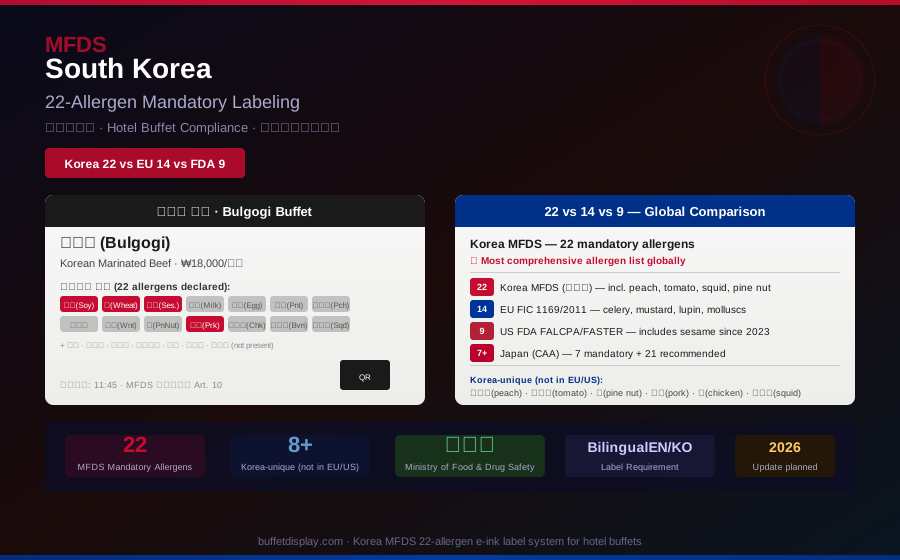
South Korea's Ministry of Food and Drug Safety (MFDS, 식품의약품안전처) requires declaration of 22 allergens on food sold in Korea — the most extensive mandatory allergen list globally. While the EU requires 14, the US requires 9, and Japan requires 7 mandatory allergens, Korea's 22-allergen requirement includes items unique to Korean food culture: peach (복숭아), tomato (토마토), squid (오징어), pine nut (잣), pork (돼지고기), and chicken (닭고기). For hotel buffets in Korea and international hotels catering to Korean guests, understanding this full list is essential.
The Complete MFDS 22-Allergen List
Korea's Food Sanitation Act (식품위생법) Article 10 and its implementing regulations require declaration of 22 allergens. Unlike the EU and US which define allergens by category (e.g., "tree nuts"), Korea specifies individual species, which is why the list is so much longer.
The 22 MFDS-mandatory allergens (알레르기 유발 물질):
Shared with EU FIC (also in the international Codex Core 8 base):
- Eggs (계란, 달걀)
- Milk (우유)
- Buckwheat (메밀)
- Peanuts (땅콩)
- Soybeans (대두)
- Wheat / gluten-containing cereals (밀)
- Mackerel (고등어) — Korea lists this where EU lists "fish" as a category
- Crustaceans (게, 새우 — crabs and shrimp specified)
- Pork (돼지고기)
- Peaches (복숭아)
- Tomatoes (토마토)
- Sulfites / sulfur dioxide (아황산류) — same as EU
- Walnuts (호두)
- Chicken (닭고기)
- Beef (쇠고기)
- Squid (오징어)
- Shellfish (조개류 — clams, oysters, mussels)
- Pine nuts (잣)
- Almonds (아몬드)
- Cashew nuts (캐슈넛)
- Kiwi (키위)
- Sesame seeds (참깨)
Key observation: Korea lists specific species (walnuts, almonds, cashews, pine nuts individually) where the EU uses a "tree nuts" category covering ~12 species. Korea also mandates peach, tomato, squid, pork, chicken, and beef — which have no equivalent in EU FIC or FDA FALCPA/FASTER.
What's Unique to Korea vs EU and US Allergen Law
For international hotel chains managing allergen declarations across multiple countries, understanding what Korea adds beyond global baseline requirements determines how much additional compliance work is needed.
| Allergen | Korea MFDS | EU FIC | US FDA | Japan CAA |
|---|---|---|---|---|
| Peach (복숭아) | ✅ Mandatory | ❌ Not listed | ❌ Not listed | 🔸 Recommended |
| Tomato (토마토) | ✅ Mandatory | ❌ Not listed | ❌ Not listed | 🔸 Recommended |
| Squid (오징어) | ✅ Mandatory | ✅ Molluscs | ❌ Not listed | ✅ Mandatory |
| Pine nut (잣) | ✅ Mandatory | ✅ Tree nuts | ✅ Tree nuts | ❌ Not listed |
| Pork (돼지고기) | ✅ Mandatory | ❌ Not listed | ❌ Not listed | 🔸 Recommended |
| Chicken (닭고기) | ✅ Mandatory | ❌ Not listed | ❌ Not listed | 🔸 Recommended |
| Beef (쇠고기) | ✅ Mandatory | ❌ Not listed | ❌ Not listed | 🔸 Recommended |
| Kiwi (키위) | ✅ Mandatory | ❌ Not listed | ❌ Not listed | 🔸 Recommended |
Why peach and tomato? These were added to Korea's list due to prevalence of oral allergy syndrome (OAS / pollen-food allergy syndrome) in the Korean population, particularly for birch pollen-related food allergies where peaches and tomatoes are common triggers.
Why pork, chicken, beef? Meat allergies are declared mandatory in Korea due to documented food allergy cases and the prevalence of galactose-alpha-1,3-galactose (alpha-gal) syndrome, as well as traditional Korean meat-heavy dishes where cross-contamination is common.
Practical buffet implication: A hotel buffet in Seoul or Busan must declare all 22 allergens for each dish — not just the EU-14 or FDA-9 subset. This means separate declarations for pork vs chicken vs beef (where EU would group these as unregulated), and for peach used in sauces or marinades (where EU compliance wouldn't require this).
Bilingual Korean/English Requirements for Hotel Buffet Labels
For hotel buffets in South Korea, the MFDS and local health authorities specify that allergen declarations must be in Korean (한국어). International luxury hotels and resort properties typically use bilingual Korean + English labels to meet both the Korean regulatory requirement and the expectations of international guests.
Language requirements for buffet labels in Korea:
- Primary language: Korean (한글) — mandatory under Food Sanitation Act
- Secondary language: English — standard practice for international hotels and 5-star properties
- Additional languages: Japanese (일본어) and Chinese Simplified (简体中文) are common additions for hotel buffets in Jeju, Seoul Gangnam, and resort properties that receive significant Japanese and Chinese tourist traffic
Korean allergen terminology for buffet labels:
- Eggs: 계란 (egg), 달걀 (egg — more formal)
- Milk: 우유
- Wheat: 밀 (wheat)
- Soybeans: 대두 (soybean)
- Peanuts: 땅콩
- Sesame: 참깨 (seeds), 참기름 (sesame oil)
- Tree nuts: 호두 (walnut), 아몬드 (almond), 캐슈넛 (cashew), 잣 (pine nut)
- Shellfish: 새우 (shrimp), 게 (crab), 오징어 (squid), 조개류 (clams/shellfish)
- Fish: 고등어 (mackerel)
- Meat: 돼지고기 (pork), 닭고기 (chicken), 쇠고기 (beef)
- Produce: 복숭아 (peach), 토마토 (tomato), 키위 (kiwi)
- Other: 메밀 (buckwheat), 아황산류 (sulfites)
BuffetDisplay supports Korean (Hangul) natively as one of its 12 supported languages. Allergen declarations can be configured once in the management dashboard and displayed in Korean and English (or any additional languages) simultaneously on the same e-ink label.
2026 MFDS Regulatory Updates and Enforcement Trends
Korea's allergen labeling requirements have evolved significantly, and further updates are expected through 2026-2027 based on MFDS regulatory consultation documents.
Current status (as of 2026):
- The 22-allergen list is fully in force under Ministry of Food and Drug Safety Notice
- Enforcement: MFDS district offices and local health departments conduct routine inspections of food service establishments including hotel buffets
- Penalties: Violations of allergen declaration requirements under the Food Sanitation Act can result in administrative fines (과태료) and suspension of food service operations
- Documentation requirement: Allergen declaration records must be maintained and available for inspector review — a paper list per dish is sufficient but digital audit trails are increasingly preferred
Expected 2026-2027 updates:
- MFDS has published consultation documents on adding mustard (겨자) to the mandatory list, aligning with EU FIC
- Discussion of adding lupin (루핀) following EU and UK amendments
- Potential expansion to cover celery (샐러리) in foodservice contexts
- Stricter cross-contamination declaration requirements for buffet operations specifically
For Korean guests at international hotels: The MFDS 22-allergen standard has educated Korean consumers to expect detailed allergen disclosure. Korean hotel guests visiting international properties often experience disappointment when allergen information is less detailed than at home. For hotels with significant Korean guest traffic — properties in Osaka, Tokyo, Singapore, Bangkok, Los Angeles, and European capitals — adding Korean-language allergen labels and covering the full MFDS 22-allergen set (not just EU-14 or FDA-9) significantly improves Korean guest satisfaction and food safety confidence.
Quellen / Sources
- 1.EU-Verordnung Nr. 1169/2011 (LMIV)(EUR-Lex)
- 2.EFSA Lebensmittelallergene(EFSA)
Add Korean Allergen Labels to Your Hotel Buffet
BuffetDisplay supports Korean (Hangul) bilingual allergen labeling with all 22 MFDS-mandatory allergens configurable per dish. A single management dashboard covers Korean regulatory requirements alongside EU FIC 14 and FDA Big 9 — one configuration, full compliance across markets.
Frequently Asked Questions
What are the 22 mandatory allergens required by South Korea MFDS?
South Korea's Ministry of Food and Drug Safety (MFDS, 식품의약품안전처) mandates declaration of 22 allergens under the Food Sanitation Act (식품위생법) — the most extensive mandatory allergen list in the world. The 22 allergens are: (1) eggs, (2) milk, (3) buckwheat (메밀), (4) peanuts, (5) soybeans, (6) wheat, (7) mackerel (고등어), (8) crustaceans (crabs and shrimp), (9) pork, (10) peaches (복숭아), (11) tomatoes (토마토), (12) sulfites (아황산류), (13) walnuts, (14) chicken, (15) beef, (16) squid (오징어), (17) shellfish (clams and oysters), (18) pine nuts (잣), (19) almonds, (20) cashew nuts, (21) kiwi (키위), and (22) sesame seeds (참깨). Compared to the EU's 14 and the US's 9, Korea adds peach, tomato, squid, pork, chicken, beef, kiwi, and lists individual nut species (walnut, almond, cashew, pine nut) rather than a generic "tree nuts" category. Hotel buffets in South Korea must declare all 22 allergens for each dish.
Why does South Korea have more allergens than the EU or US?
Korea's 22-allergen list reflects the Korean population's specific allergy profile and food culture. Peaches and tomatoes were added because oral allergy syndrome (OAS / pollen-food allergy syndrome) associated with birch pollen is common in Korea, triggering reactions to peaches and tomatoes in sensitized individuals. Pork, chicken, and beef are mandatory because meat allergies (including alpha-gal syndrome from tick bites) are documented in Korean consumers, and these proteins appear in virtually every Korean dish category making cross-contamination common. Squid (오징어) is widely used in Korean cuisine (in kimchi, as banchan, grilled whole, dried as snack) and represents a meaningful allergy risk. Korea also lists individual tree nut species — walnut, almond, cashew nut, pine nut — rather than grouping them as "tree nuts" like the EU and US do. Pine nuts (잣) are particularly prevalent in traditional Korean cooking: in japchae (잡채), in mul-naengmyeon garnish, as a garnish on many royal court dishes, and in pine nut porridge (잣죽), making them a meaningful allergy risk that the generic EU "tree nuts" category doesn't specifically flag.
Do hotel buffet labels in South Korea need to be in Korean?
Yes — under the Food Sanitation Act (식품위생법) and MFDS regulations, allergen declarations in South Korea must be in Korean (한국어/한글). International luxury hotels and 5-star resort properties typically use bilingual Korean + English labels to meet both the Korean regulatory requirement and the expectations of international guests. For hotel buffets serving significant Japanese and Chinese tourist traffic (particularly in Jeju, Busan, and Seoul Gangnam hotel corridors), adding Japanese (일본어) and Chinese Simplified (简体中文) is common practice. BuffetDisplay supports Korean (Hangul) as one of its 12 built-in languages. The allergen icons are configurable to show Korean terminology (e.g., 계란 for egg, 우유 for milk, 참깨 for sesame) alongside English equivalents on the same e-ink display, with a single management dashboard managing all language versions simultaneously.
How should international hotels handle Korean guests' allergen expectations?
Korean guests traveling internationally are accustomed to the MFDS 22-allergen standard — the most detailed mandatory allergen disclosure system in the world. When Korean guests encounter hotel buffets abroad that only show 9 (US) or 14 (EU) allergens, they notice the gap and may feel less confident about food safety. International hotels with significant Korean guest traffic — properties in Osaka, Tokyo, Singapore, Bangkok, Bali, Los Angeles, Paris, and London — benefit from adding Korean-language allergen labels and expanding beyond the local regulatory minimum to cover the full MFDS 22-allergen set. This means adding declarations for peach (in sauces, desserts, marinades), tomato (very common and often undeclared internationally), squid/molluscs (in broths, sauces, Asian dishes), pork vs chicken vs beef as separate declarations, and individual tree nut species. BuffetDisplay can be configured to display Korean-language allergen labels with the full 22-allergen set regardless of the property's host country, making it practical for any international hotel to match the Korean standard for Korean guests.