Halal, Kosher, and Dietary Certification Display on Buffet Labels
The Religious and Dietary Compliance Landscape in International Hotels
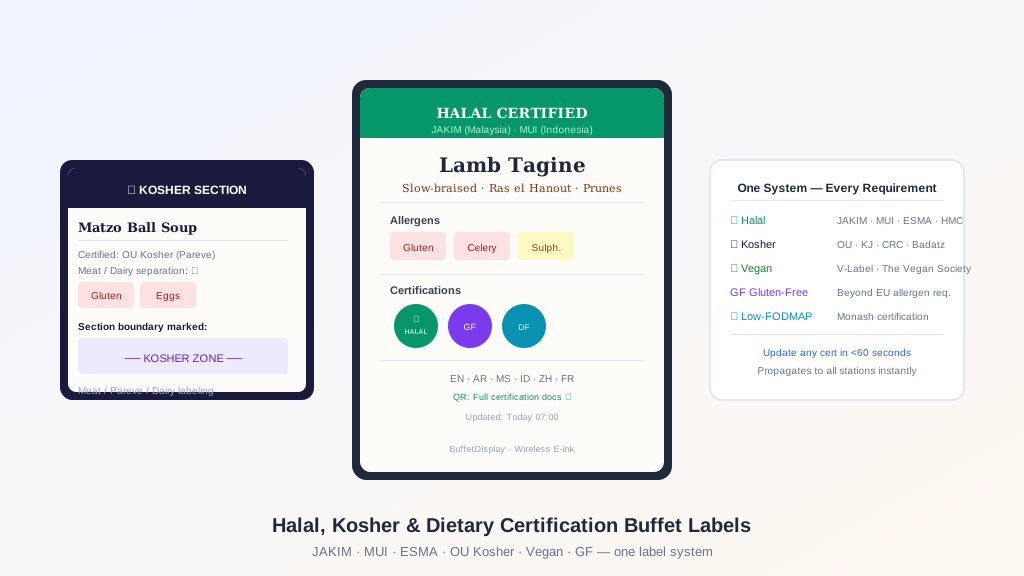
Religious dietary requirements are governed by certification bodies that audit food production chains: halal certification by bodies such as MUI (Indonesia), JAKIM (Malaysia), ESMA (UAE), or local national authorities; kosher certification by recognised rabbinic bodies. These certifications apply to ingredients, preparation processes, equipment separation, and sometimes the certification of the kitchen itself. A hotel buffet displaying a halal icon on a dish is making a claim that extends up through the entire supply chain — if the claim is inaccurate, the reputational and contractual consequences fall on the hotel.
Lifestyle dietary preferences — vegan, vegetarian, gluten-free (beyond the EU allergen meaning), low-FODMAP, diabetic-suitable — are not legally defined in the same way as allergens, but they carry significant guest trust implications. A guest who has been told a dish is vegan and discovers it contains dairy feels the same betrayal as a guest who discovers an unlabelled allergen. The complaint dynamics are similar.
For hotels serving international business travelers, religious tourists, or guests from communities with strong dietary traditions, getting certification display right is as commercially important as allergen compliance — and in markets like the UAE, Malaysia, and parts of Southeast Asia, halal certification display is effectively expected at all premium properties.
Halal Certification Display: Middle East and Southeast Asia Requirements
Certification source tracking. Not all halal certifications are equivalent in all markets. A certification from one authority is recognised in some countries but not others. Hotels serving guests from multiple Muslim-majority countries need to display which certification body approved the dish, not just a generic halal icon. Digital label systems that pull certification data from a recipe management database can display the specific certification body alongside the halal icon.
Ingredient-level rather than dish-level certification. A dish may be made from certified halal meat but prepared on a surface shared with non-halal items. Kitchen separation protocols determine whether the final dish qualifies for a halal claim. Digital label content management allows hotels to configure halal status at the dish level based on actual kitchen protocols rather than defaulting to ingredient-only claims.
Middle East hotel market specifics. Hotels in the UAE, Saudi Arabia, Qatar, and Bahrain typically serve guest populations that are 60-90% Muslim. For these properties, halal status on every dish is the baseline expectation — non-halal items (pork, alcohol-containing dishes) need clear labeling, while halal status is assumed for everything else. This inverts the typical Western hotel labeling logic where halal is the exception to mark rather than the rule.
Southeast Asia multi-certification environments. Malaysia and Indonesia have government-level halal certification requirements for food service in hospitality settings. JAKIM certification in Malaysia and MUI in Indonesia are the respective national standards. International hotel brands operating in these markets typically display the national certification mark alongside allergen information, requiring label systems that can store and display multiple certification icons per dish.
Kosher, Vegan, and Specialist Dietary Icons on the Same Label
Digital e-ink labels solve the density problem through configurable display templates. A 4.2" e-ink label can display the dish name, up to 14 allergen icons, 4 dietary certification icons (halal, vegan, vegetarian, kosher), and a brief description simultaneously at readable font sizes — without any visual compromise. The hotel configures which icons appear for each dish in the management system, and those icons render correctly on every label for that dish across every station.
The accuracy maintenance advantage is where digital systems dramatically outperform paper for certification display. When a halal-certified supplier changes an ingredient to a non-certified source — a common event during supply chain disruptions — the hotel can remove the halal icon from all labels for affected dishes in under two minutes from the management dashboard, with the change propagating to every display station simultaneously. On paper labels, the same change requires manually identifying every label in the property that references the affected dish, physically replacing each one, and verifying no old labels remain — a process that realistically takes 30-60 minutes and still risks missed labels.
Kosher display in international hotels presents a specific operational nuance: kosher certification typically requires complete separation of meat and dairy dishes, including separate service equipment. Hotels with certified kosher sections of their buffet need to label not just individual dishes but the section boundaries. Digital labels with custom border styles or background colors can serve as section dividers that visually group certified items together — a function paper labels cannot perform without printed section headers that are easy to miss or misplace.
Display Every Certification Your Guests Need
BuffetDisplay supports halal, kosher, vegan, vegetarian, and custom dietary certification icons on every e-ink label. Certification status updates from one dashboard change in under 60 seconds across all stations.
Frequently Asked Questions
How do digital buffet labels display halal certification?
Digital e-ink label systems display halal certification icons configured per dish in the management dashboard. The system stores which certification body approved each dish (MUI, JAKIM, ESMA, etc.) and displays both the halal icon and the specific certification body on the label. When a halal-certified ingredient is replaced by a non-certified source, the F&B manager removes the halal icon from all affected labels in under two minutes from the dashboard — the change propagates to every display station simultaneously.
Can hotel buffet labels display kosher certification?
Yes. Digital buffet label systems support kosher certification icons at the dish level. For kosher sections of a buffet — which require separation of meat and dairy and may require entire section labeling — digital labels can display section-level certification indicators in addition to dish-level icons. Section boundaries can be marked with different label templates or background treatments that visually group certified items, helping observant guests identify the kosher section without staff assistance.
How do Middle East hotels handle halal vs non-halal buffet labeling?
In UAE, Saudi Arabia, and other GCC markets, halal status is the baseline expectation — the labeling logic is inverted compared to Western markets. Non-halal items (pork products, alcohol-containing dishes) require clear labeling, while halal status for everything else is assumed. Digital label systems allow this configuration: dishes without a non-halal flag are understood as halal-certified, and the few non-halal items carry explicit icons. This matches the expectation pattern of the local guest population.
Can one buffet label display halal, vegan, gluten-free, and allergen information simultaneously?
Yes. A 4.2" e-ink label can display the dish name, up to 14 allergen icons, and 4 dietary certification icons (halal, vegan, vegetarian, kosher) simultaneously at readable font sizes. The hotel configures which icons appear for each dish in the management system. Larger labels (7.5" or 13.3") can additionally carry the dish description and provenance notes. This replaces the physical impossibility of carrying all information on a small paper card with a display system that scales to the information needed.