Golf Resort and Country Club Buffet Labels: Premium Dining, Discreet Compliance
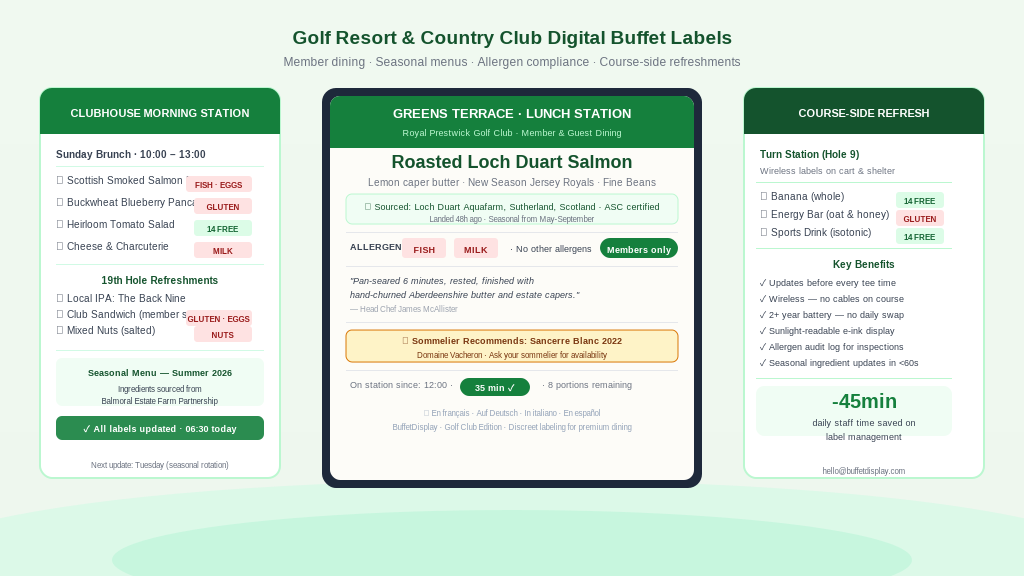
The Member Dining Standard
Digital e-ink labels in the clubhouse dining room, halfway house, and course-side refreshment points deliver the information quality members expect without disrupting the aesthetic of the environment. The displays are paper-thin with a matte finish that complements printed menus, and require no power cables — essential for outdoor shelter installations on the course. See how this approach compares to traditional options in our comparison of e-ink labels vs handwritten buffet cards.
Seasonal Menu Rotation and Provenance Display
Chef provenance notes (farm origin, breed, harvest date, fishing zone) display alongside allergen and dietary information on the same label. Wine pairing recommendations link to the club wine list. All of this is pre-loaded at the start of each service and updated instantly when ingredient availability changes — for example, when the local venison allocation is exhausted and the kitchen substitutes wild boar.
The system also displays certification badges: Organic, Biodynamic, Sustainable Seafood (MSC), or the club farm partnership logo. These credentials reinforce the narrative that distinguishes a club dining program from a hotel restaurant. For a detailed guide on displaying certifications and provenance on buffet labels, see our post on luxury hotel digital buffet labels and guest experience.
Allergen Compliance for Member Events and Visiting Societies
Digital labels ensure consistent allergen display at every station regardless of service volume. The system shows all 14 EU major allergens with visual icons that allow rapid identification without reading text — important when guests are moving quickly along a buffet line after a competitive round.
A full audit log records every allergen change with timestamp and user ID. If a guest reports an incident, the club can demonstrate exactly what was declared on each label at the time of service — an increasingly important protection as food safety regulations tighten across the UK, EU, and international markets. For the specifics of EU allergen labeling requirements, see our EU allergen labeling guide for hotels and venues.
Course-Side Refreshments: Wireless Labels Without Infrastructure
E-ink labels operate on battery power for 2+ years. Placed in an acrylic stand or magnetic clip mount on the shelter counter, they display current allergen information, ingredient lists, and pricing without any cabling. The wireless gateway in the nearby maintenance building or halfway house structure provides connectivity for updates.
Sunlight readability is a critical factor. E-ink displays maintain full contrast in direct sunlight — unlike backlit tablets that wash out or printed menus that fade. When the kitchen prepares a fresh batch of soup or adds a daily special, the label updates wirelessly from the clubhouse kitchen in under 10 seconds.
Quellen / Sources
- 1.EU-Verordnung Nr. 1169/2011 (LMIV)(EUR-Lex)
- 2.EFSA Lebensmittelallergene(EFSA)
See BuffetDisplay for Golf Clubs and Resorts
BuffetDisplay manages clubhouse dining room stations, halfway house refreshments, and course-side labels from a single browser dashboard. No cabling, no reprinting, full allergen compliance with audit log.
Frequently Asked Questions
What information can golf club buffet labels display beyond allergens?
Golf club and country club buffet labels can display the full complement of dining information: dish name, description, allergens (all 14 EU major allergens with visual icons), provenance and sourcing notes (farm name, breed, harvest date, fishing zone), dietary attributes (gluten-free, vegan, vegetarian), wine pairing recommendations linked to the club wine list, freshness timestamp, and member versus guest pricing. The label template is configured to match the visual standards of the club — the same font, color, and layout used on printed menus. All information is managed from a single dashboard and updates wirelessly in seconds when the kitchen makes a change.
How do course-side refreshment labels work without power at the halfway house?
E-ink labels at course-side refreshment points (halfway house, turn station, driving range cafe) operate entirely on battery power with no cabling required. A standard e-ink label has a 2+ year battery life at typical update frequencies (3-5 updates per day). The wireless gateway that provides connectivity is installed in the nearest fixed structure — the halfway house building, maintenance shed, or pro shop — and the labels communicate with it over a low-power wireless protocol. Updates from the clubhouse kitchen reach the course-side labels in under 15 seconds. The labels are fully readable in direct sunlight, unlike backlit tablets or printed cards that fade outdoors.
Can golf club labels handle visiting societies and guest days with unknown dietary requirements?
Yes. When visiting societies, corporate groups, or charity tournament guests arrive without pre-registered dietary information, the club relies on accurate allergen display at every buffet station. Digital e-ink labels show all 14 EU allergens as visual icons at each station, enabling guests to make self-service allergen decisions without asking staff. For events where pre-registration is used (larger corporate events or society days with advance catering arrangements), dietary requirements collected during booking can be imported into the label management system to calculate how many portions of each dietary variant are needed at each station.
How do digital labels handle the seasonal ingredient changes common in golf club menus?
Golf clubs often change menus weekly or even daily based on seasonal availability — estate game, local fish catches, seasonal produce from club farm partnerships. Digital label updates propagate to all labels on the property in under 60 seconds from the management dashboard. When a specific ingredient is exhausted or a new local supplier is added, the change is made once in the system and reflected immediately across every station. Chef provenance notes (farm origin, breed, harvest date) also update in the same operation, so guests always see current sourcing information rather than a generalized description.
Related Articles
Digital Food Labels for Spa Resorts and Wellness Retreats: Meeting Health-Conscious Guest Expectations
Wellness resort guests expect unprecedented transparency at the buffet: calories, macros, organic certifications, allergen details, chef sourcing stories, and special diet indicators — all accurate, updated daily, and available in multiple languages. Digital e-ink buffet labels deliver this without reprinting a single card.
Read article →Buffet Label POS Integration: Oracle MICROS Simphony, Agilysys & CalcMenu Guide
Integrating digital buffet labels with your hotel POS system — Oracle MICROS Simphony, Agilysys InfoGenesis, Shiji, or CalcMenu — eliminates the manual step of updating labels every time a menu changes. This guide covers the integration architectures available (REST API, webhooks, direct database sync), what data flows between POS and buffet labels, how allergen validation works in the integration layer, and how to implement for the most common hotel POS platforms.
Read article →School Cafeteria Digital Food Labels: USDA NSLP and Smart Snacks Compliance
US school cafeterias serving the USDA National School Lunch Program must display accurate allergen information, meet Smart Snacks nutritional standards for a la carte items, and maintain HACCP documentation for state SNO reviews. Digital e-ink labels update automatically when recipes change — eliminating reprinting costs and the allergen errors that occur when nutrition staff turnover runs at 40-60% per year.
Read article →