Digital Food Labels for Spa Resorts and Wellness Retreats
The Wellness Guest Expectation Gap
Standard hotel buffet labels — a laminated card with the dish name and one or two allergen icons — do not meet this expectation. Neither do handwritten chalkboards, which can display no more than a name and perhaps a note about dietary suitability. The gap between what wellness guests expect and what properties provide with traditional labeling is the primary driver of negative reviews in the wellness hospitality segment. For the luxury angle on this, see how luxury hotels use digital labels for chef storytelling and provenance.
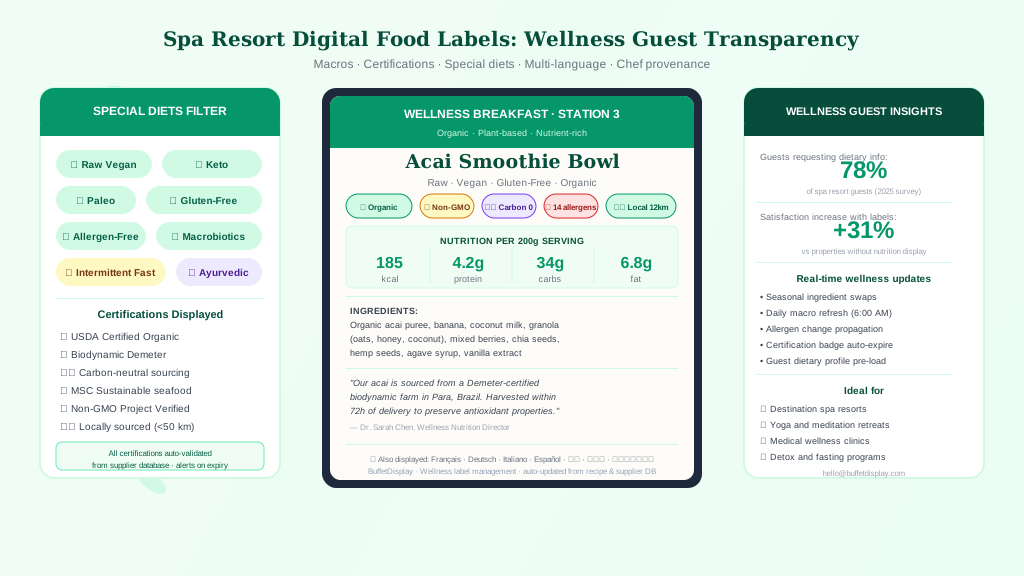
Digital e-ink buffet labels close this gap entirely. A 4.2-inch e-ink label has sufficient space for dish name, full ingredient list, macro breakdown (calories, protein, carbohydrates, fat), certification badges (Organic, Non-GMO, Biodynamic, Locally Sourced), allergen icons, and a chef provenance note — all updated from a single dashboard when any ingredient changes.
Special Diet Complexity at Wellness Properties
Digital label platforms designed for wellness operations allow custom dietary tags beyond the standard 14 allergens. A dish tagged as "Raw" appears with a raw-vegan indicator; a dish meeting ketogenic macro ratios displays a keto badge automatically when the recipe data confirms the fat/protein/carbohydrate split. These tags update automatically when recipes change — no manual re-carding required.
For retreats offering personalised nutrition programs (common in medical wellness properties), the platform can pre-load individual guest dietary profiles and highlight which buffet dishes are appropriate for each guest's program. Properties serving guests with specific religious or cultural dietary requirements should also see our post on displaying halal, kosher, and vegan certification on buffet labels. This requires room integration or a guest-facing app, but the label data foundation is already in place.
Certification Display and Supplier Validation
Digital label platforms integrated with supplier databases solve this by pulling certification status directly from verified supplier records. A label displays the USDA Organic or EU Organic badge only while the supplier certification is current; when a certification lapses or a supplier changes, the badge is removed automatically and a management alert is triggered.
This applies equally to seasonal sourcing claims. A label stating "locally sourced — Graubunden farm" is accurate in summer when the ingredient is available; in winter, when the property switches to a contracted supplier, the claim auto-updates. The result: a property can make specific, verifiable provenance claims on every label without any manual maintenance burden.
Macro Display and Nutrition Transparency
Digital labels connected to recipe management software display macros calculated directly from ingredient quantities and nutritional databases. When a recipe changes — even a small adjustment to portion size or an ingredient substitution — macros update automatically across all affected labels within seconds. This eliminates the risk of displaying outdated nutritional information, which is both a guest trust issue and, for medical wellness programs, a potential liability concern.
For spa resorts offering weight management or sports nutrition programs, the macro display is not optional — it is a core service element. Digital labels provide this at a level of accuracy and consistency that printed cards cannot match, because printed macros represent a point-in-time calculation that becomes outdated the moment a recipe or supplier changes.
Quellen / Sources
- 1.EU-Verordnung Nr. 1169/2011 (LMIV)(EUR-Lex)
- 2.EFSA Lebensmittelallergene(EFSA)
Elevate Your Wellness Guest Experience
BuffetDisplay delivers macro display, certification badges, special diet indicators, and chef provenance notes on every label — updated in real time from your recipe and supplier database.
Frequently Asked Questions
What nutritional information can spa resort buffet labels display?
Digital e-ink buffet labels for spa resorts can display a comprehensive nutritional profile per serving: calories, protein, carbohydrates (with sugar breakdown), fat (with saturated fat breakdown), fibre, and sodium. These values are calculated directly from recipe ingredient data using validated nutritional databases — not estimated from external sources. When a recipe changes (seasonal ingredient swap, portion adjustment, supplier change), the nutritional values update automatically across all affected labels within seconds. This is critical for medical wellness programs and weight management retreats where nutritional accuracy is a core service element, not a marketing addition.
How do digital labels display certification badges for organic, biodynamic, and sustainable ingredients?
Digital label platforms integrated with supplier databases pull certification status directly from verified supplier records. An organic certification badge appears on the label only while the supplier certification is current. When a certification lapses or a supplier change occurs, the badge is removed automatically and a management alert is triggered. This applies to all certification types: USDA Organic, EU Organic, Demeter Biodynamic, MSC Sustainable Seafood, Non-GMO Project, and custom local sourcing declarations. For spa resorts making specific provenance claims to health-conscious guests, automatic certification validation eliminates the risk of displaying outdated or inaccurate certification information.
How do wellness resorts handle special diet labeling (raw, keto, paleo, Ayurvedic) on buffet labels?
Digital label platforms for wellness operations support custom dietary tags beyond the standard 14 allergens. A dish is tagged in the recipe management system with all applicable dietary attributes — raw vegan, ketogenic, paleo, Ayurvedic, macrobiotic, low-FODMAP, etc. These tags are set by the nutrition team at the recipe level and propagate automatically to every label where that recipe is displayed. When a recipe changes in a way that affects a dietary attribute (an oil type change that moves a dish out of the paleo category, for example), the tag is updated across all labels at the next sync. This eliminates the risk of displaying incorrect dietary claims when ingredients change.
Can spa resort labels be updated in real time when seasonal ingredients change?
Yes. Digital e-ink labels update wirelessly from a management dashboard in under 60 seconds. For a wellness resort where seasonal ingredient changes happen weekly — and where the provenance story (this week's acai is from a new Demeter farm, the summer menu uses local Graubunden berries) is a differentiating service element — real-time updates mean every label is always current. The same update that changes the dish description on the label also triggers the macro recalculation, certification badge review, and allergen confirmation — all from a single change in the recipe database. Staff do not need to manually reprint or replace any labels.
Related Articles
Golf Resort and Country Club Buffet Labels: Premium Dining, Discreet Compliance
Golf resorts and country clubs serve members and guests who expect premium culinary presentation and complete dietary transparency. Digital e-ink buffet labels match the aesthetic of premium clubhouse dining while delivering allergen compliance, seasonal menu rotation, and course-side refreshment labeling — all managed from a single dashboard.
Read article →Buffet Label POS Integration: Oracle MICROS Simphony, Agilysys & CalcMenu Guide
Integrating digital buffet labels with your hotel POS system — Oracle MICROS Simphony, Agilysys InfoGenesis, Shiji, or CalcMenu — eliminates the manual step of updating labels every time a menu changes. This guide covers the integration architectures available (REST API, webhooks, direct database sync), what data flows between POS and buffet labels, how allergen validation works in the integration layer, and how to implement for the most common hotel POS platforms.
Read article →School Cafeteria Digital Food Labels: USDA NSLP and Smart Snacks Compliance
US school cafeterias serving the USDA National School Lunch Program must display accurate allergen information, meet Smart Snacks nutritional standards for a la carte items, and maintain HACCP documentation for state SNO reviews. Digital e-ink labels update automatically when recipes change — eliminating reprinting costs and the allergen errors that occur when nutrition staff turnover runs at 40-60% per year.
Read article →