Buffet Labeling in Hotels: A Comprehensive Guide
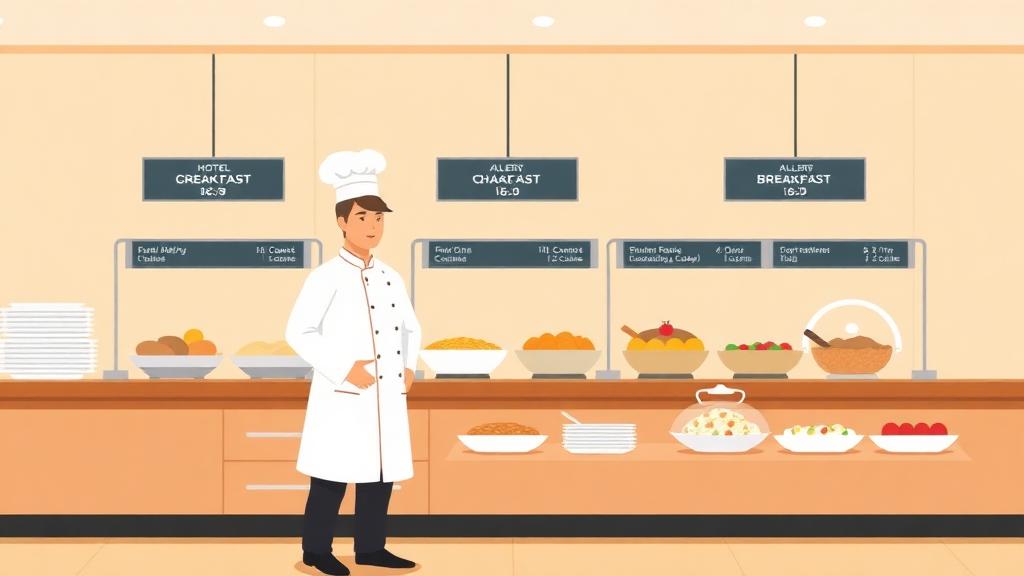
The Hotel Buffet Challenge
Allergen Compliance Made Simple
Real-World Hotel Success Stories
Cost Analysis and ROI
Seamless Integration with Hotel Systems
Advanced Technology Features
Operational Benefits for Hotel Staff
Ready to Transform Your Hotel Operations?
For more information, see our hotel breakfast buffet display solution.
The Total Cost of Hotel Buffet Labeling: Paper vs Digital
For a hotel buffet with 50 label positions running 3 service periods daily:
Paper system annual cost: consumables (paper, ink, laminating pouches, printer maintenance) = EUR 3,000-8,000 per year. Staff time (printing, placing, collecting, discarding) = 1.5-4.5 hours per day × 365 days × EUR 18/hr = EUR 10,000-30,000 per year. Total: EUR 13,000-38,000 per year.
Digital label system: Hardware (50 e-ink labels + gateway) = EUR 8,000-20,000 one-time. Software subscription = EUR 1,500-4,000 per year. Ongoing costs approach zero — no consumables, 10-20 minutes of staff time per day for menu management. Total over 5 years: EUR 15,500-40,000.
At equivalent 5-year cost, the digital system provides zero consumable cost, dramatic staff time reduction, an allergen audit trail, multilingual capability, and zero allergen transcription errors. The math favors digital for almost any hotel running a daily buffet.
Implementation Timeline: Going Digital in 3 Days
Day 1: Installation and configuration. The gateway device (similar in size and setup complexity to a WiFi router) is installed in the F&B office. The system is connected to the hotel network. Default display templates are configured for the property brand.
Day 2: Menu data migration. Existing menu items are imported from the POS system, recipe management software, or manually entered for properties without digital recipe records. Allergen data is verified against the recipe database. Labels are assigned to physical display positions on the buffet.
Day 3: Staff training and go-live. F&B managers receive 2-3 hours of system training covering menu management, allergen updates, scheduling, and the audit trail. The system goes live for the first service period. From this point, paper label printing stops immediately.
Choosing the Right System for Your Property Size
Boutique hotels (10-30 buffet positions): Entry-level e-ink label systems with a single gateway, browser-based management, and basic allergen tracking. Budget EUR 3,000-8,000 for hardware, EUR 800-1,500 annual subscription.
Mid-market hotels (30-80 positions): Full BuffetDisplay deployment with POS integration, multilingual support, and scheduling. Budget EUR 8,000-20,000 for hardware, EUR 1,500-3,000 annual subscription.
Large resorts and casino-hotels (80-300+ positions): Enterprise deployment with multiple gateways, API integration with property management systems, consumption analytics, and multi-outlet management from one dashboard. Budget EUR 20,000-60,000 for hardware, EUR 3,000-8,000 annual subscription.
In all tiers, the hardware investment is recovered within 12-24 months through consumable and staff time savings.
Frequently Asked Questions
What is a hotel buffet label system and how does it work?
A hotel buffet label system provides each dish on the buffet with a display showing dish name, allergen information, ingredients, and optionally price and nutritional data. Modern systems use wireless e-ink labels that update from a central dashboard when menus change. Staff enter dish information once; all labels update automatically without physical intervention at the buffet station.
What information should hotel buffet labels display by law?
Under EU Regulation 1169/2011, hotel buffets serving unpackaged food must provide the 14 major allergens for each dish. The information must be clearly accessible to guests either on physical labels or on request. Many hotels also display ingredients, dietary tags (vegan, halal, etc.), and freshness timestamps — going beyond the legal minimum to improve guest experience and reduce staff enquiries.
How long does it take to implement a digital buffet label system in a hotel?
Most hotels complete full implementation in 2 to 3 days. Day 1 covers gateway installation and system configuration. Day 2 covers menu data migration from the POS or recipe management system. Day 3 covers staff training (typically 2-3 hours for F&B staff) and go-live. From go-live, no paper buffet labels need to be printed.
What is the difference between e-ink buffet labels and LCD buffet displays?
E-ink labels are designed for per-dish labeling at each serving station — small, batteryless for 3-5 years, readable in bright light, and showing detailed allergen icons per dish. LCD menu boards are designed for room-level display showing the full menu from 5+ metres away. For allergen compliance, per-dish e-ink labels are the more effective format; LCD boards work as a supplement for overview menus.
Related Articles
Digital Food Labels for Corporate Cafeterias
Corporate staff cafeterias face employer duty-of-care for allergen compliance under EU Regulation 1169/2011. Digital food label systems deliver the audit trail, daily rotation management, and dietary transparency that hotel buffets rely on — adapted for corporate catering scale.
Read article →Digital Buffet Labels for All-Inclusive Resorts
All-inclusive resorts managing 6-12 dining venues need digital buffet labels that handle outdoor pool bar stations, automatic meal period transitions, and multilingual display for international guests — with one central management dashboard.
Read article →Digital Buffet Labels in Luxury Hotels: Elevating the Guest Experience
Luxury hotels use digital buffet labels to display chef storytelling, ingredient provenance, and wine pairings alongside allergen data. PMS integration enables dietary pre-registration for VIP guests — the white-glove personalisation that five-star guests expect.
Read article →