Caribbean and Mexico All-Inclusive Resort Digital Buffet Labels: IP65, FDA Big 9, and Chain-Wide Management
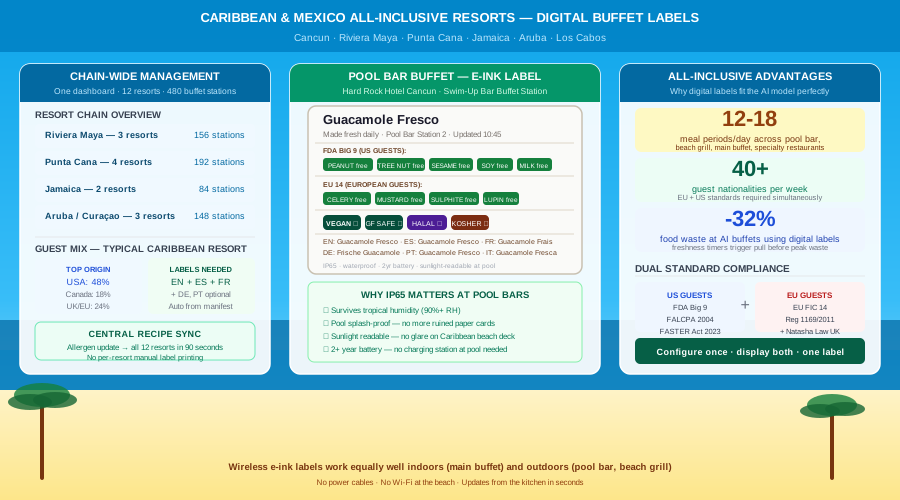
The All-Inclusive Labeling Problem: 40 Nationalities, 12 Venues, 2 Allergen Standards
US guests are protected under FALCPA and the FASTER Act (FDA Big 9 including sesame, effective January 1, 2023). European guests are protected under EU Regulation 1169/2011 (14 allergens, including celery, lupin, molluscs, mustard, and sulphites that are not in the US list). Canadian guests travel under CFIA priority allergen standards. A complete resort allergen label must address all three simultaneously — displaying the relevant information for each dish regardless of which guest is standing in front of it.
Simultaneously, the same resort operates 8-18 distinct food venues: the main buffet, pool bars, beach grills, specialty restaurants, room service, and late-night snack stations. Each venue needs labels appropriate for its physical environment. A pool bar label must be IP65-rated, waterproof, and sunlight-readable. A fine-dining specialty restaurant label needs a premium look. The main buffet label needs to handle the highest dish count — sometimes 120+ items at peak service.
Aus der Praxis / From the field
Alpine resort properties serving guests from 15+ countries during peak season find multilingual label support a genuine operational necessity, not a luxury. The ability to switch label language on-demand eliminates a category of guest-staff misunderstandings — typically around allergen queries where language uncertainty was previously escalated to a manager or resolved by removing the dish from the guest's plate.
IP65 Labels for Pool Bars and Beach Grills
IP65-rated e-ink labels are specifically designed for this environment. IP65 means the enclosure is fully dust-tight and protected against water jets from any direction — more than adequate for pool bar splash. The e-ink display technology shows the same image whether in direct Caribbean sunlight or under a palapa — unlike backlit LCD tablets, which are nearly invisible in bright outdoor light. Battery life of 2+ years means the pool bar labels require zero maintenance infrastructure; there are no charging cables to run to each display position.
For beach grill stations, where labels sit in salt air and direct UV exposure, the same IP65 rating applies. The wireless gateway inside the beach bar building covers a 30-metre radius, reaching all label positions at the outdoor stations without requiring cable runs through beach structures. See our all-inclusive resort digital label system overview for full venue coverage details.
Chain-Wide Management: One Dashboard for 12 Resorts
A centralized digital label platform allows a corporate F&B team to manage all properties from one dashboard. When a supplier changes a product formulation — introducing a sesame derivative into a sauce used across all 12 properties — the allergen update is applied at the recipe level and propagates to every label at every resort displaying that dish within 90 seconds. The alternative — calling 12 F&B directors and trusting each to update their paper labels before the next meal service — is not a process that US-owned chains can defend in a liability context.
Chain-wide management also enables brand consistency: the same label template, the same allergen icon style, the same guest-facing format across every Barcelo or Iberostar property in the region. Guests who stay at a brand across multiple visits see the same label format and learn to trust it as a consistent allergen reference.
US and EU Allergen Standards on the Same Label
A digital label system configured for all-inclusive resorts handles this by maintaining a single allergen database per recipe with both the Big 9 fields and the EU 14 fields populated. The label template displays the US Big 9 in one visual zone (clearly labeled for US/Canadian guests) and the EU 14 in a second zone (for European guests), both drawn from the same recipe record. This eliminates the need to maintain separate label sets for US and European guests — which would be impractical at a buffet where US and European guests are standing side by side at the same station. For the regulatory background on the US side of this requirement, see our FDA Big 9 allergen guide for US food service.
Quellen / Sources
- 1.EU-Verordnung Nr. 1169/2011 (LMIV)(EUR-Lex)
- 2.EFSA Lebensmittelallergene(EFSA)
Digital Labels for Caribbean and Mexico All-Inclusive Resorts
BuffetDisplay supports IP65 waterproof labels for pool bars, simultaneous FDA Big 9 and EU 14 allergen display, 12-language guest menus, and chain-wide management for multi-property resort groups.
Frequently Asked Questions
How do Caribbean and Mexico all-inclusive resorts handle different allergen standards for US and European guests?
Caribbean and Mexico all-inclusive resorts routinely host guests from both the US (protected under FDA Big 9 / FALCPA, including sesame since the FASTER Act effective January 1, 2023) and Europe (protected under EU Regulation 1169/2011, which covers 14 allergens including celery, lupin, molluscs, mustard, and sulphites not in the US list). The standards overlap significantly but differ in the additional EU-specific allergens. A digital label system configured for all-inclusive resorts maintains both Big 9 and EU 14 allergen fields per recipe and displays both on the same label — typically in two clearly labeled zones. This allows American, Canadian, British, German, and French guests standing at the same buffet station to all find the relevant allergen information for their market on the same label without maintaining separate label sets.
Do digital buffet labels work at outdoor pool bars in tropical climates?
Yes, specifically because e-ink label hardware can be specified at IP65 rating, which means the enclosure is fully dust-tight and protected against water jets from any direction. Pool bar labels in the Caribbean experience pool spray, tropical humidity regularly exceeding 85%, and direct Caribbean sunlight. IP65-rated e-ink labels handle all three — unlike paper labels (destroyed within hours in high humidity), LCD tablets (nearly invisible in direct sunlight and damaged by moisture), or standard ESL labels (rated for indoor retail environments only). The e-ink technology displays the same high-contrast image in direct sunlight as it does indoors, making the allergen information fully readable at the swim-up bar. A wireless gateway inside the pool bar building covers outdoor label positions within a 30-metre radius without requiring cable runs through beach structures.
Can a resort chain manage digital buffet labels across multiple properties from one dashboard?
Yes, chain-wide management is one of the primary advantages of digital label systems for Caribbean and Mexico resort groups. A corporate F&B director managing multiple Barcelo, Iberostar, RIU, or AMResorts properties can apply a recipe allergen update from the central dashboard and have it propagate to every label at every property displaying that dish within 90 seconds — without calling each property or trusting each F&B manager to update their paper labels. This is particularly important when a supplier changes a product formulation and the allergen declaration for a recipe used across all properties needs to be updated immediately before the next meal service. Chain-wide management also ensures brand consistency in label format, allergen icon style, and language configuration across every property in the group.
How many meal venues does a typical Caribbean all-inclusive resort run, and how do digital labels handle all of them?
A 600-room Caribbean all-inclusive resort typically operates 8-18 distinct food venues: a main buffet restaurant (100+ dishes at peak service), one or more specialty restaurants, a pool bar, a swim-up bar, a beach grill, a snack bar or late-night food station, and sometimes an adults-only venue. Digital label systems manage all venues from a single dashboard, with each venue configured independently: its own label template, its own menu schedule, and its own language configuration. A pool bar in the adult section might display labels in English and Spanish only; the main buffet might display six languages for the full nationality mix. Scheduled publishing handles automatic transitions between breakfast, lunch, dinner, and late-night service at each venue independently, so no staff need to manually switch labels during the day.
Related Articles
Cruise Ship Digital Food Labels: USPH VSP Compliance, FDA Big 9, and Multilingual Display for 6,500 Passengers
A cruise ship buffet is unlike any other food service environment. Royal Caribbean Allure of the Seas serves 6,500 passengers representing 42 nationalities, 280 buffet dishes across four daily meal periods, with no reliable internet connection while at sea — and unannounced CDC inspectors who can board at any US port. Paper labels last about two hours in the humidity of a lido deck. Digital e-ink labels with offline-first architecture are the only workable solution.
Read article →Codex Alimentarius and International Allergen Standards: The Global Buffet Label Guide
Codex Alimentarius is the UN FAO/WHO food standards body that published the original 8-allergen framework now underlying every national allergen law. Understanding how FDA Big 9, EU 14, Canada CFIA, Mexico NOM-051, and GCC standards relate to each other helps international hotels and resorts choose the right allergen display strategy for their guest mix.
Read article →School Cafeteria Digital Food Labels: USDA NSLP and Smart Snacks Compliance
US school cafeterias serving the USDA National School Lunch Program must display accurate allergen information, meet Smart Snacks nutritional standards for a la carte items, and maintain HACCP documentation for state SNO reviews. Digital e-ink labels update automatically when recipes change — eliminating reprinting costs and the allergen errors that occur when nutrition staff turnover runs at 40-60% per year.
Read article →