Conference Hotel and MICE Venue Buffet Labels: Allergen Compliance Across Multiple Sessions
Key Takeaways
- MICE catering requires allergen accuracy across multiple simultaneous room setups — a capability that paper labelling cannot reliably provide at scale.
- Event organisers increasingly specify digital allergen display as a contract requirement, not a preference — particularly for corporate clients with duty-of-care policies.
- Last-minute menu changes (the norm in event catering) must reach all labels within minutes — digital systems handle this; paper systems require reprinting and redistribution.
- Multi-room digital label management from a single dashboard is operationally equivalent to managing one outlet — the complexity does not scale linearly.
The Multi-Session Labeling Problem
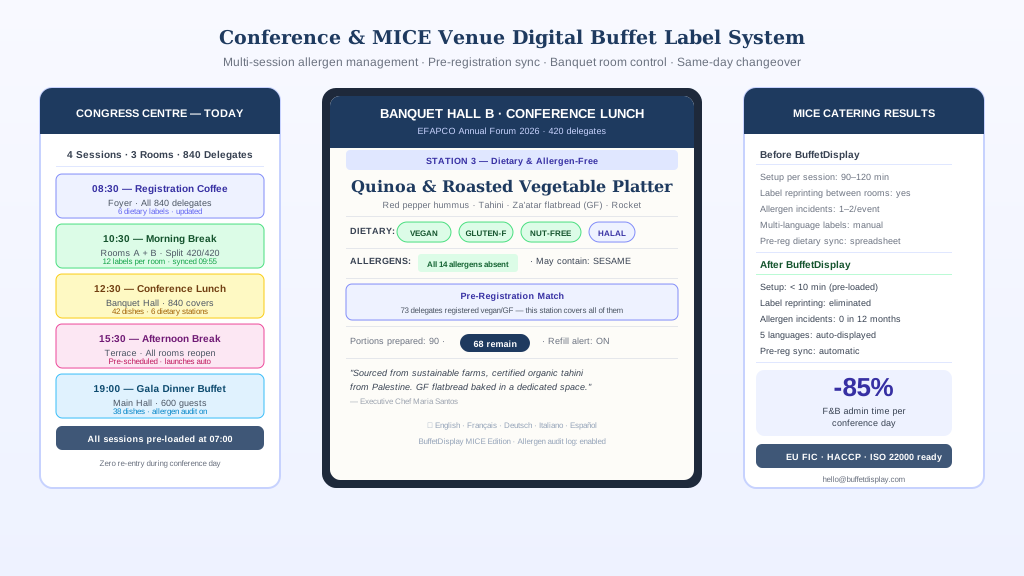
The traditional approach — printed labels reprinted between sessions and manually verified against pre-registration dietary data — requires 60–90 minutes of F&B staff time per session. On a 12-session conference, that is up to 18 hours of label management labor over three days. Any deviation between the printed label and the actual dish content creates an allergen incident, and any mismatch with pre-registered dietary requirements creates a delegate experience failure.
Digital buffet labels pre-loaded for all sessions from a single dashboard eliminate this labor entirely. The session transition happens automatically at the configured time — the breakfast label becomes the morning break label becomes the lunch label — without staff intervention. For a benchmark comparison, see our e-ink labels vs paper comparison.
Aus der Praxis / From the field
Allergen documentation has become a standard line item in MICE event RFP responses in DACH markets. Corporate clients — particularly those in food, pharma, and financial services — increasingly specify allergen management systems as a contract requirement, not a preference. 'Digital allergen display' is appearing in procurement checklists at major European conference hotel operators.
Pre-Registration Dietary Sync
The system generates a station setup checklist for the F&B team: Station 3 (vegan/GF) covers 73 registered delegates, Station 4 (halal) covers 41. When a delegate reports a new requirement at check-in — not uncommon at large corporate events — the kitchen updates the station count in seconds, and the label updates instantly.
The result: no manual cross-referencing between dietary registration spreadsheets and label content. The system does the matching automatically. For an operational guide to setting up this kind of allergen compliance system, see our 7-step hotel allergen compliance setup guide.
Get the complete ROI calculator for your property
Enter your email and hotel name — we'll send the full cost-vs-paper breakdown with real numbers from comparable properties, plus a demo invite with no obligation.
No spam. Unsubscribe anytime. Your info is never shared.
Managing Multiple Rooms and Rapid Session Changeovers
BuffetDisplay manages multiple event rooms independently from a single dashboard. Each room shows its own label set, session schedule, and dietary configuration. Session changeover — switching from a morning break menu to a lunch menu — happens at the scheduled transition time without staff action. For back-to-back conference days, the next day menu is pre-loaded the previous evening, and the full schedule runs without kitchen staff needing to touch the label system during service.
Label content can be pre-approved by the event planner or catering manager before the event begins, creating a documented sign-off trail for large corporate contracts. This is increasingly a contractual requirement from corporate event organizers.
Allergen Audit Trail for Corporate Liability
A digital label system maintains a complete immutable audit log: which dishes were on which station, which allergens were declared, and who approved each label update — all with timestamps. This documentation standard is what increasingly large corporate event contracts require the venue to provide.
The audit log also protects the venue when claims are inaccurate. If a delegate reports that a nut allergen was not displayed but the log shows it was declared on the label at the correct station 30 minutes before the delegate visited the buffet, the documentation is available immediately.
For a full overview of allergen audit requirements in hotel and catering operations, see our allergen compliance in the digital age guide and our post on EU allergen labeling requirements for hotels in 2026.
Frequently Asked Questions
Quellen / Sources
See BuffetDisplay for Conference and MICE Venues
BuffetDisplay pre-loads your full conference F&B schedule from registration export to final gala dinner — multi-room, multi-session, with complete allergen audit documentation and delegate dietary sync.
Frequently Asked Questions
How do digital buffet labels sync with conference delegate pre-registration dietary data?
Conference registration platforms (Cvent, Eventbrite, and venue-specific event management systems) export dietary requirement data as part of the delegate list. BuffetDisplay imports this export to calculate how many portions of each dietary variant (vegan, gluten-free, halal, kosher, etc.) are needed at each station for each session. The system generates a per-station setup checklist for the F&B team: this station covers the registered vegan and GF delegates, that station covers the halal registrations. If a delegate reports a new requirement at check-in, the kitchen updates the station count in seconds and the relevant label updates immediately.
How many rooms and sessions can a single BuffetDisplay installation manage?
BuffetDisplay manages multiple rooms and sessions from a single dashboard without theoretical limits. A MICE venue running concurrent events in four ballrooms simultaneously — each with its own menu, dietary profile, and language requirements — manages all four from one browser interface. Each room is configured independently with its own label set, session schedule, and dietary configuration. Label content pre-loaded for the full conference schedule (all sessions across all days) activates automatically at the scheduled transition time, requiring no staff intervention during service. Pre-loading the next day schedule happens in the evening, so the conference day runs unattended.
What allergen documentation can a conference hotel produce from a digital label system?
A digital label system with a full audit log produces: a timestamped record of every label update (what changed, when, who approved it), a point-in-time snapshot of every station label at any moment during the event, an export of allergen declarations for any station at any session, and a user activity log showing which team member made each change. For a corporate event investigating an allergen incident, this documentation can be produced within minutes. The audit log is immutable — it cannot be edited after the fact — providing credible evidence of what was displayed at the time of service.
Can MICE venue labels display in multiple languages for international delegate groups?
Yes. BuffetDisplay supports up to 12 languages simultaneously on each label, with the display layout configured for the specific label template size. For an international pharmaceutical congress with delegates from 30 countries, the most practical approach is typically English plus the primary conference language plus the host country language — three languages displayed side-by-side or in a rotating format on a 4.2-inch label. Language configuration is set per event and can differ between rooms at the same venue. Event-specific translation packages can be imported directly from the registration platform language data.
Related Articles
Buffet Label POS Integration: Oracle MICROS Simphony, Agilysys & CalcMenu Guide
Integrating digital buffet labels with your hotel POS system — Oracle MICROS Simphony, Agilysys InfoGenesis, Shiji, or CalcMenu — eliminates the manual step of updating labels every time a menu changes. This guide covers the integration architectures available (REST API, webhooks, direct database sync), what data flows between POS and buffet labels, how allergen validation works in the integration layer, and how to implement for the most common hotel POS platforms.
Read article →School Cafeteria Digital Food Labels: USDA NSLP and Smart Snacks Compliance
US school cafeterias serving the USDA National School Lunch Program must display accurate allergen information, meet Smart Snacks nutritional standards for a la carte items, and maintain HACCP documentation for state SNO reviews. Digital e-ink labels update automatically when recipes change — eliminating reprinting costs and the allergen errors that occur when nutrition staff turnover runs at 40-60% per year.
Read article →Military Dining Facility (DFAC) Digital Food Labels: DoD Allergen Compliance
US military dining facilities (DFACs) serve 12,000+ covers per day at major installations under 5 meal periods, managed by contractors including Sodexo Government Services, Aramark Federal, and KBR. Digital e-ink labels eliminate paper reprinting between meal periods, display FDA Big 9 allergens per the FASTER Act, and support multilingual labeling for OCONUS bases serving allied and host nation forces.
Read article →